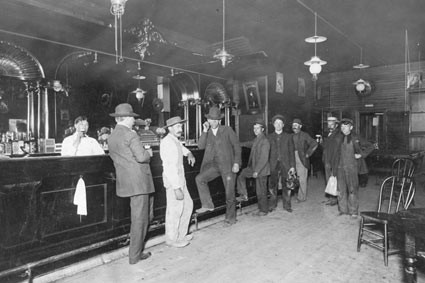
At McMenamins' White Eagle Saloon in Portland, the staff have one answer for whatever shoves and pinches people in the cellar: blame Sam, a bartender from the saloon's early days whose photograph still hangs above the bar.
One night at McMenamins' White Eagle Saloon in Portland, Oregon, a server was half-shoved, half-carried down the basement stairs by something nobody could see. The bartenders working the floor above didn't panic or call anyone. They blamed Sam, the way they always do. It's the house rule.
Sam was a real man, or at least one of the names for him is. He tended bar and boarded upstairs in the saloon's early-1900s years, and his photograph still hangs above the bar today. The ghost stories can't quite agree on his last name, but they agree on the shape of him: a man who lived his whole life inside the building and, by the lore, never once left it. The cellar is his. Patrons and staff who go down alone come back saying they were pinched, shoved, or touched by no one, while footsteps cross the floor of empty rooms overhead. He gets blamed for smaller indignities too, like the downstairs toilets that back up after close with no one left in the building to clog them.
The saloon opened in 1905, billed today as Portland's oldest bar, down in the rough waterfront neighborhood of Albina, serving dock workers and sailors off the Willamette. The trolley line up Mississippi Avenue dropped its passengers right at the front door, and the brawling got bad enough that conductors called out the next stop as the "Bucket of Blood." One manager, describing the basement, told a reporter, "I started feeling this masculine energy, but it was more of a womanizer kind of energy, a little bit misogynistic." McMenamins' own history says psychics who examined the place "report a sensation of violence and death in the basement and a deep well of sadness dwelling on the second floor."
The trouble upstairs is quieter than the cellar, and stranger. Guests in the hotel rooms report a lamp clicking on by itself, a face in a mirror, the feeling of being watched in an empty room. The ghost tours give that sadness a story: a young woman murdered in the rooms, who haunts Room 2 with the scent of perfume and the sound of weeping. But her story needs a brothel to have existed up there, and McMenamins' own historian went looking and couldn't find one. The 1920 census counted nine Polish men in those rooms, not women. The "vault" everyone points to in the basement was added in the 1970s. The famous tunnel is a coal chute.
So the woman upstairs rests on a past the building's own records can't locate. The cellar needs no such story. It just keeps pinching the people who go down there alone.