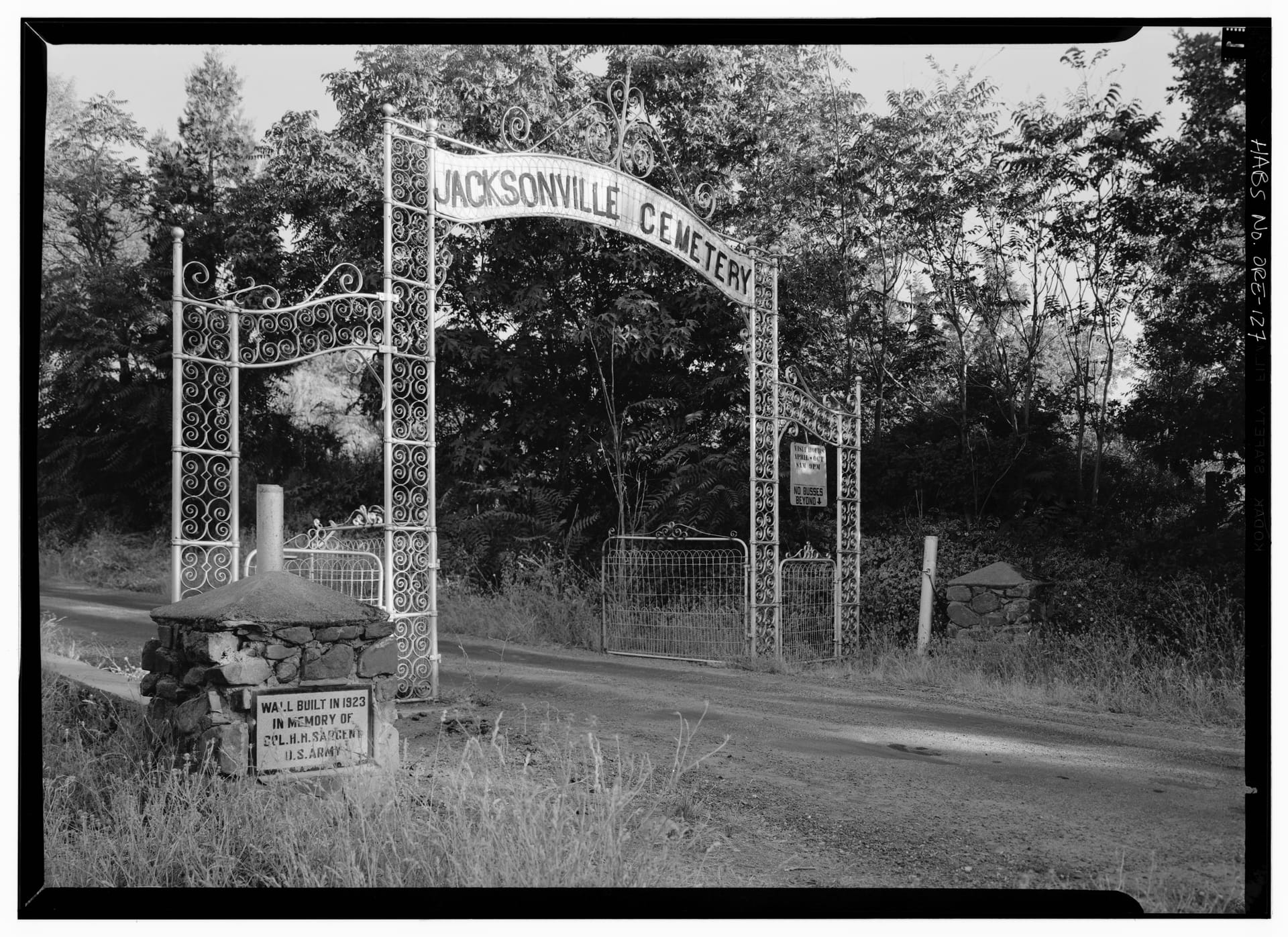
The Jacksonville Cemetery in Oregon has no famous ghost and no lady in white. What it has is a hilltop of gold-rush dead, a potter's field of 133 unmarked graves, and a town that every other October dresses in period clothes to stand graveside and speak for them.
Every other October, the Jacksonville Cemetery in Jacksonville, Oregon puts its dead back on their feet. Costumed players in period dress take up positions graveside in the dark, one at each of roughly eight stops along the hill, and tell the personal stories of the people buried beneath them — names, families, the small and ordinary facts of lives lived in the late 1800s and early 1900s. The cemetery's caretakers call the night "Meet the Pioneers."
The town has its reasons to keep its dead close. Jacksonville exists because someone struck gold at Rich Gulch in 1851, and the boomtown that grew up around the strike filled this hilltop in something close to real time. The stones read like a casualty list. The causes of death are etched right onto the markers — measles, diphtheria, smallpox, lead poisoning, "Indian War" — a frontier ledger carved in granite. Children got a carved lamb. Lives cut short got a half-opened rose.
The very first grave went in before the cemetery officially opened. In October 1859, a businessman named John Love got special permission from the city to bury his mother, Margaret, ahead of the dedication, so her body would never have to be moved later. The ground was consecrated the next year. More than 5,600 graves have followed it up the slope since.
On the north edge sits a potter's field, 133 unmarked graves holding, in the cemetery's own words, "blacks, whites, Native American Indians, Hawaiians and possibly Chinese, and others." A single monument stands in for all of them. The rest of the hill sorts the dead by the lives they led: Jewish, Catholic, Odd Fellows, Masons, Red Men, and the city's own ground.
There's no lady in white here, no named figure anyone claims to have seen between the headstones. What there is instead is a town that won't let its pioneers go quiet. Historic Jacksonville runs sold-out summer walking tours whose costumed guides trade in "tales of pioneers whose spirits still dwell," routes that thread past old saloons, brothels, hangings, and Oregon's first Chinatown. In the Odd Fellows section, one stone names a man directly: Silas J. Day, a Rogue River War veteran who became county clerk and then county judge. It calls him a "Pioneer of 1852. Indian War Veteran."
The cemetery has no famous ghost, no figure who refuses to leave. What it has is the opposite arrangement. The dead here don't wander the rows on their own. Every other autumn, the living climb the hill, take their places among the stones, and stand in for them.