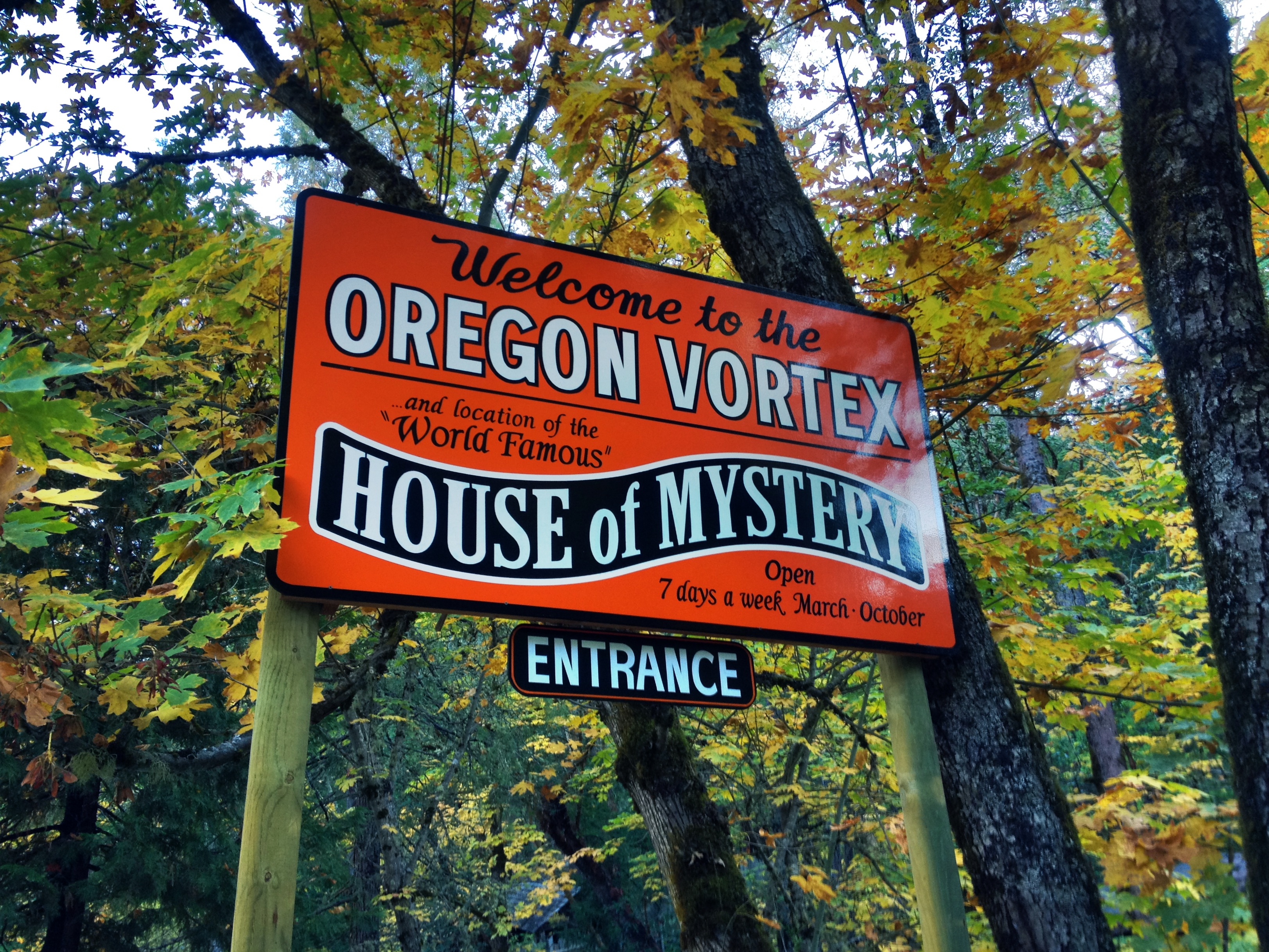
The Oregon Vortex outside Gold Hill has drawn tourists since 1930, built around a crooked 1904 shack that slid off its foundation on its own. A Scottish geologist spent decades insisting the place warps gravity. James Randi needed one afternoon to disagree.
At the Oregon Vortex, a patch of hillside outside Gold Hill, Oregon, a person walking from one end of a level plank to the other appears to grow or shrink by several inches. Brooms stand balanced on their handles, bottles set down on the slope roll uphill, and visitors report stranger effects than the eye can explain: back pain that vanishes inside the circle, seasickness in a town nowhere near the sea.
The centerpiece is a real building. In 1904 the Old Grey Eagle Mining Company put up a gold-assay office on the slope above Sardine Creek. Sometime in the early 1910s it slid off its foundation and stopped at a crooked angle, and it has sat there ever since — the House of Mystery, a half-collapsed shack that predates the attraction built around it.
A prospector rediscovered the place in 1914 and brought in a friend: John Litster, a geologist and engineer who came over from Alva, Scotland. Litster spent decades on the site, running thousands of experiments inside what he called the "165-foot magnet radius," a circle marked on the ground by a painted line of demarcation. The explanations he floated in his self-published notes — warped atoms, buried electromagnets, an underground super-machine left behind by prehistoric aliens — never made it past the page.
When a near-identical Mystery Spot opened in Santa Cruz in 1939, Litster sued for copyright. He dropped the suit when someone pointed out he had always called the Vortex a natural phenomenon, and you cannot copyright nature.
The lore runs back further than the shack, in the telling. Local legend holds that the Rogue Valley's Native peoples called this ground forbidden, and that travelers found their horses refusing to step into it. The family that owns the place says they tested the horse story on their own animals, and the animals balked.
James Randi came in 1998 with a camera and some trigonometry and called the whole thing an optical illusion: distorted backgrounds that trick the eye into a forced perspective, the same way an Ames room does. A physics professor reached the same verdict, and so did a television crew sent to test it. The effect everyone photographs — you shrink walking toward magnetic north, grow walking toward magnetic south — is the eye being fooled by a building that is not square to anything around it.
The Coopers have run the Vortex since 1960, and they sell Sasquatch merchandise to the visitors who turn up sure the place is a portal. In March 2025, Sardine Creek jumped its banks and pushed mud and debris through the property. The Vortex has been closed ever since, repairs running well past $150,000, the creek's protected salmon habitat allowing work only in a short window each year. After 95 years, the family is hoping to reopen the crooked little shack in 2027.