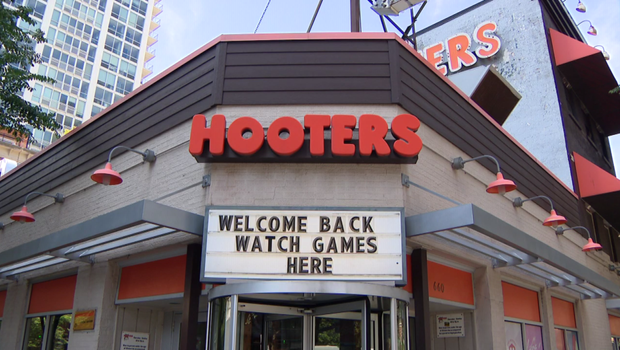
The Hooters at 660 N. Wells in River North, Chicago looks like any wing joint upstairs. The basement is where the staff stop joking — voices on the stairs that go quiet at the bottom, hands they can't see, and a block that once moved corpses in barrels labeled as poultry.
There's a Hooters in River North, Chicago — the only one downtown, open since 1993 — and the people who work there will tell you the basement is the part to be afraid of. They describe voices coming down the basement stairs that fall silent at the bottom. Rough hands that grab a waitress when no one's behind her. Footsteps with no source, things sliding off shelves untouched, a jukebox that switches itself on. Guides who run ghost tours past 660 N. Wells St. say the building's had reports like these for about two decades.
The dining room has its own. Patrons and staff describe figures in drab 19th-century clothes, sitting among the tables with vacant faces, who vanish the moment you look straight at them. Most tellings put it at two men and a woman; the count shifts depending on who you ask.
The block has older trouble. In February 1875, the Chicago Tribune reported that body snatchers were routing fresh corpses through an alley behind a charnel house at what was then 167 N. Wells, a few doors from where Hooters now stands. They dragged the dead out of their coffins with hooks, packed them into pickle barrels labeled "poultry," and shipped them off to medical colleges in Ann Arbor and Iowa City. At least five barrels of bodies turned up around the area. The man of record jumped bail and was never found.
Whether the corpses ever sat in this exact basement, the historian who surfaced the record won't say — only that the trade ran through this block. But the figures people describe in the dining room fit the era they came from, drab coats and slack faces among the lunch crowd.
In March 2006, a seven-person team from the Ghost Research Society spent the small hours down there. They clocked the closet dropping from 65°F to 55°F in about a minute, a camera battery dead in half the time it should have lasted, and two recordings they couldn't explain. One of them, played back, was a voice.
It said, "Shut it off."