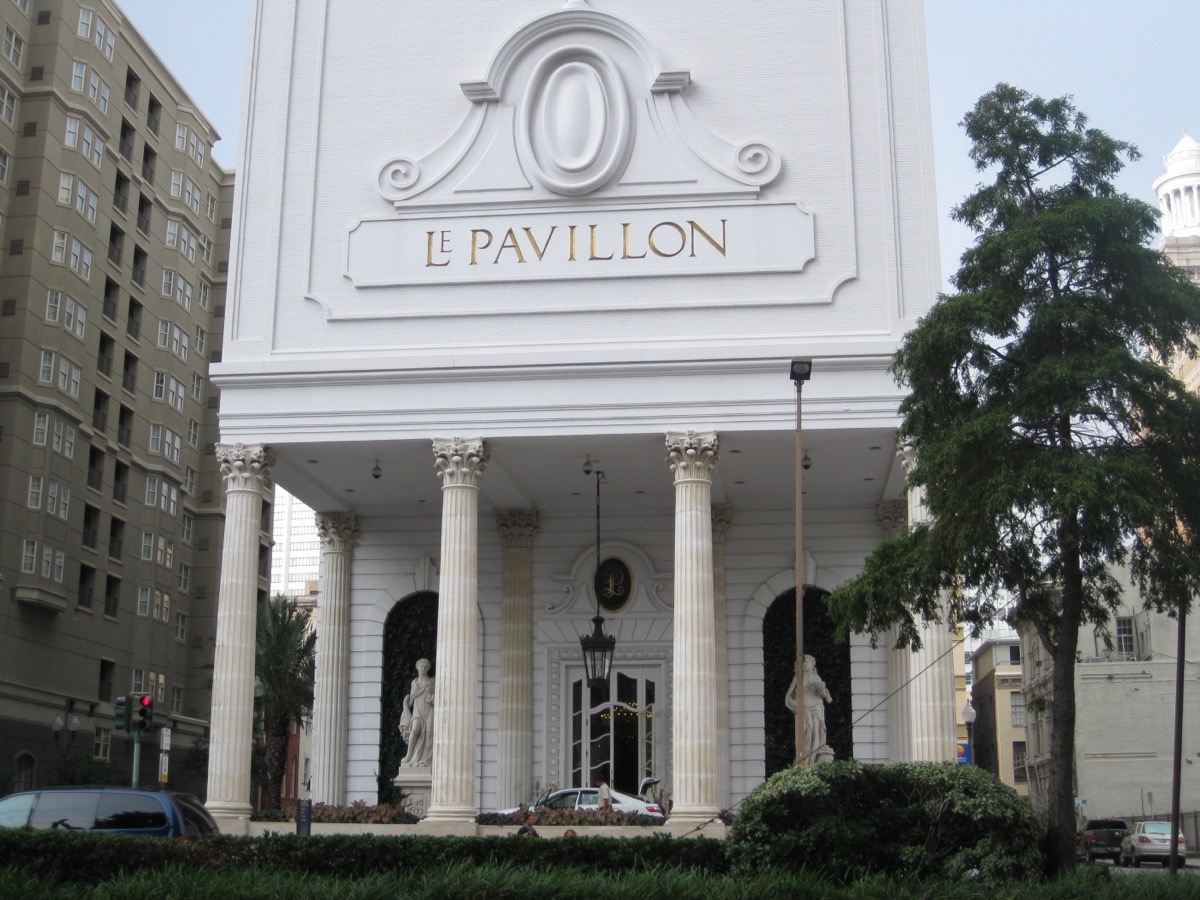
At Le Pavillon Hotel in New Orleans, a young woman in black approaches guests in the lobby, says some version of "I am... very lost," and disappears. They mistake her for a costumed reveler until she's gone. She smells of lilacs.
At Le Pavillon Hotel in New Orleans, a young woman in black keeps walking up to guests in the lobby. She is fair-skinned, brown-eyed, her hair pulled back, and she carries a small clutch she sometimes drops at your feet. She says some version of "Pardon me, I am... very lost." Then she isn't there.
What unsettles the people who meet her isn't that she's translucent. It's the opposite. She feels solid. They take her for a Mardi Gras reveler, someone in costume, and only realize otherwise when she's already gone and the smell of lilacs, or roses, is the only thing left of her. Staff aren't even sure of her name. Depending who you ask, it's Ada, Adda, Ava, or Eva. The name came to a psychic investigator as an impression, not from any record.
The hotel's story has her killed by a runaway carriage on Poydras Street, steps from the front entrance, and carried up to Room 930, where she died. By most accounts the era was the mid-1800s, the 1840s, though one telling moves it to the early 1900s. No newspaper or death record confirms any of it happened.
She isn't the only one people report. A well-dressed couple in 1920s evening clothes turns up walking hand in hand through the lobby, and the way it's told, they step into an elevator, the doors close, and a moment later the car returns empty. Some accounts give them a backstory, the husband dropping dead of a heart attack and the wife following weeks later, but the more careful tellings admit there's no record the couple ever lived or died here at all. Then there's the prankster on an upper floor, barefoot and long-haired in a bright shirt, who pulls the sheets off sleeping guests and hides their shoes and keys. Housekeeping treats him as a running joke.
The building itself opened in 1907 and has run as a hotel ever since, under three names. But the ground underneath is older and rougher. Before the hotel there was a theater on the lot, fined by the city for lewd shows, that burned. Before that, a drainage canal and a horse-railcar depot on swampy land an unnamed writer is said to have called a place of "foul deeds and midnight murders."
In 1996 a parapsychologist, Dr. Larry Montz, brought his research team through. That investigation is why the front desk can hand you a ghost-history pamphlet at check-in. Of everyone the building is said to hold, the girl is the one they keep coming back for. She doesn't haunt you. She asks for help, and then she's gone before anyone can give it.