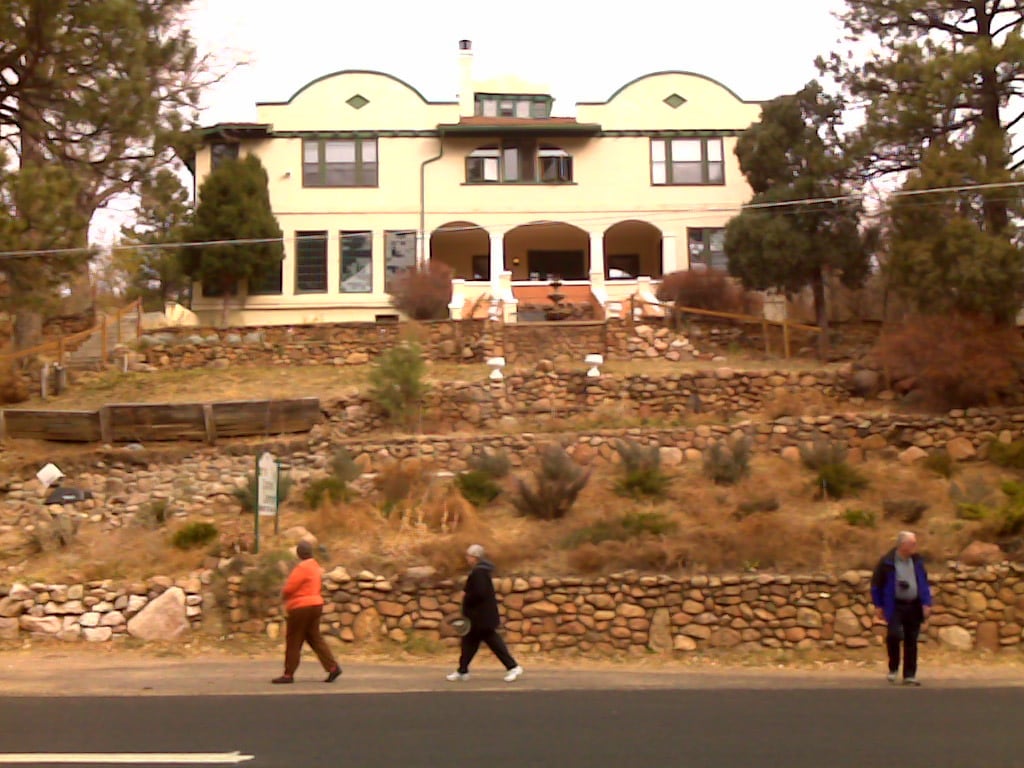
The Cheyenne Cañon Inn in Colorado Springs has interior doors that open onto solid wall and trapdoors set into the floor. The building has lived five separate lives, and the people who stay there report the dead from all of them drifting the halls at once.
The Cheyenne Cañon Inn in Colorado Springs has doors that open onto nothing. Interior doors, set into walls, swinging open against flat plaster. There are trapdoors in the floor, too. The floor plan doesn't add up, and the people who stay there keep seeing strangers in old clothes pass through it.
The reason the rooms don't connect is that the building has been five different things. Lillian Casey, the eldest of nine children, started it in 1918, and the Mission-style mansion she finished in 1921 was a resort home called Sunnycrest. After her, the place stopped being respectable. It ran as an upscale bordello, the story goes, serving wealthy men staying at the nearby Broadmoor. Then it became a Prohibition gambling den called the Dixieland Casino. During the Second World War it turned into a sanctuary for army nurses. In 1993 the Starrs bought it and made it a four-star bed and breakfast.
Each life remodeled over the last one, and the doors to nowhere are what got left behind. The trapdoors are almost certainly where the casino moved its liquor when liquor was illegal.
The hauntings come from all five lives at once. There's no single ghost here, no name anyone agrees on. Guests coming back to their rooms late report lights on the stairs and in the hallways. They report apparitions in period dress, objects that move on their own, doors opening and closing with no one near them. The dead don't seem to belong to one era. They belong to whichever one the corridor used to be.
One account got written down. In 1995, a guest and her boyfriend felt watched in their room for about an hour. It ended when the bathroom faucet turned itself on, ran, and shut off. The owner told her the room next door had the same problem.
So the floor plan stopped making sense a long time ago, and so did who, exactly, is still walking it.