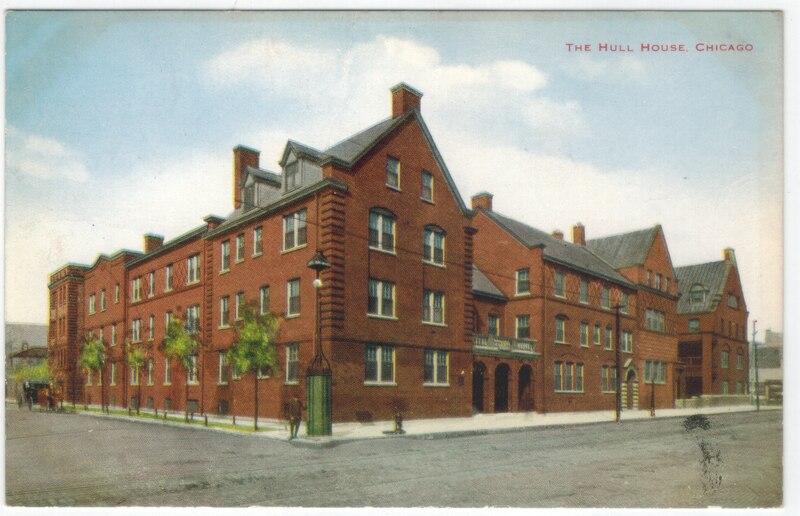
In the spring of 1913, crowds of Chicagoans pressed against the door of Hull-House on South Halsted Street, sure a Devil Baby with horns and cloven hooves was hidden in the attic. Jane Addams spent six weeks turning them away. It wasn't even the house's first ghost.
In the spring of 1913, crowds of Chicagoans came to the door of Hull-House on South Halsted Street, the famous settlement house Jane Addams ran, and demanded to be shown the Devil Baby in the attic. The story was specific. It had horns, cloven hooves, a pointed tail, and it could speak — usually to curse — from the moment it was born.
The hysteria held for about six weeks. Addams, who had founded the settlement in 1889 to serve the immigrant neighborhood around it, spent that time personally turning people away from the door and saying, over and over, that no such baby existed. The more she denied it, the more certain the crowds grew that she was hiding it upstairs.
The legend traveled in versions. In one, an Italian wife married an atheist who scorned a holy picture, and the baby came as punishment. In another, a Jewish father wished aloud for a devil rather than another daughter before his seventh child arrived. Addams was so struck by how the tale gripped the neighborhood's women that she wrote it up for The Atlantic in 1916, reading it as a way the humiliated could claim a kind of cosmic justice.
There was never a baby. The historian Adam Selzer puts it flatly: no evidence at all. Visitors today still say they hear it scurrying in the attic anyway.
But the attic was already spoken for. In her 1910 memoir, Addams recorded that the house had "a half-skeptical reputation for a haunted attic," and that the second-floor tenants kept a pitcher of water on the attic stairs at all times. Their reason was muddled, but she had a guess: it was the old belief that a ghost cannot cross running water.
Addams herself slept in the second-floor bedroom where Charles Hull's wife had died around 1860 — the room the tenants called haunted. She moved out.