The H.H. Holmes Murder Castle in Englewood, Chicago is long demolished. A New Deal post office stands on the lot now, and one section of its basement looks far older than the rest. Workers there will tell you not to go down — and Holmes's own descendant came up a believer.
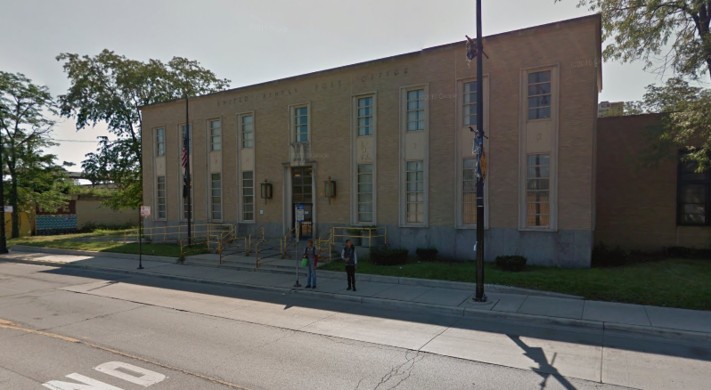
The Englewood post office at 611 W 63rd Street in Chicago is a plain New Deal brick building where people buy stamps. Part of the basement, the section that runs under the grassy lot next door, looks older than the rest of it. Workers there will tell you not to go down.
This is the corner where H.H. Holmes built his castle. His real name was Herman Webster Mudgett. In 1886 he took over a drugstore here, and a few years later he put up a mixed-use building across the street, then added a third floor in 1892 and called it the World's Fair Hotel, timed to the exposition coming to the city the next year. It never opened. The hotel was a story he told investors.
The story everyone else got later was worse and made up: gas chambers, soundproofed rooms, a basement crematorium, body chutes. Most of that was 1890s newspaper invention. The building did have hidden rooms, but historians think Holmes used them to hide furniture from the people he owed money to. What's real is the count. Historian Adam Selzer puts it plainly: "There's a total of about nine that we can say with some confidence he probably killed." They were people Holmes knew — a woman named Julia and her daughter Pearl, who disappeared around Christmas 1891. The confessed number was 27. The legend grew to 200.
An unknown arsonist set fire to the building right after his 1895 arrest. It only half burned, stayed in use for decades, and finally came down in 1938. The post office went up where it stood. A tree grows over the spot people point to as the surviving foundation.
Holmes's great-great-grandson, Jeff Mudgett, came to see it. He went down into that basement a skeptic. As he tells it: "Before I walked down those steps I was a non believer. Absolutely non." An hour later he came back up. "My whole foundation had changed. I was a believer."