TLDR
A 119-acre garden cemetery in Chicago's Uptown where the glass case around six-year-old Inez Clarke's marble statue reportedly empties during thunderstorms, and Lorado Taft's ten-foot "Eternal Silence" figure is said to show you a vision of your own death if you stare into its hooded face.
The Full Story
During thunderstorms, the glass case around Inez Clarke's statue turns up empty. Security guards on night patrol have found the six-year-old girl's marble likeness simply gone, the case sealed shut, no sign of tampering. By morning, she's back. One guard quit on the spot after finding the case vacant during a storm, leaving the cemetery gates wide open behind him.
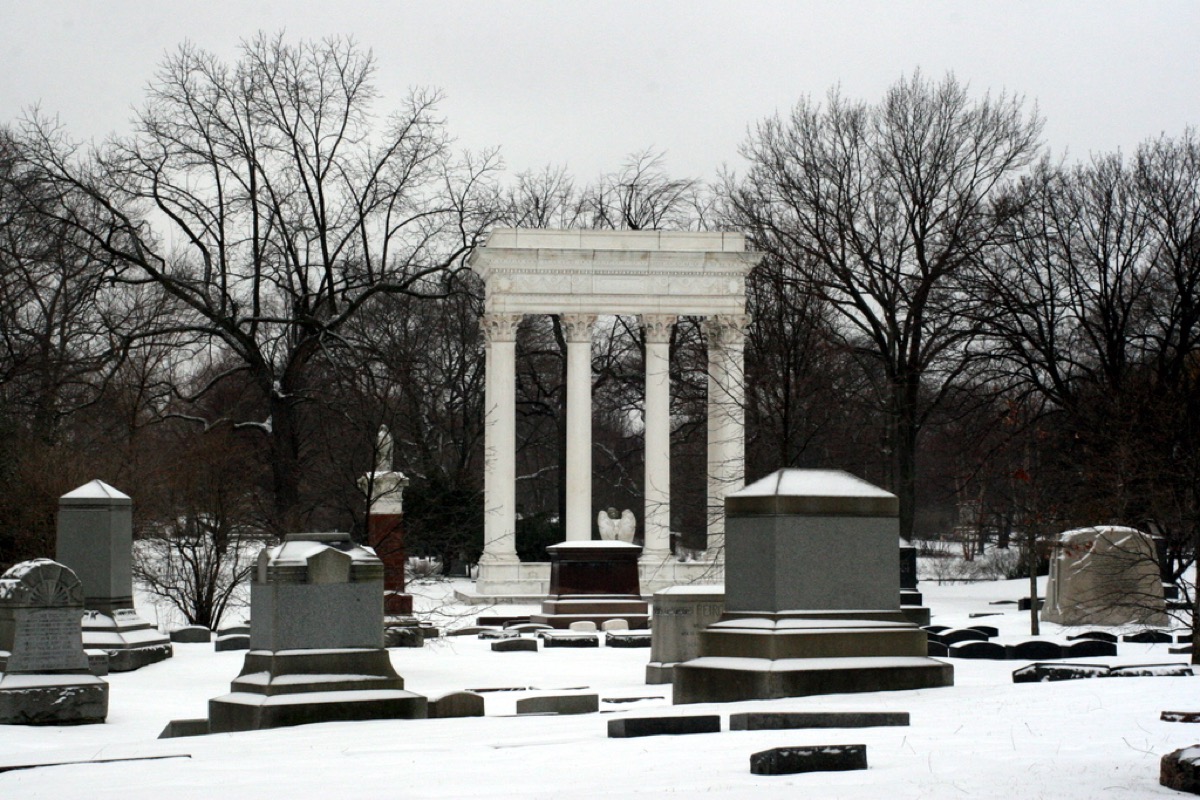
Graceland Cemetery opened in 1860 on 119 acres in Chicago's Uptown neighborhood. It was designed as a garden cemetery, more park than graveyard, and it became the preferred resting place for Chicago's wealthiest families. The list reads like a city history textbook: Marshall Field, George Pullman, Potter Palmer, Daniel Burnham. But the ghost stories center on humbler monuments, and they're oddly specific.
Inez's statue sits on a stone pedestal deep in the cemetery, a life-sized marble girl holding a parasol. The plaque reads "Inez Clarke, 1873-1880." The popular legend says lightning struck her during a family picnic and her spirit flees the glass case whenever storms return. The truth, uncovered by genealogist John Binder, is less dramatic but stranger: the girl's real name was Inez Briggs. Her mother Mary was 16 when she married Wilbur Briggs, who abandoned the family after Mary demanded he stop drinking. Mary later remarried a man named Clarke, and the monument carried the second husband's surname. Inez died of diphtheria at six, not lightning. Her brother Dilbert died months later from cholera infantum. The whole family is in the ground there, misnamed and mostly forgotten, except for the statue that won't stay put.
Children visiting the cemetery have wandered off near the monument and been found playing beside it, telling their parents they were "playing with Inez."
On the other side of the grounds, Lorado Taft's "Eternal Silence" stands over the Graves family plot. A ten-foot bronze figure in a hooded robe, set against black granite, it memorializes Dexter Graves, who led thirteen families from Ohio to what would become Chicago in July 1831 aboard the schooner Telegraph. Graves opened The Mansion House, one of the city's first hotels, and died in 1844. His descendants commissioned the statue around 1909, using part of a $250,000 bequest originally meant for a mausoleum.
The statue has oxidized to a deep green over the decades. The cemetery once polished it back to its original bronze, but visitors complained, so they let the patina return. The legend says that if you stare directly into the hooded figure's face, you'll see a vision of your own death. It's a good story. The other claim, that the statue can't be photographed, falls apart faster, given the thousands of photos online. But the face is hard to make out in person. The hood casts a deep shadow, and the oxidation has darkened the features into something almost featureless, which is probably where the legend comes from.
The cemetery has at least two more ghosts worth mentioning. Ludwig Wolff, who spent his life fearing premature burial, has a tomb near Montrose Avenue where residents of the adjacent apartment buildings have spotted a ghostly hound pacing in front of the entrance on full-moon nights. The cemetery does have coyotes, so the explanation might be simple, but the sightings are specific to Wolff's tomb and not other plots. Daniel Burnham, the architect who designed the 1893 World's Fair and Chicago's lakefront plan, is buried on a small island in the cemetery's pond. A man matching his description has been seen standing on the island's bank with his hands in his pockets, staring out. Burnham's ghost has also been spotted at the Jackson Park fairgrounds and the Rookery Building downtown.
Graceland is open to the public during daylight hours. The Chicago Architecture Center runs walking tours that focus on the monuments as works of art. The ghost tours run separately, usually in October. Most visitors come for the architecture or the history. But if you visit during a thunderstorm, check the glass case first.
Researched from 6 verified sources. How we research.