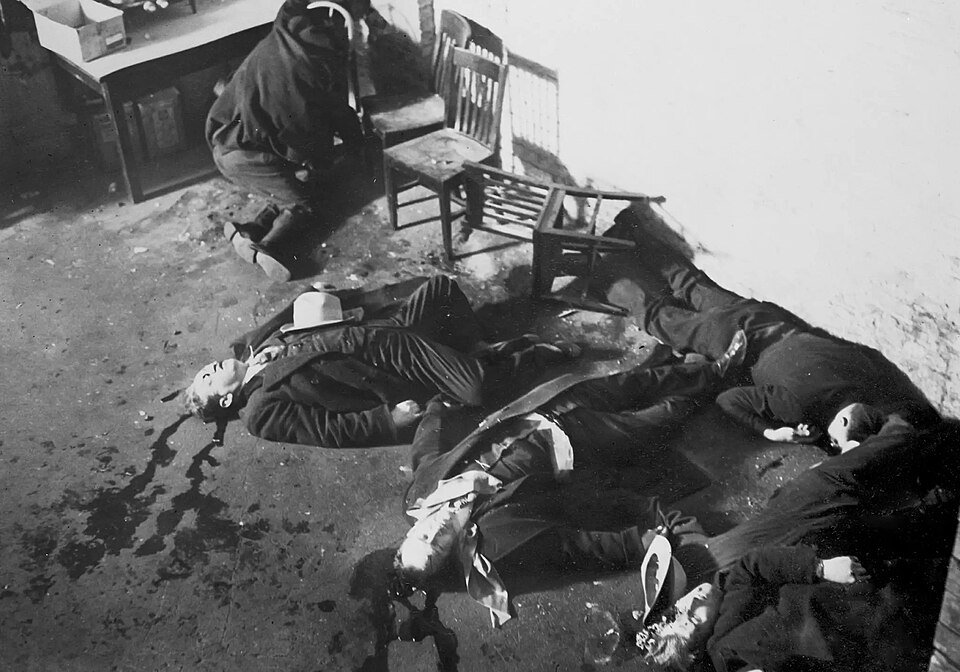
There's a lawn at 2122 North Clark Street in Chicago where a garage once stood. Seven men were machine-gunned against its north wall on St. Valentine's Day, 1929. The wall is gone now, sold off brick by brick — and the people who bought the bricks say they're cursed.
The address of the St. Valentine's Day Massacre, 2122 North Clark Street in Chicago, is an empty patch of grass now, in Lincoln Park. No marker, no plaque, just a lawn beside a senior-living development. For years the story went that dogs wouldn't walk across it — that they balked, whined, pulled their owners back from a spot they couldn't see.
What stood there until 1967 was a garage, the SMC Cartage Company. On the morning of February 14, 1929, seven men were lined up against its north wall and cut down. About 70 rounds came out of two Thompson submachine guns, plus one shotgun blast. The killers wore police uniforms and arrived in a car dressed up as a Chicago Police squad car, which is likely why the men faced the wall without a fight — they thought it was a raid.
The only thing left alive inside was a German shepherd named Highball, tied to a truck at the back, barking at a room of bodies. His barking is what brought the neighbors. Al Capone's outfit was suspected of ordering the hit. No one was ever charged.
When the garage came down in 1967, a Canadian businessman bought the bullet-scarred wall. He toured the bricks, failed to open a museum, then rebuilt the wall behind a plastic screen in a nightclub men's room in Vancouver, with targets to aim at. Later he sold the bricks off one at a time, $1,000 each with a letter of authenticity.
The curse story starts there. Buyers reported illness, ruin, divorce, death. Enough of them mailed their bricks back that the seller said he got about as many returned as he sold. Roughly 300 are reassembled now at The Mob Museum in Las Vegas, bullet holes intact, and visitors near them say they hear gunshots, and men moaning, and falling.
As for the dogs at the lawn — a Chicago historian who's watched the spot says he's seen dozens go by without incident. Whatever was there seems to have left with the wall.