Hotel Baker

Hotel Baker

🏨 hotel

St. Charles, Illinois ยท Est. 1928

TLDR

Guests in the sixth-floor penthouse suite wake to a woman sobbing, feel their bedding pulled by invisible hands, and encounter icy drafts with no source. The ghost is believed to be a chambermaid who drowned herself in the Fox River after being abandoned by her lover, and the hotel's founder Colonel Baker and his wife Harriet haunt the building too.

The Full Story

The sixth-floor penthouse at Hotel Baker has a weeping problem. Guests check into what looks like a luxury suite overlooking the Fox River, fall asleep, and wake up to the sound of a woman sobbing. The crying comes from somewhere inside the room. Their bedding gets yanked. An icy draft fills the space even in July. And then, just as suddenly, it stops.

The woman they hear is a chambermaid. Or at least, that's the story St. Charles has told for decades. She worked at the hotel in the mid-twentieth century, and her boyfriend did too. The details shift depending on who tells it. In one version, he left her at the altar on their wedding day. In another, he lost big in a poker game and abandoned her afterward. Both versions end the same way: she walked down to the Fox River behind the hotel and drowned herself.

The chambermaids' quarters were on the sixth floor back then. The hotel converted that space into its penthouse suite years later, but the grief apparently stayed. Guests in that suite describe a heaviness in the room, a sadness that comes on suddenly and has nothing to do with their own mood. Cold air moves through the space with no source.

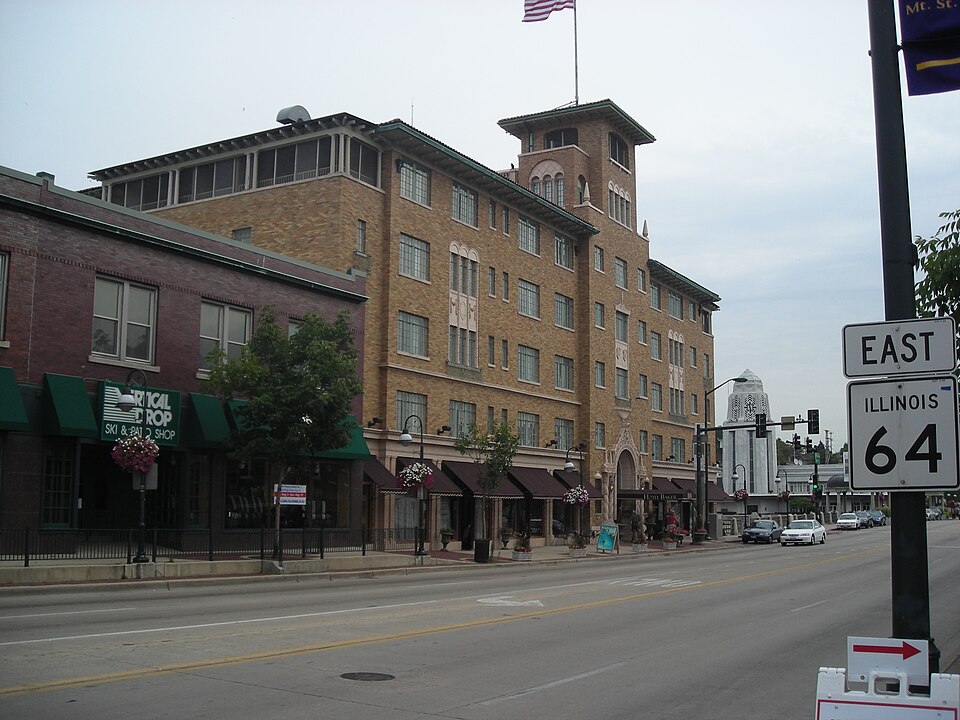
Colonel Edward J. Baker opened this hotel on June 2, 1928, after spending somewhere between $600,000 and $1.25 million (sources disagree) to build the finest small hotel he could imagine. Baker had inherited a fortune through his sister Dellora Baker Gates, heiress to the Texaco Oil Company. He was first and foremost a farmer from St. Charles who happened to come into about $20 million at age 50 and decided to build something extraordinary with it.

The result was a Spanish-Moroccan stunner on the west bank of the Fox River. The Rainbow Room debuted one of the world's first lighted dance floors: 2,620 colored lights under 300 glass blocks, synchronized to the music. Louis Armstrong played there. Tommy Dorsey. Guy Lombardo. Lawrence Welk. JFK stayed as a guest. The hotel kept Venetian gondolas on the river for guests to rent and maintained rose gardens along the waterfront. Rooms started at $2.50 a night.

Baker ran the hotel at a yearly deficit for its first 31 years, prioritizing guest experience over profitability. He moved into the penthouse after losing his son and wife, and he lived there until he died in 1959. His niece Dellora Norris took over and ran it until 1970, when she donated the building to Lutheran Social Services. The hotel hit hard times, changed hands, got a $9 million renovation in the 1990s, and landed on the National Register of Historic Places on December 8, 1978.

Baker's wife, Harriet Rockwell Baker, died of a heart attack in 1940. She's the hotel's second ghost. People see her on the top-floor balcony, looking out over the property her husband built.

Then there's Room 441. Guests hear footsteps from the room directly above, except there is no room above 441. A vintage-style radio in the room has turned on by itself in the middle of the night, played what sounded like 1930s-era music, then shut off. People walking the fourth-floor hallway in the early morning hours have seen translucent figures that vanish when approached.

The Rainbow Room has its own stories. Staff hear distant music echoing through the ballroom on quiet days when the room is closed. Investigators running audio equipment in the space captured what they described as faint music and a child's giggle on their recorders. That last detail is odd because children were rarely allowed at Rainbow Room events during the hotel's 1930s heyday.

Around 3:37 a.m. on one documented occasion, a group of five guests staying on the sixth floor heard moaning coming from a storage room area near their rooms. The fourth floor has had bathroom lights cycling on and off around 3 a.m., and a bathroom door that moved slowly from open to halfway closed with no one touching it.

The hotel sits at 100 West Main Street in downtown St. Charles, about 40 miles west of Chicago. It was recognized at the 1933 Chicago World's Fair as one of the best places to stay in the region, and the Rainbow Room's dance floor was one of only three like it in the world at the time. The building earned the nickname "Crown Jewel of the Fox" and, later, "Honeymoon Hotel."

Baker built his dream hotel on the site of an old mill called Haines Mill, which had burned down in 1918. He turned a dumping ground into something beautiful. Maybe that's why he refused to let it fail, running it at a loss year after year. He poured everything into this place, and when his family was gone, he moved in. The chambermaid did too, in her own way.

Researched from 8 verified sources. How we research.