About This Location
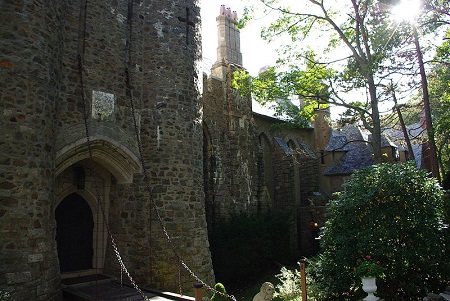
A medieval-style castle built between 1926-1929 by inventor John Hays Hammond Jr., who held over 400 patents. The castle incorporates elements from European buildings dating to the 12th century and houses Hammond's collection of Roman, medieval, and Renaissance artifacts.
The Ghost Story
Rising from the rocky cliffs of Gloucester's Magnolia neighborhood, Hammond Castle stands as a monument to one man's twin obsessions: scientific innovation and the supernatural. Built between 1926 and 1929 by John Hays Hammond Jr.—a Yale-educated inventor who held over 437 patents and was known as the "Father of Radio Control"—this medieval-style fortress was designed not merely as a home, but as a gateway between worlds.
Hammond, a protégé of both Alexander Graham Bell and Thomas Edison, constructed his castle to house both his cutting-edge laboratory and an extraordinary collection of Roman, medieval, and Renaissance artifacts salvaged from war-torn Europe. The granite structure, mined from nearby Cape Ann quarries, incorporates authentic 15th, 16th, and 18th-century European architectural elements—genuine church doors, French tradesman facades from the 13th century, and over 50 funerary headstones scattered throughout the museum. The Great Hall houses a massive 8,400-pipe organ where George Gershwin once performed, and Walt Disney privately screened Fantasia here in 1940.
But beneath Hammond's brilliant scientific mind burned a fascination with the occult. He and his wife Irene were devoted spiritualists who regularly hosted séances in the castle, believing that spirits were attached to many of the ancient artifacts in their collection—including, it's rumored, a human skull said to belong to one of Christopher Columbus's crew members. Hammond maintained an extensive occult library and designed his castle with hidden passageways and secret doors, which he used to play elaborate pranks on overnight guests.
Hammond's paranormal research reached its apex between 1951 and 1952 when he collaborated with renowned psychic Eileen Garrett, president of the Parapsychology Foundation. In his Great Hall, Hammond constructed a seven-foot copper Faraday cage designed to block all electromagnetic frequencies. The experiment sought to determine whether telepathy operated on electromagnetic waves. When Garrett successfully communicated telepathically with scientists despite the electromagnetic isolation, Hammond concluded that ESP transcended known physical laws. Legend holds that the electrical currents running through the cage became so intense that they permanently faded the dark stone floor beneath—a mark reportedly still visible today.
Perhaps most revealing of Hammond's beliefs was his oft-repeated promise: after death, he intended to return as a black cat. He had such devotion to his Siamese cats that he held formal funeral processions for them, preserving their bodies in formaldehyde. When Hammond died in 1965, he was buried on the castle grounds alongside his beloved cat, with poison ivy deliberately planted over his grave to prevent disturbance.
Since Hammond's death, the castle has become a beacon for paranormal activity. The TAPS team from Ghost Hunters investigated in 2012 (Season 8, Episode 23: "Paranormal Pioneers"), capturing what they called "some of the more fascinating pieces of evidence seen in a long time." Their equipment recorded a voice clearly whispering "Hammond," and investigators witnessed a chandelier swinging wildly in the basement with no apparent cause. Dave and Tango recorded mysterious voices; Amy and Adam detected both voices and unexplained whistling; and Jason and Steve heard footsteps following them through empty corridors.
Visitors report feeling constantly watched around every corner, particularly in the Great Hall near the massive organ. Photographs taken in the castle have captured anomalies—half-formed faces in backgrounds, mist-like figures in the library, and what some describe as an apparition ascending the stairs. Books have been known to fly off shelves without explanation, and cellphones and electronic devices frequently malfunction within the castle walls.
Three spirits are most commonly reported. Hammond himself appears peering around corners with what witnesses describe as a devilish smile, vanishing as quickly as he appears—perhaps still using those secret passageways he loved so much in life. His wife Irene has been seen floating through rooms with an expression of sadness, as if searching for something that continues to elude her in death. And a former groundskeeper is sometimes spotted trimming hedges or polishing stonework, blamed for unexplained doors slamming shut and visitors' hair being mysteriously pulled.
Most intriguing are the sightings of a black cat wandering the castle grounds—a cat no one can ever quite catch or identify. Given Hammond's promise to return in feline form, many believe the inventor has kept his word, continuing his paranormal research from the other side. The castle now offers Candlelight & Spiritualism tours, inviting visitors to explore the same spaces where Hammond once sought to pierce the veil between the living and the dead.
Researched from 9 verified sources including historical records, local archives, and paranormal research organizations. Learn about our research process.