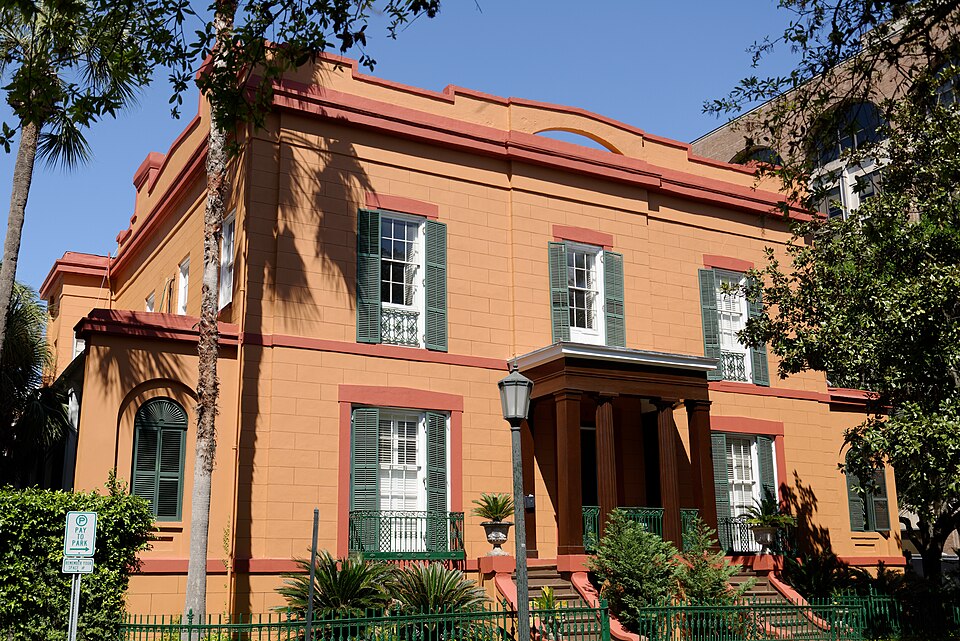
The Sorrel-Weed House in Savannah, Georgia draws ghost-hunting crews from all over the country. The story they come for — a wife who jumped, an enslaved woman murdered — has almost no documentary record. The death it's built on happened next door.
The Sorrel-Weed House in Savannah, Georgia is one of the most-filmed haunted houses in America. Ghost Hunters shot their first Halloween special there in 2005, Ghost Adventures followed in 2014, and a long line of YouTube crews — Sam & Colby, Watcher, Project Fear — have filmed inside since. The story they all come for is the same one. It's also the one the record doesn't support.
The tour version goes like this. Francis Sorrel, the shipping merchant who built the house, was caught with an enslaved woman named Molly. His wife Matilda threw herself from a balcony. Molly was found dead soon after. Visitors and guides report a woman in white near the master bedroom, faint sobs, footsteps in empty halls.
Matilda Sorrel did die. But not here. Sorrel had sold this corner mansion to Henry D. Weed in 1859, deed dated June 14, $23,000, and moved his family next door, to 12 West Harris Street. A contemporary letter, published later in *The Children of Pride*, records that Matilda "sprang from the second — or third — story window of her residence on Harris Street, next door to the house which was the family mansion for so many years." That was the spring of 1860. The fall the tours stage in this house happened in the building beside it.
And Molly is harder still. No census, no family paper, no record of any kind places an enslaved woman by that name in the Sorrel household. "No documentation," the Savannah historian James Caskey wrote, "has ever surfaced which proves that Molly was a real person."
The carriage house the tours point to was finished after the war — it couldn't have held anyone enslaved. A depression in its floor, long said to be a grave, was dug up and found to be a trash pit.
What's documented is grimmer than the legend. Sorrel owned enslaved people, and sold three named Minda, Louisa, and Virginia — two women and a ten-month-old child. The invented affair, as Wikipedia puts it, "reflects the horrors of sexual abuse that enslaved women faced." The real history was here the whole time. The ghost story moved in over it.