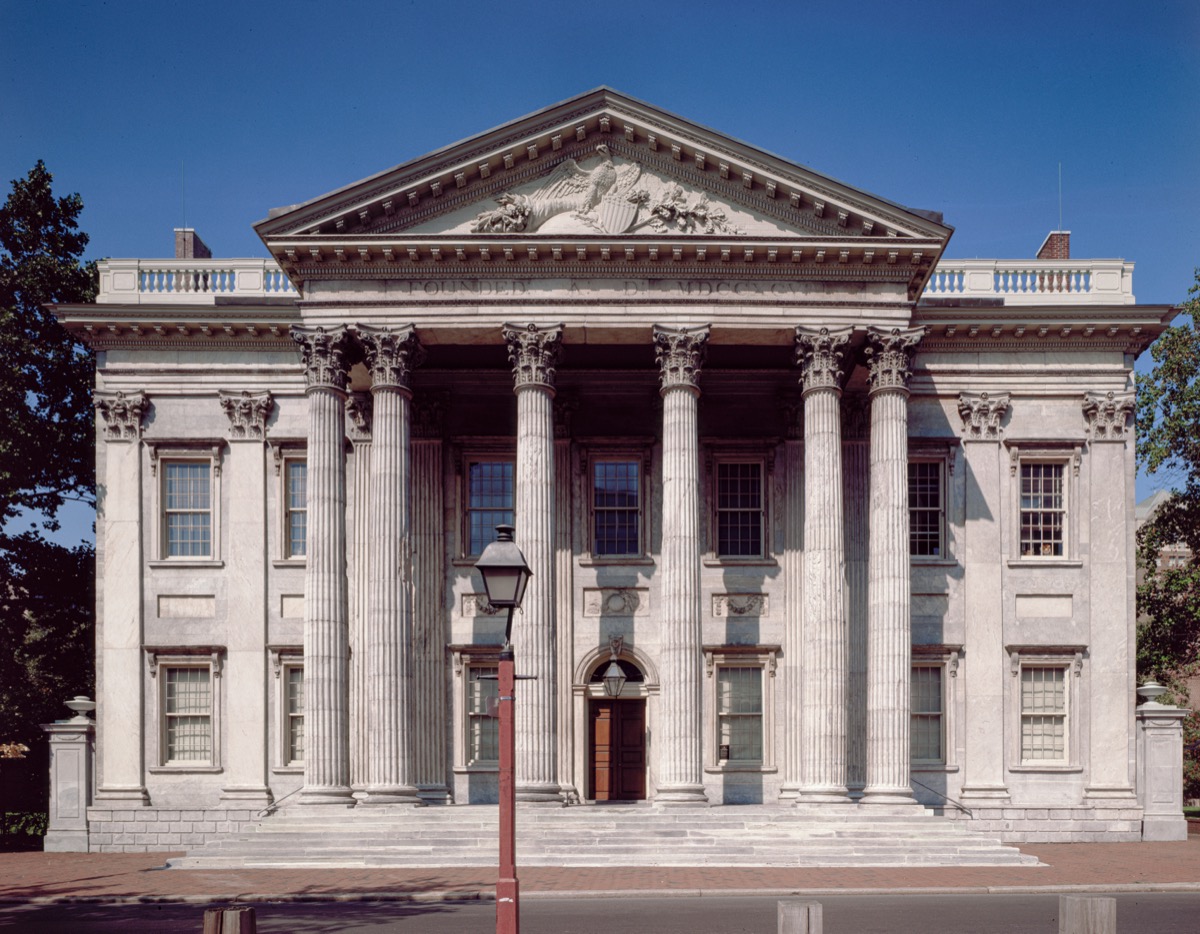
At the First Bank of the United States in Philadelphia, ghost tours say Alexander Hamilton paces the halls and watches from the closed upstairs windows. The trouble with the story is that he never set foot in the building it haunts.
The First Bank of the United States, at 120 South Third Street in Old City Philadelphia, has a famous ghost: Alexander Hamilton. For decades, ghost tours have stopped on the sidewalk below the marble facade and pointed up at the closed upstairs windows, where a face is said to watch the street. The story has Hamilton pacing the halls inside, tied to the debts he left at his death and to the bank he built and then watched Congress kill.
There is one problem with all of it. Hamilton never set foot in the building.
He won the bank as an argument. In 1791 he out-argued Jefferson and Madison, insisting Congress held the implied power to charter a national bank where the two of them swore it held none. It was a constitutional flashpoint, and Hamilton won it: the House passed the bill 39 to 20, with nearly all the opposition coming from southern representatives, and Washington signed it into law on February 25 that year. The charter ran twenty years.
But the Third Street building wasn't finished until 1797, two years in the making, and by then Hamilton had already left the Treasury. He died on a New Jersey dueling ground in 1804. The charter expired in 1811, and Congress let the whole thing lapse. The institution he had built and defended was gone, seven years after he was.
So the monument outlived the man and the bank both. After the charter died, the Philadelphia financier Stephen Girard bought the building and ran it as his own private bank until his own death in 1831. The original bank vaults still sit in the basement. Then the building went quiet. It was closed to the public from the 1970s until it reopened as a museum of the early American economy on July 1, 2026, a renovation meant, as one director put it, to "tell the story of money" the way the city already tells the story of the Declaration and the Constitution.
What people actually report is thin and unattributed. No investigation, no recording, no named witness traces to any of it. The face at the windows and the pacing in the halls live entirely in ghost-tour patter. The one detail that keeps recurring is small and modern: visitors who stop to photograph the marble columns say their phone and camera batteries drain fast, faster than they should.
Behind the blue marble and the two-story Corinthian columns is a mahogany eagle carved by a French wood carver, the oldest surviving architectural use of the American national seal. The architect modeled the whole thing on a classical temple to signal that the new government would last. A monument to permanence, championed by a man who never once walked through its doors — and who the city has pacing it still.