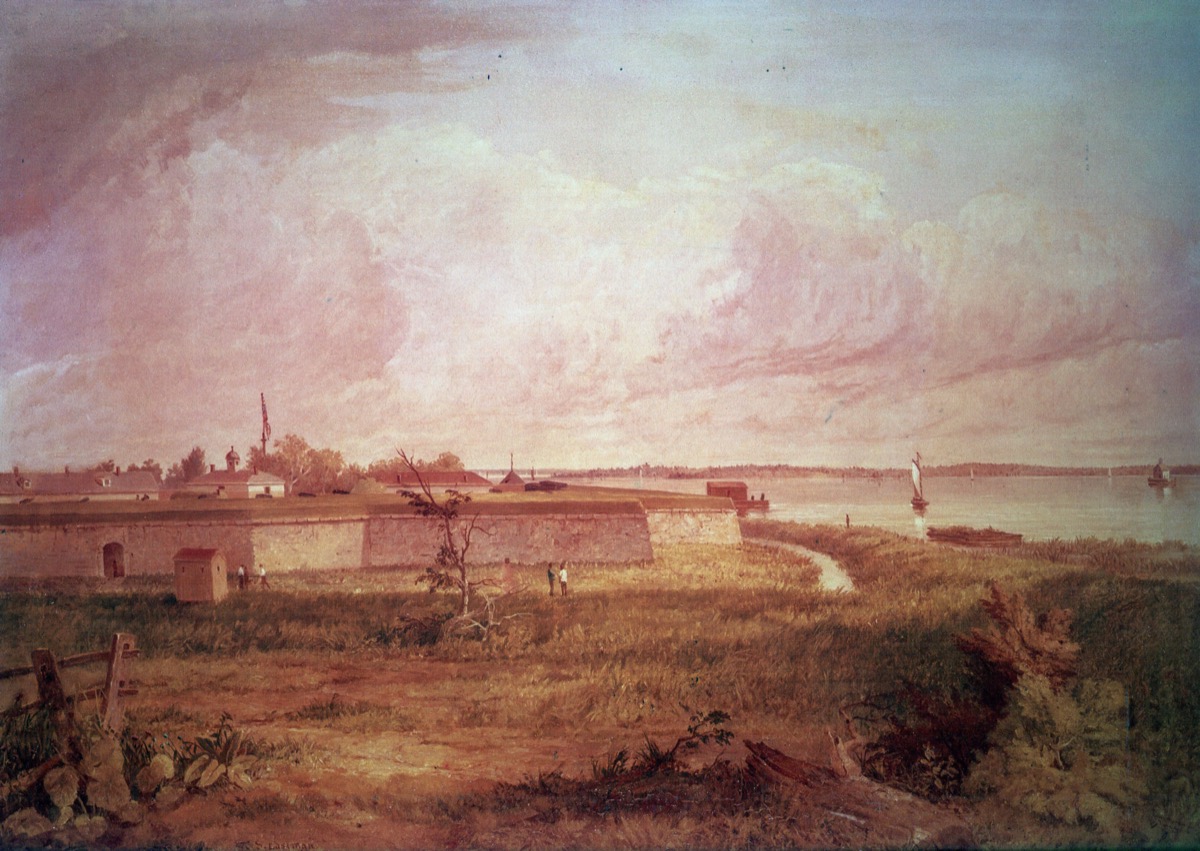
At Fort Mifflin, on a spit of land near the Philadelphia airport, a woman is said to scream from the Officers' Quarters. The story names her Elizabeth Pratt, a grieving mother. The records tell a quieter, sadder version.
The story at Fort Mifflin, on a narrow spit of land near the Philadelphia airport where the Delaware and Schuylkill meet, is about a woman who screams. The shrieks come from the Officers' Quarters, loud enough that neighbors have called the police. The way it's told, officers drive out, find the buildings locked and empty, and leave. The screaming keeps happening.
Locals name her Elizabeth Pratt, an officer's wife who lived at the fort and lost her children there. The legend has her hanging herself in grief after her daughter died of fever, and it's the version most tellings give. The documented record disagrees. Research traced an Elizabeth Pratt who died in February 1803 of yellow fever, not by her own hand, her two children gone the year before, likely in the epidemic sweeping Philadelphia. The same researcher noted the screams could be a red-tailed hawk's call. No recording has settled it either way.
She isn't the only name people give the place. The roster runs long: Joseph Adkins the lamplighter in the Soldier's Barracks, Jacob the blacksmith slamming doors, a child called Amanda in the Artillery Shed. "It doesn't matter where you are," a museum employee said. "People have experiences morning, noon, and night." In Casemate 5, where the screams are loudest, a 2012 investigation ran an audio session. A voice on the recording asked, "Did you die in here?" Another answered, "I think so."
The fort is one of the few Revolutionary War sites where the original siege-era walls still stand, pockmarked from 1777, when the British fired more than 1,000 cannonballs at it in a single hour. The Americans held on, denied the Royal Navy the Delaware, then evacuated that November. Roughly 250 of the garrison were killed or wounded.
The other ghost came later. During the Civil War the Union ran the place as a prison, and on August 26, 1864, Private William Howe was hanged here, a decorated soldier who deserted while sick and shot the officer sent to arrest him. He carved his name into the wall of his underground cell, Casemate 11, and the markings are still there. They call his ghost the Faceless Man, after the hood pulled over his head before the drop. "I think he's not at rest because he was made an example of," a paranormal host said of him.
On the scaffold, Howe spoke last. "I never sought the life of the man I killed," he said. "I feel God will pardon me for taking it as I did."