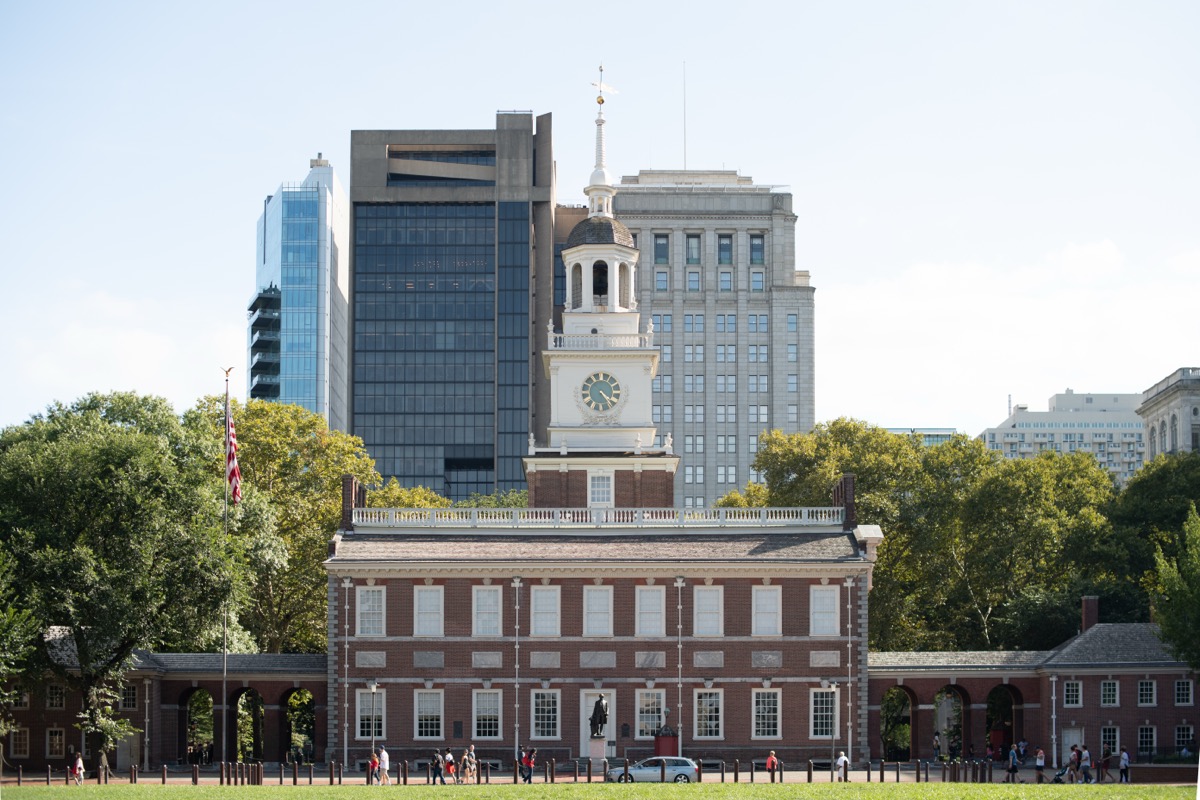
Old City Philadelphia tells the cheeriest ghost story in America: a bronze Benjamin Franklin who climbs off his pedestal at night and dances the streets near Independence Hall. Inside the Hall, the ghosts people report are the solemn ones, the Founders themselves.
The cheeriest ghost in America belongs to Benjamin Franklin, and the story is told around Independence Hall in Philadelphia. Old City lore holds that a toga-clad bronze Franklin climbs down off his pedestal after dark and dances, skips, or strolls the streets, sometimes drifting toward his old house or stopping by a tavern. The statue stands at the American Philosophical Society building, steps from the Hall, and the legend belongs to that figure, not to anything on the Hall itself.
Philadelphians keep repeating it straight. The dancing Franklin shows up in two real books, Matt Lake's Weird Pennsylvania and Darcy Oordt's Haunted Philadelphia, and a writer chased it down for The Hairpin in 2016. A cemetery caretaker she spoke to just shrugged: "it seems like it's just a funny story for people to tell." Nobody knows when it started or who told it first. It is a two-hundred-year-old joke the city says with a straight face.
Against all that lightness sits the building itself, originally the Pennsylvania State House, finished in 1753. Here the ghosts people report are the solemn ones. Visitors and guides describe an elderly man in colonial clothing near the Assembly Room, resembling Franklin, and a tall military figure where Washington once presided. Benedict Arnold is named in the lore too, said to wander rather than keep to a room.
The Assembly Room earns the weight. It is one room where four turning points happened: the Continental Army was created there in 1775 and Washington made its commander, the Declaration of Independence was adopted there in 1776, the Constitution was signed there in 1787, and after his funeral train reached the city in April 1865, Abraham Lincoln's body lay in state there near the Liberty Bell. Estimates of those who filed past Lincoln range from roughly 100,000 to 300,000.
Both signings used the same silver inkwell, the Syng inkstand, made in 1752 by a Philadelphia silversmith who knew Franklin. The same hand-sized object sat on the table in 1776 and again in 1787, and it still exists, displayed in the park today.
Washington presided over the Constitution from a mahogany chair carved with a half-sun. When the convention closed, Franklin looked at it and said, by Madison's notes, that he had often wondered through the session whether the sun behind the president's chair was rising or setting, and now knew at last it was rising. The man who settled that question is the one the city pictures, two centuries on, skipping down a dark street toward a tavern.