In the early 1990s a locksmith named Gary Johnson was repairing a lock in Cell Block 4 at Eastern State Penitentiary in Philadelphia when he felt something watching him, then saw a black shadow leap across the block. His story is what made the abandoned prison famous.
The thing people keep coming back to at Eastern State Penitentiary in Philadelphia happened to a man fixing a lock. In the early 1990s, a locksmith named Gary Johnson was removing an old lock in Cell Block 4 when, by his account, the work stopped feeling routine.
"I had this feeling that I was being watched, real intensely," he told NPR. He looked down the empty block and saw nothing. A few seconds later the feeling came back, stronger. "As I start to turn down the block, this black shadow just leapt across the block." He said tortured faces appeared on the cell walls. A maintenance worker, not a tour guide, is the one widely credited as the spark for the prison's second life as one of the most-investigated haunted sites in America.
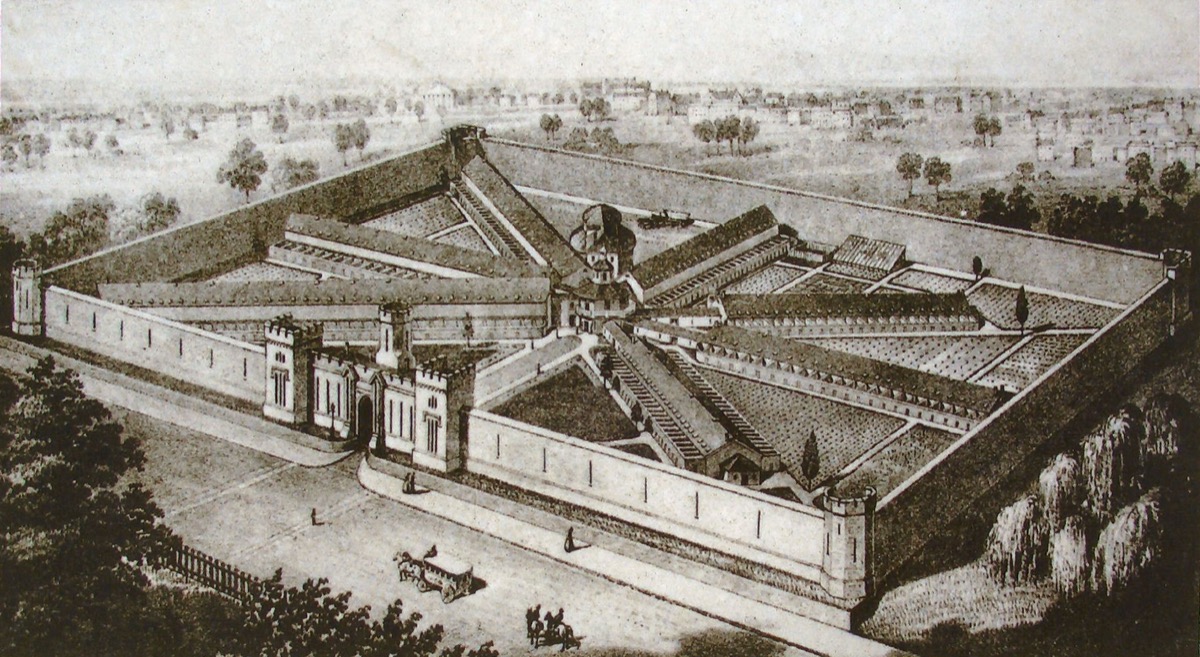
The building behind that story was built to do something to the men inside it. Eastern State opened in 1829 as the first true penitentiary in the world, designed by John Haviland on a radial plan, seven cellblocks fanning out from a central rotunda. The model would be copied more than 300 times across six continents. The theory was that total solitude would force repentance, so inmates were hooded whenever guards moved them through the halls, kept from seeing or being seen. Charles Dickens spent a full day there in 1842, walking cell to cell, and called the system "the slow and daily tampering with the mysteries of the brain." Critics argued almost from the start that it was driving men insane. The strict isolation was officially abandoned in 1913.
Al Capone served roughly eight months here in 1929, in a "Park Avenue" cell furnished with an oriental rug and a cabinet radio while the men around him had nothing.
The prison closed around 1970 and stood abandoned for two decades with no maintenance at all, vaulted ceilings crumbling, iron doors hanging open on empty cells, before a task force pulled it back from redevelopment and it reopened for tours in 1994. The first Halloween fundraiser, held in 1991, eventually grew into the haunted attraction that runs there every October.
By then the reputations had sorted themselves by cellblock. Block 12 for echoing voices, where the first Ghost Hunters investigation caught a shape moving down the corridor. Block 6 for shadows drifting along the walls. Tour accounts add a woman in white in a second-floor cell. And Block 4, where the locksmith was working alone, the day a force he could not see gripped him and would not let go.