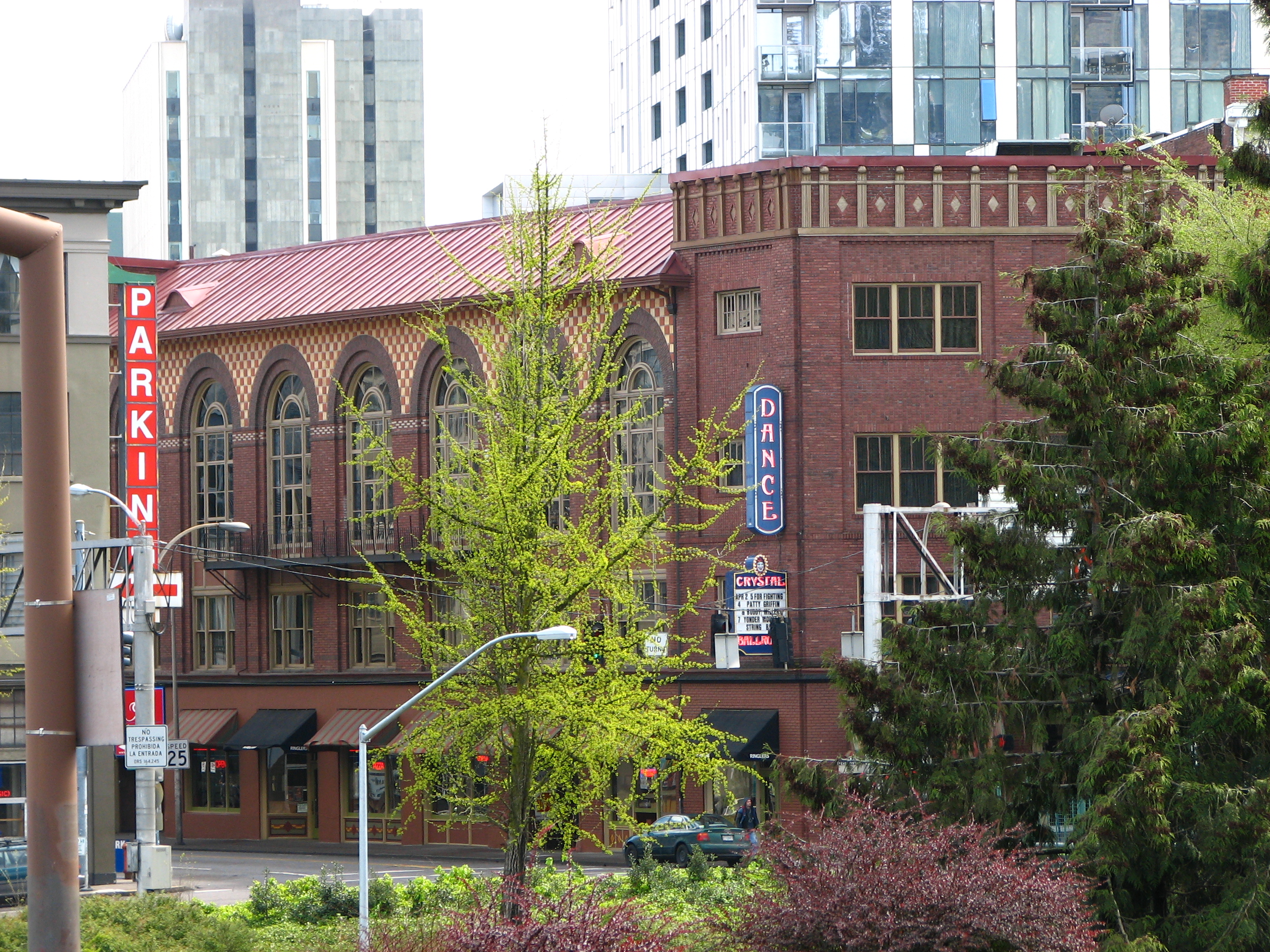
The Crystal Ballroom in Portland, Oregon was built on a floating dance floor that bounces as people move on it. A century later, staff and patrons still see couples in 1920s dress crossing the empty hall, and still feel the boards move when no one is there.
At the Crystal Ballroom in Portland, Oregon, the dancers never quite left. Staff and patrons keep describing the same figures along the edge of the main hall: women in beaded, drop-waist dresses and men in slim suits, drifting across the floor in styles that went out a hundred years ago. Some of them hear it before they see anything. The sound of leather soles gliding over the boards, the low murmur of a conversation no one is having, a room that feels full when it's empty.
The main ballroom sits on a "floating" floor: maple boards laid over a bed of rockers and ball bearings, built to flex up and down as people dance, and tunable to the style on the floor. It was considered one of a kind on the Pacific Coast when it went in, and it may be the only one left in the country. So the reports of the floor bouncing with no one on it sit on a room whose defining feature is a floor that already feels alive.
The reports don't stop at the dancers. People describe big-band music rising in the empty hall, footsteps crossing the wooden floors long after hours, and the elevator riding up and down on its own with no one there to call it.
The building opened in 1914 as Ringler's Cotillion Hall. Montrose Ringler ran a dancing academy there, and his draw was the tango, scandalous enough at the time that Portlanders could be arrested for dancing it. A city crackdown on jazz and "indecent" dancing cost him the hall in the early-to-mid 1920s. The apparitions belong to exactly that stretch, the flapper-era crowd of the room's first heyday, not a random scatter of phantoms from unrelated decades.
One account gets retold more than the rest. A staff member cleaning up after closing looked out across the hall and saw a couple in 1920s dress dancing the jitterbug on the empty floor. They were gone before she could call anyone over to look.
The dancing didn't last. The hall closed to the public in 1968 and sat largely unused for close to three decades, the floating floor still and quiet under a building no one came to. McMenamins restored the ballroom and reopened it in late 1997, brewery and bar and a refurbished floating floor, and the company doesn't hide the ghost stories that came with it. It documents them.
The floor was engineered to move under the people dancing on it. It still does, on nights the room is empty.