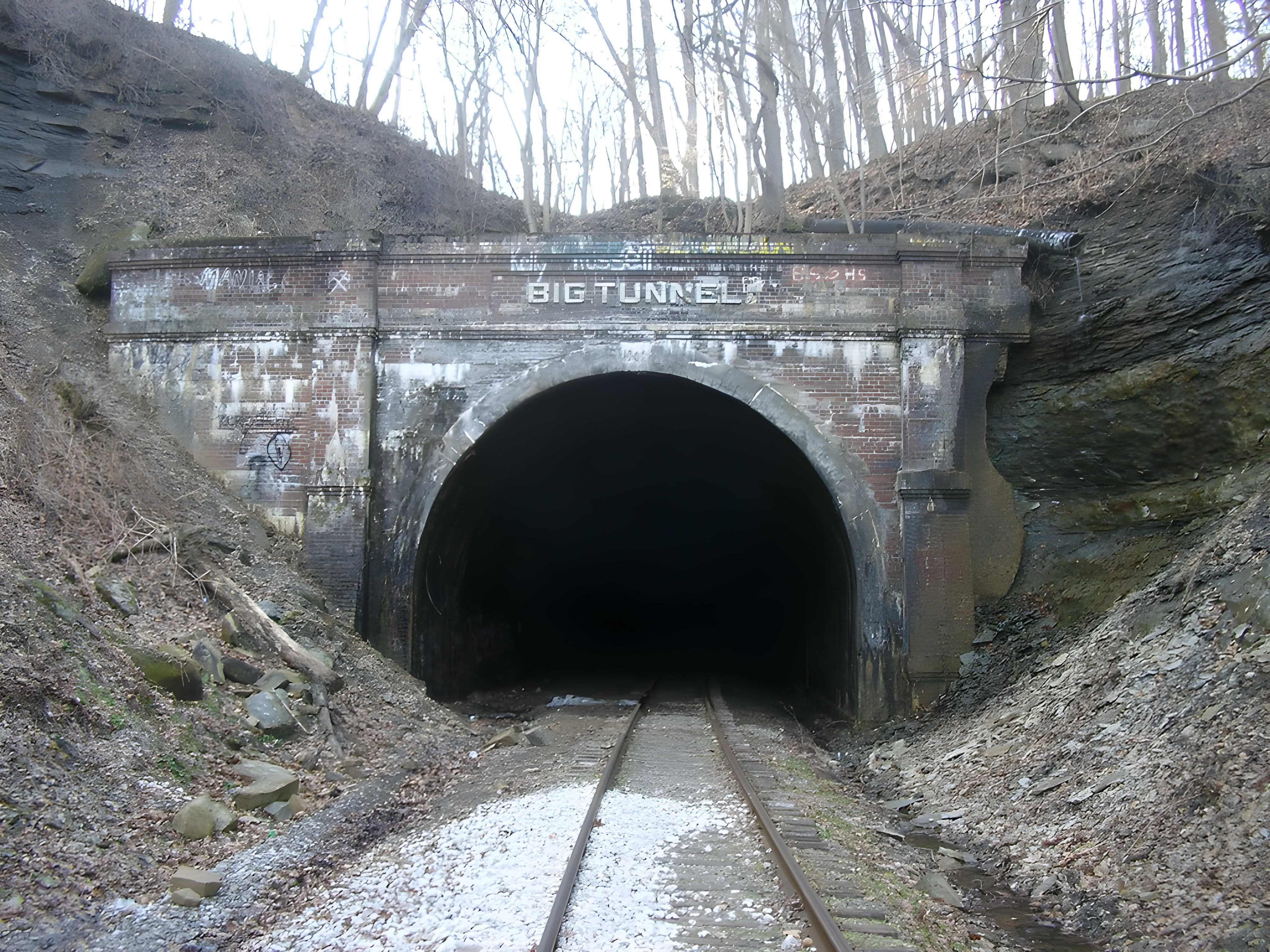
At the Big Tunnel near Tunnelton, Indiana, people walk in and watch a single lantern-light appear deep in the dark and grow brighter as it drifts toward them. The story is that it's Henry Dixon, the night watchman who was murdered here in 1908 and never put his lantern down.
The thing people see at the Big Tunnel near Tunnelton, Indiana is a light. A single lantern-glow appears deep inside the bore and grows brighter as it drifts toward you, faint to bright, never the reverse. The story is that it belongs to Henry Dixon, who was the tunnel's night watchman, and who is supposed to still be walking the track with it.
Dixon was 27. In July 1908 the day watchman, a man named James Fields, found him dead along the rails near the tunnel's mouth, struck in the back of the head. His body lay nearly 300 feet from where he should have been standing. His lantern was found upright beside the track, still burning. "He must have been struck by a heavy club or stone and almost instantly killed," a railroad detective said. He left a wife, two small sons, and a daughter who was born three months after he died. No one was ever charged. About a week before, Dixon had escorted two young women through the tunnel after a run-in with a group of men, and the evidence pointed to those men, but the railroad declined to prosecute for lack of proof.
The tunnel was bored through a limestone hill in 1857 to save the line about eight miles, and at roughly 1,700 feet it was the longest in Indiana when it opened. The words "Big Tunnel" are carved into the arched stone portal, still legible. The ceiling rock kept falling on trains, so crews lined the bore with brick in 1898. And it curves. Because of that you can never see daylight at both ends at once, so the inside is absolute dark. Turn off a flashlight and you can't see the person standing next to you. An Indianapolis Star writer put it in 1925: "There is no point in it where the visitor can see the faint glimmer of light at both ends at the same time."
That dark is part of why teenagers have walked in here for generations, hand in hand, to dare the ghost out. The folklorist Linda Dégh, who founded the journal *Indiana Folklore* at Indiana University, studied this exact ritual, and the Big Tunnel was one of her cases. Some tellers have turned Dixon into a headless watchman searching the track for his head, though nothing in the record supports that — he was struck, not dismembered. The plainer version is the one that lasts: a man who never put his lantern down.
The line is still live. The railroad passed from one company to the next over the years and runs as a CSX freight line now, equipment through it several times a week, into a dark that swallows your own lantern whole.