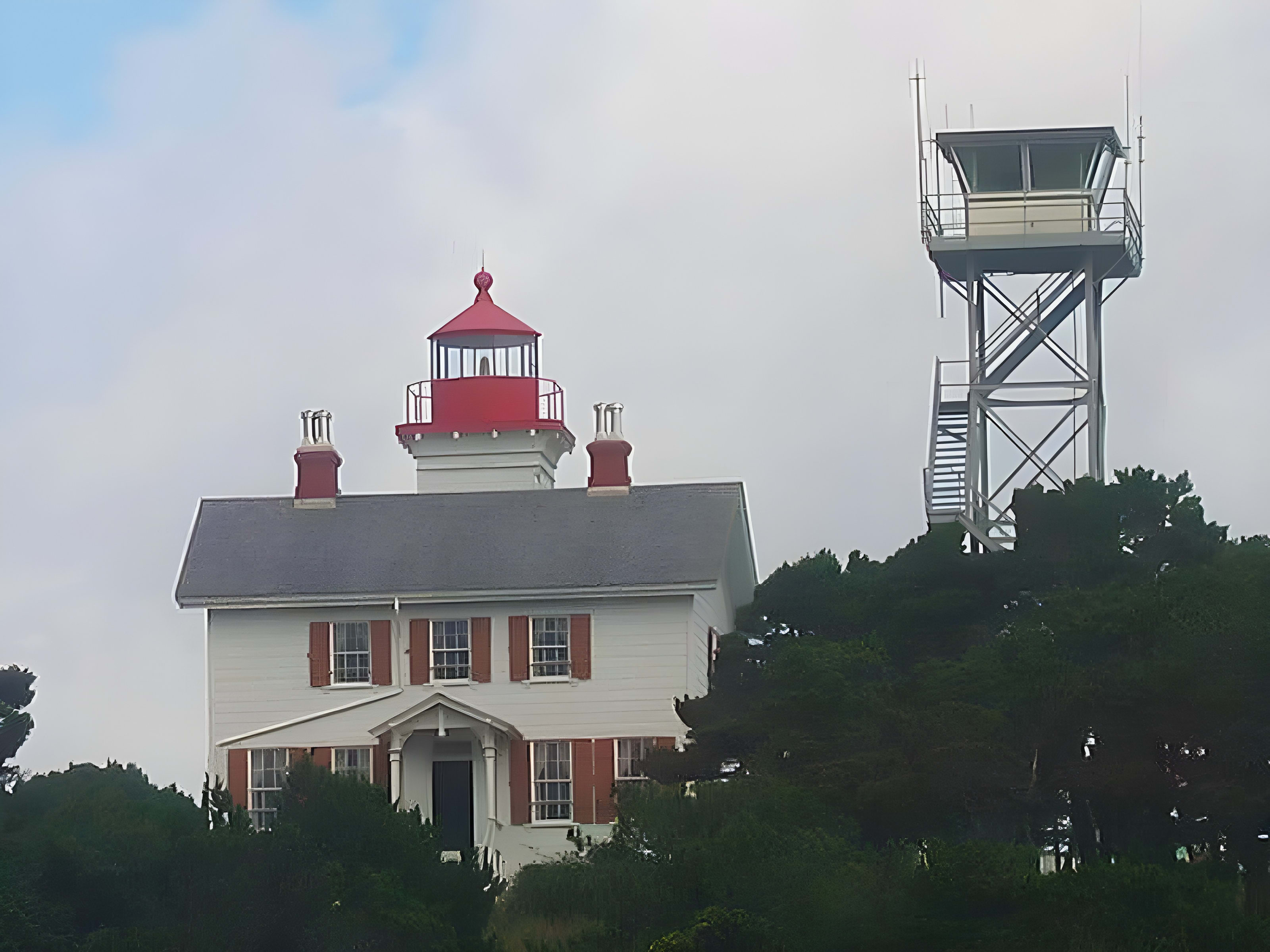
Muriel Trevenard haunts the Yaquina Bay Lighthouse in Newport, Oregon, seen in the upstairs windows. Except she never lived. A writer invented her for a short story in 1899, and the fiction outlived the lighthouse's three working years by more than a century.
Visitors to the Yaquina Bay Lighthouse in Newport, Oregon keep describing the same woman: a dark shape standing in the upstairs windows of the old keeper's house, and, on some nights, screams carrying up from the direction of the light. The story goes that she's a young woman named Muriel Trevenard, who vanished inside the lighthouse more than a century ago.
She did vanish there. But only in print.
Muriel was invented in 1899 by a writer named Lischen M. Miller, sister-in-law of the poet Joaquin Miller, for a short story called "The Haunted Light at Newport by the Sea." It ran in the August issue of Pacific Monthly, labeled as exactly what it was: fiction.
In the story, a sea captain leaves his daughter Muriel at a Newport boarding house and sails off. She and a group of young people go exploring the abandoned lighthouse, where she finds a hidden door that opens onto a dark vertical shaft. Later she slips back alone for a handkerchief she'd left behind. The others hear her scream. When they reach the spot, the secret door is locked, Muriel is gone, and a pool of warm blood is spreading on the floor beside the handkerchief. Miller's last line: "But to this day it is said the blood-stains are dark upon the floor."
Then something strange happened to the story. Over a few decades the byline and the publication date quietly fell away, and the tale got reprinted on restaurant placemats and in chamber-of-commerce brochures as a true account of a real disappearance. People started arriving at the lighthouse asking the staff to show them where the bloodstains were.
By then the building needed all the attention it could get. The Yaquina Bay Lighthouse had only ever worked as a lighthouse for about three years: built in 1871, decommissioned in 1874 once the taller Yaquina Head light went up three miles north, then left to sit empty for decades. In 1946 it was deteriorating and slated for demolition, and citizens formed the Lincoln County Historical Society in the late 1940s specifically to save it. By that point the building was far better known for Muriel than for the three years it had actually shone.
It still is. The lighthouse stands today in a state park on the bay, and people keep reporting Muriel in the upstairs windows: a ghost with an author, a byline, and a publication date, provably invented down to the month, and seen there anyway.