Staff working late at Houston's Julia Ideson Building hear a violin playing Strauss waltzes from the third-floor gallery, and a dog's claws clicking across the tile. The janitor who lived in the basement died there in 1936. No record says he owned a violin.
Staff working late in the Julia Ideson Building in Houston hear a violin. It comes from the third-floor gallery that looks down over the inner court, and it is playing waltzes. Some of them report the sound that goes with it: the click of a dog's claws crossing tile.
They know whose it is supposed to be. Jacob Frank Cramer was the library's janitor, and he lived in the basement.
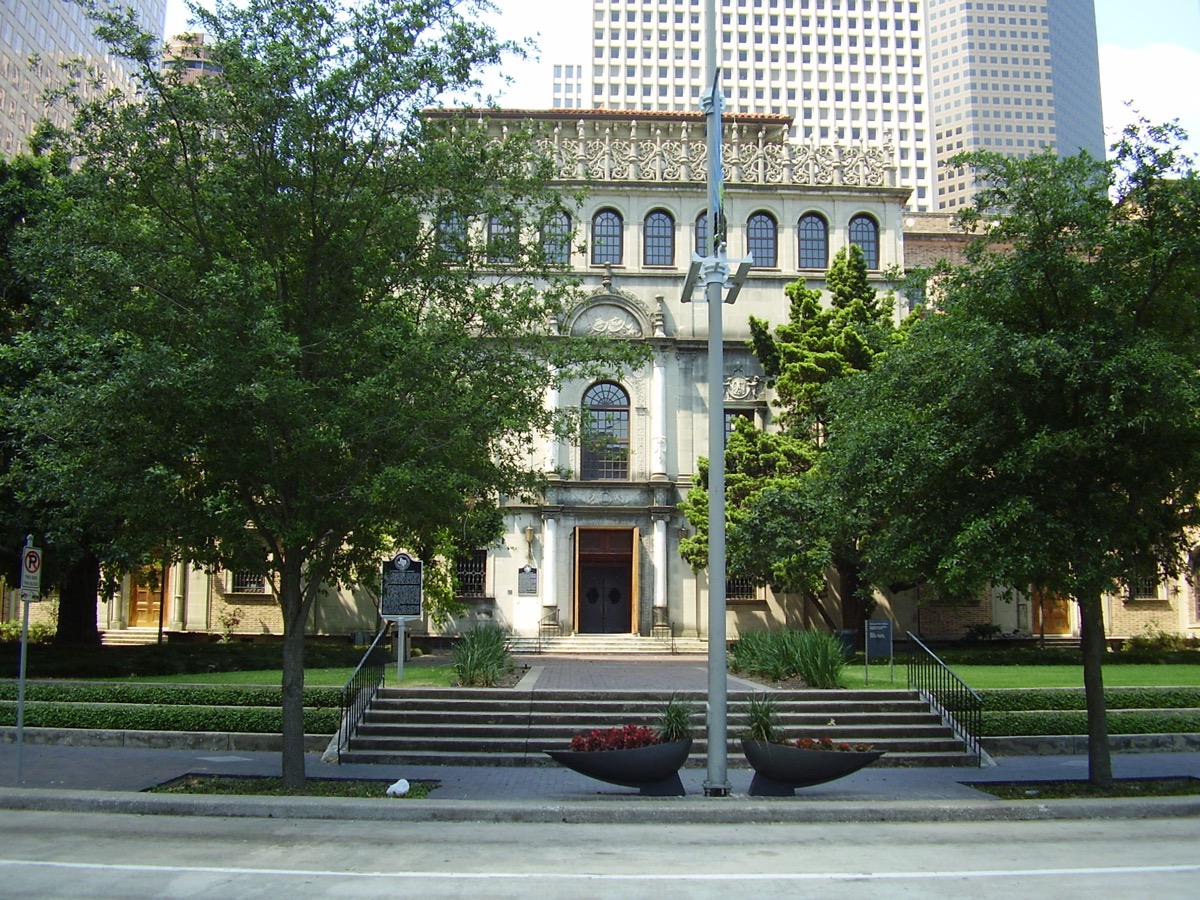
The genealogist Ronald Howard Livingston, who worked through the census and the city directories, finds Cramer first appearing in Houston in 1911, listed as a buttermaker at the Texas Star Creamery. Two years later the entry reads "Cramer J. F. janitor Carnegie library, r. same" — janitor at the old Carnegie library downtown, rooming in the building he cleaned. Houston station KPRC, covering the building's hundredth birthday, dates the opening of the new library to October 18, 1926, a Spanish Renaissance pile that Ralph Adams Cram designed after six months traveling in Spain. Cramer moved into a basement apartment there and stayed.
The way Texas Co-op Power tells it, he walked the three floors after hours with a violin, favoring that same third-floor gallery, playing Johann Strauss. The Blue Danube most of all. His dog Petey, a German shepherd, went with him.
On November 22, 1936, staff arrived in the morning to find the building still locked. Cramer was inside, dead in his basement apartment at 79. No account found gives a cause. His body went north to Kansas, where he is buried at Powhattan Cemetery in Brown County, and the magazine notes that Petey was never located afterward.
The violin started up after that. The music is reported from the space now called the Tudor Gallery, the third-floor room where he is said to have played. Houston's own tourism office lists the building among its haunted places and describes strains of violin, "especially on gloomy days," and the clicking of Petey's toenails on the marble floors. Sheet music turns up scattered across the floor. Lights blink on and off. The elevator arrives empty, and the elevator takes a key to operate.
"I still remember the auras, or senses of his presence," said Douglas Weiskopf, who worked there for years as a senior library services specialist. "And I thought I heard Pete's footsteps a couple of times."
What is strange is how much of Cramer the record actually holds. Baltimore, born 1857, one of five sons of German emigrants. Livingston's genealogy gives him a wife named Ida, five children, and a 1930 census in which he described himself as widowed while Ida was alive and remarried in Ohio. The creamery. The directories Livingston transcribed run year after year, janitor, rooming on site, right through 1935.
The violin appears in none of it. It shows up only in what people hear.