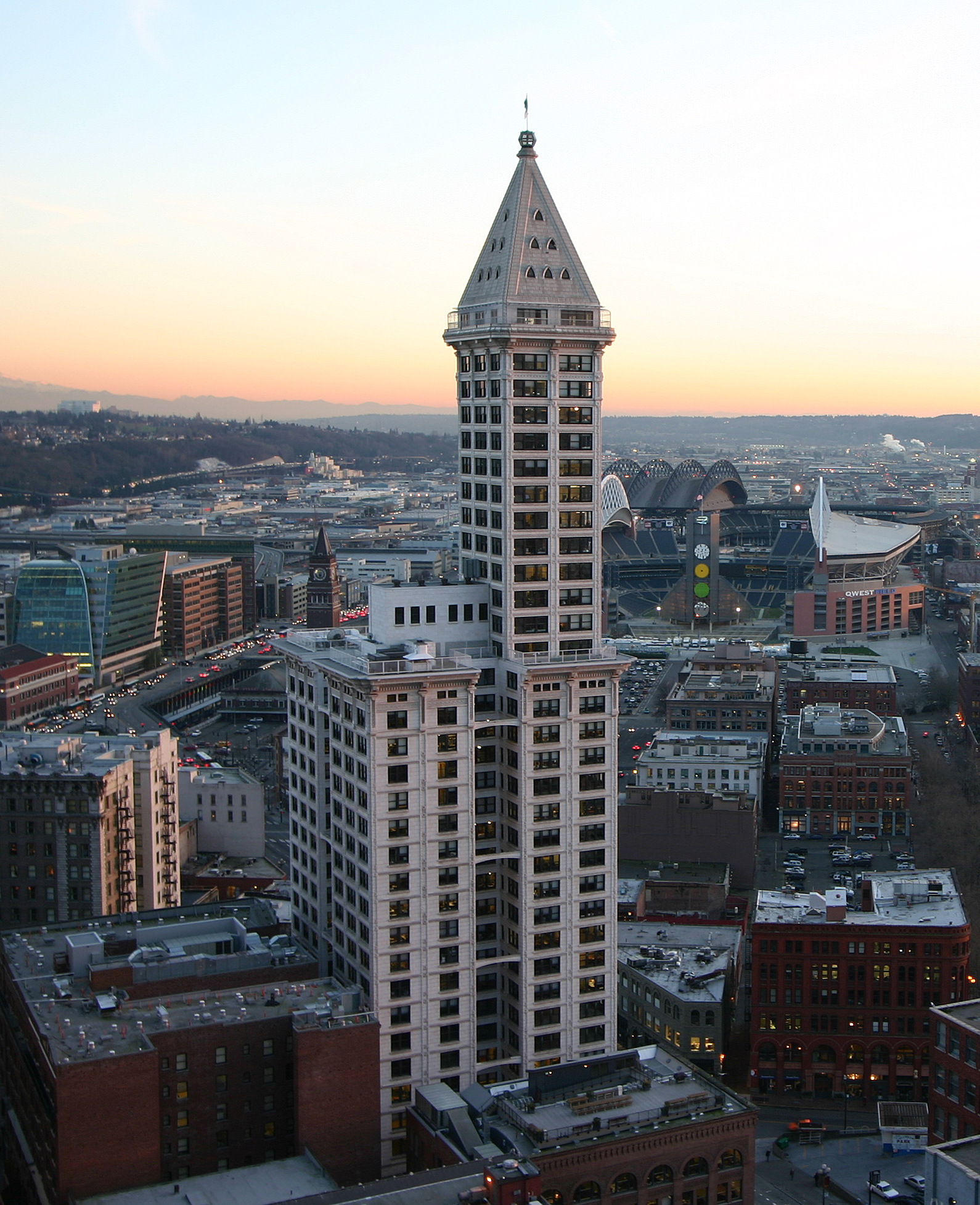
A workman in Seattle's Smith Tower turned around to find Bertha Landes, the city's first woman mayor, inspecting his work. A weeping woman walks the 35th floor. And the restaurant staff downstairs kept meeting an opaque gray man in the wine cellar.
In the 1980s, a workman assembling an exhibit of historical artifacts in a hallway of Seattle's Smith Tower felt someone creep up behind him. He turned around and found an older woman standing over his shoulder, checking his handiwork. Shown a photograph some time later, he recognized her: Bertha Knight Landes, the city's first woman mayor, who ran Seattle from 1926 to 1928 and died in Michigan in 1943.
The writer Bess Lovejoy collected that story for a Northwest ghost guide, and it is the only sighting in the whole building with a witness, a scene, and a name attached to it. It also has no anchor. Nothing on the record puts Landes inside Smith Tower while she was alive. No office, no ceremony, no recorded visit.
The basement account is better witnessed and worse to sit with. A short-lived French lunch restaurant ran on the tower's ground floor in the early 2000s, and its owner told Queerspace Magazine in 2016 that Smith Tower was the most haunted building he had ever been in. His staff, he said, "used to see this man in the wine cellar who was completely opaque, like a human-shaped slab of concrete. There were other ghosts too." He brought in a specialist to look into it and was told the haunting was permanent, because the land the building sits on is "something like a bus stop for ghosts traveling between planes."
Thirty-five floors up is where the visitors go. The observation deck opened on the Fourth of July, 1914, and the room beside it is a Prohibition-themed bar now. A woman in white is said to walk that floor, and people claim to hear her crying through the upper stories. The ghost tours say she went off the observation deck. None of them can say when, or who she was. "Her identity has faded into history," the tour company's own page admits.
No source records her fall. No source records any death at Smith Tower at all, across 112 years. The only documented harm to a body here is a laborer named J.O. Charest, whose foot was crushed by an iron girder on October 15, 1912, and was later amputated.
At most buildings that silence would settle the question. Not this one. HistoryLink's essay on the tower calls it "the subject of more exaggeration and misinformation, on both a popular and scholarly level, than perhaps any other high rise building anywhere." The 35th-floor room was sold for a century as a room furnished by the last Empress of China, when the teak was carved in Philadelphia and the ceiling tiles were fired in Syracuse. Four brass plaques on the first-floor exterior still claim 42 stories. The tower has never had 42 floors.