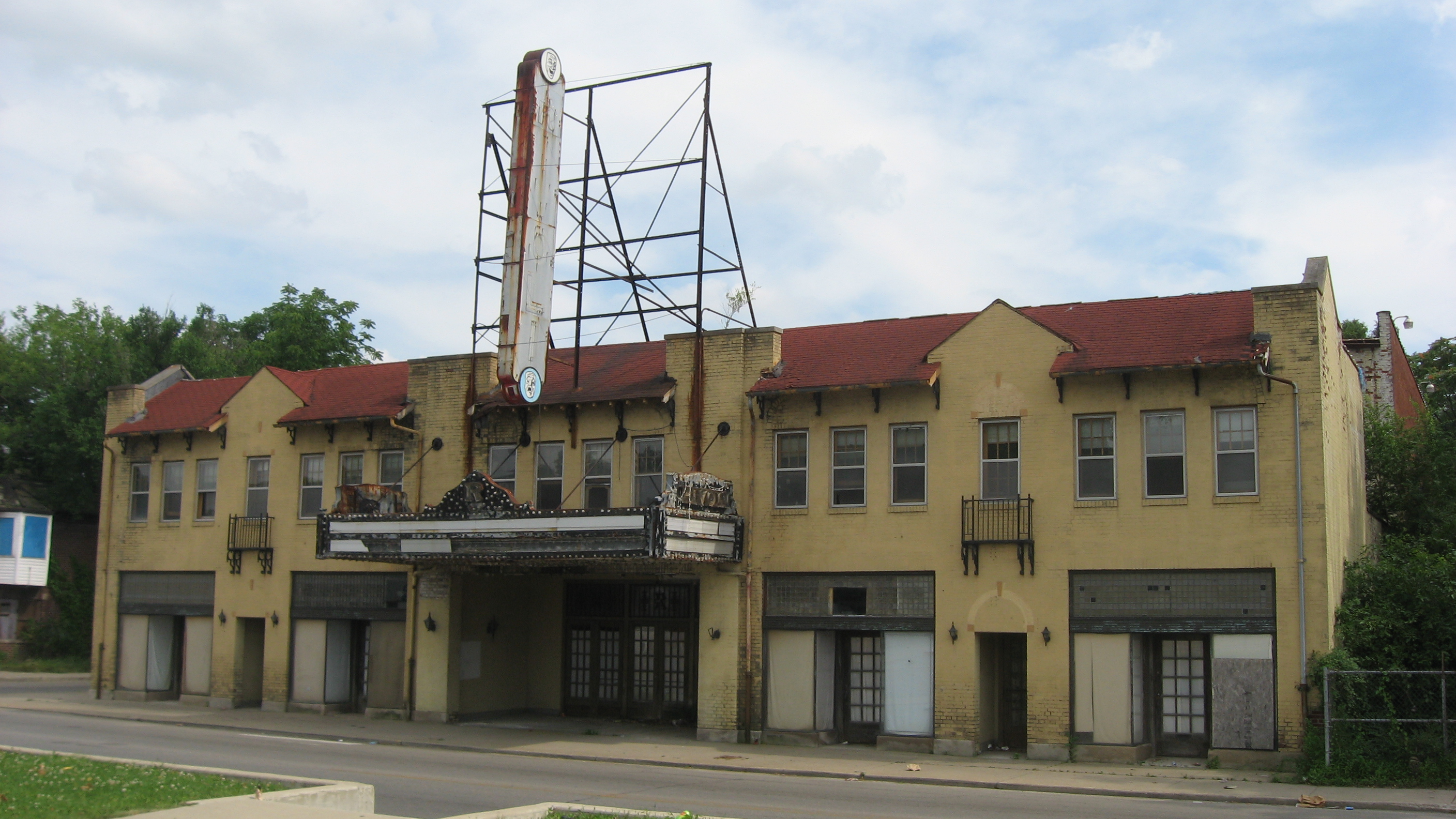
The shuttered Rivoli Theatre on East 10th Street in Indianapolis has a haunting that keeps coming back to one room. Across decades, employees describe the women's powder room doing things it shouldn't: faucets opening, toilets flushing, stall doors swinging in empty stalls.
The strangest spot in the old Rivoli Theatre in Indianapolis isn't the stage or the dark auditorium. It's the women's powder room. Across decades of employee accounts, the same small room keeps doing things it shouldn't: faucets that turn on by themselves, toilets that flush in empty stalls, lights that flicker, stall doors that swing open with no one near them. Different people, different years, same room. It's the corner of the building former staff bring up first, and the consistency of those accounts is what gives the place its hold.
The Rivoli opened on September 15, 1927, with a film called "Painting the Town." It was built under Carl Laemmle Jr. of Universal Pictures as the first Universal-owned theater in Indiana, designed in Spanish Mission Revival style, with red clay tile, faux balconies, and a calligraphic "R" worked into each upper window above the doors. It seated 1,500 and had the largest stage in the city. For a while it was the showplace of East 10th Street.
The faces come second to the bathroom, but staff report them too. A former employee described a man in a hat who turns up "about the second or third row from the front," seated and watching nothing. Another, working there in the late 1970s, said he heard voices and saw people in the theater before the doors opened, and was once yelled at by something he couldn't see in the cleaning room. Past owners told of finding people already seated in the auditorium who "melt away before their eyes." One couple kept coming back: a man in an old-fashioned tux and a woman in a white dress, sitting together before they were gone.
A woman has been reported on the stairs to the projection room. The resident of the apartment above the theater described waking to find the place rearranged overnight, pots and pans moved to the kitchen table, canned goods carried out to the stairs, and figures in the living room. One owner said something with cold arms embraced him in the boiler room while he worked.
The theater closed in 1992 and sat dark. Lore has it the ground itself was the problem: a farmhouse and a family burial plot here long before the marquee went up, the haunting older than the building. No record confirms it. A nonprofit took the property in 2007 and has been slowly restoring it since.
The seats are empty now. People keep finding them filled.