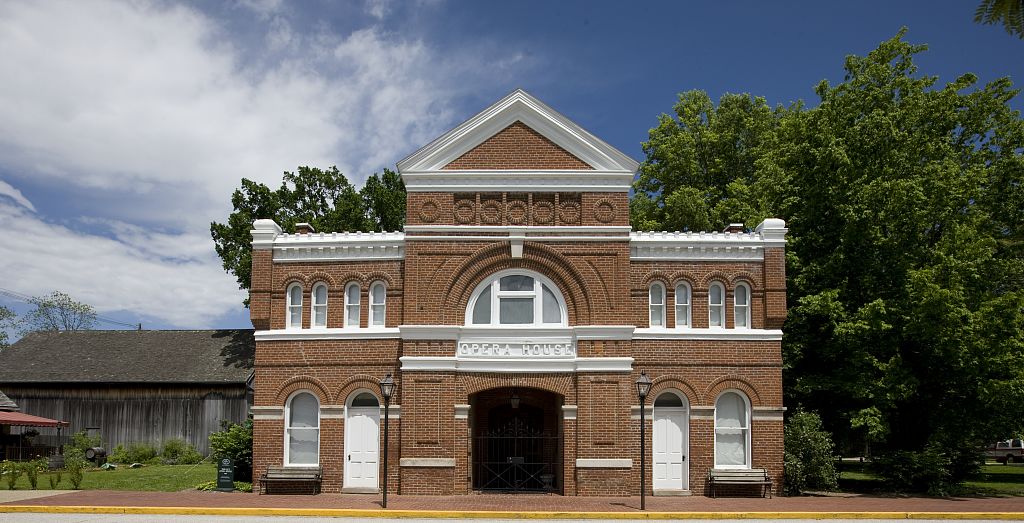
Thrall's Opera House in New Harmony, Indiana, holds two ghosts in two fixed spots. Ghost walks say Eugene Thrall, whose name is over the door, never left the stage he restored. The other is Gus, said to be still working his shift in the dressing room.
Thrall's Opera House sits at 612 Church Street in New Harmony, Indiana, and the man it's named for is said to have never left it. Ghost walks point to the stage and the storage behind it as Eugene Thrall's territory, and call him the venue's eternal guardian. Visitors and investigators report footsteps on empty stairs, a voice on a stage with no performer, and a figure in period dress near the boards that watchers take for Thrall himself.
He earned the building twice over. Thrall co-owned it from 1867, then bought out the rest in 1888 and remodeled the front into a Victorian opera house, with cherry paneling, arches over the windows and door, and a curved balcony. His name went up over the entrance, where it remains. The stage he restored hosted performances until about 1910.
But the place was many things before Thrall arrived, and that is the strange part. The Harmonists built it in 1824 as a dormitory for their unmarried men, the last thing the religious commune put up before selling the town and leaving for Pennsylvania. When Robert Owen bought New Harmony for his own secular experiment, his followers moved into the building and packed it tight, 16 families across its 16 rooms, before that second utopia failed too. After the opera house years it ran as a nickelodeon, then a gas-station garage, before Indiana acquired it in 1964 and restored the Victorian theater. Two utopian movements rose and collapsed inside the same brick walls, and a town grew up calling itself one of the most haunted in the Midwest, long before anyone fixed the haunting to this address.
The building is open today as an event venue, restored to its Victorian elegance and rented for weddings and concerts, seating 160. The official operator says nothing about ghosts. That part of the story belongs to the lantern-lit ghost walks that meet out front, and to Joni Mayhan, a paranormal investigator who lives in town and wrote a 2017 book on its hauntings.
There is a second ghost, and he keeps to himself. Tour guides tell of Gus, a former maintenance man whose territory is the ladies' dressing room, where the running town joke is that he never clocked out. No record names a Gus who worked or died at the building. He has no documented history at all, no death date, no grave to check. He exists only in the telling, somewhere backstage, keeping a shift that ended long ago.