TLDR
Nineteen patriot militia held Black Rock Fort against 2,600 British troops on July 5, 1779, spiking their own cannons when ammunition ran out. Now called Fort Nathan Hale, the site has generated over a century of reports of green glowing orbs floating between the Revolutionary War and Civil War fortifications, phantom footsteps on the drawbridge, and an EVP recording where a spirit requested "La Bamba."
The Full Story
Nineteen men held a rock fort against 2,600 British soldiers until they ran out of ammunition. Then they spiked their own cannons, hammering metal into the touchholes so the enemy couldn't fire them, and surrendered. That was July 5, 1779. The fort fell. The defenders were captured. And something green has been glowing on those ramparts for over a hundred years.
Black Rock Fort sat on a rocky ledge on the eastern shore of New Haven Harbor, first fortified in 1659 when the New Haven Colony erected earthworks and a battery. By the time of the Revolution, it was a small but critical defensive position. Lieutenant Daniel Bishop (some accounts name Lieutenant Pierpont) and his militia were all that stood between Commodore Sir George Collier's warships and the city. Major General William Tryon commanded the land forces: the 23rd Royal Regiment, the Landgrave's Hessian Regiment, and a Tory unit called "The King's Americans."
The defenders held for hours, pouring cannon fire into the British ranks. When the ammunition ran dry and the cannons were spiked, Tryon's forces captured the fort, burned the barracks, and marched into New Haven. Over the next two days they burned homes, killed patriots, and (according to multiple accounts) got thoroughly drunk on local rum. When they finally withdrew, they reportedly declared the city "too pretty to burn," despite having already done considerable damage.
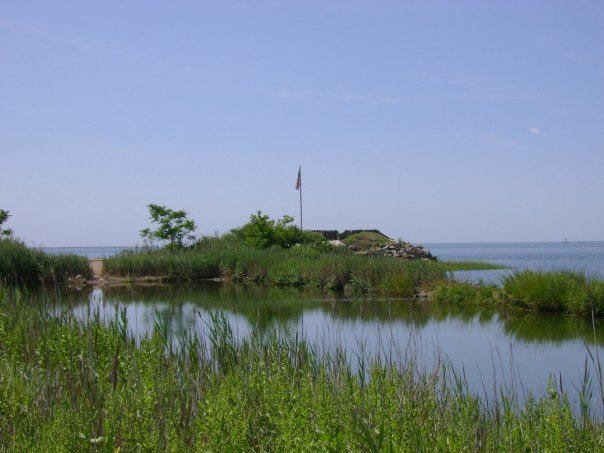
The fort was reconstructed between 1807 and 1812 with six guns under the second system of US fortifications and renamed Fort Nathan Hale, after Connecticut's martyred spy hero. Federal guns kept British warships out of the harbor during the War of 1812. Then, in 1863, concern over Confederate raiders prompted construction of Fort Nathan Hale II alongside the original. This Civil War fortification was imposing: earthen ramparts, five bombproof bunkers, a moat crossed by a drawbridge, and eighteen heavy-caliber guns. It was completed in 1866. It never saw combat.
The ghosts apparently don't know the war ended.
Green glowing orbs are the most consistent report at Fort Nathan Hale. They float silently across the property, drifting between the reconstructed Revolutionary War fort and the Civil War earthworks. People have been seeing them for more than a century, long before ghost hunting was a hobby or green orbs were a paranormal cliche. A local resident who camps and visits the beach there regularly put it simply: "I've seen and heard voices and the green orb."
Figures appear on the battlements. Some visitors describe Continental-era soldiers. Others see Civil War uniforms. The shapes move across the ramparts and vanish when approached, or disappear into the walls of the bombproof bunkers. Phantom footsteps cross the wooden drawbridge when nobody is on it. Voices echo through the tunnels and earthworks with no one around.
The most entertaining piece of evidence comes from May 2015, when a visitor captured an EVP recording at the fort. A male voice whispered the visitor's first name. Then, in response to the question "what song should I sing?", a voice replied clearly: "La Bamba." Whatever walks the ramparts of Fort Nathan Hale has unexpected taste in music.
Author Garrison Leykam posed the question in his book Haunted New Haven: "What are those voices trying to tell us at Fort Nathan Hale?" Paranormal researchers describe the site as a "layered haunting," soldiers from different centuries coexisting in the same space. The Cosmic Society of Paranormal Investigation, one of Connecticut's most established paranormal groups, has documented the location and noted "psychic photos" captured at the fort.
The Fort Nathan Hale Restoration Project maintains the twenty-acre park, and over 7,000 visitors tour the site annually. Both Black Rock Fort and Fort Nathan Hale have been meticulously reconstructed, complete with drawbridge, moat, ramparts, powder magazines, and bombproof bunkers. The site was rededicated on July 5, 1976, exactly 197 years after the British attack.
The history alone makes Fort Nathan Hale worth visiting. Nineteen men against an invasion force, spiking their own cannons rather than let the enemy use them. That's a story that would stick to any piece of ground. Add a century of green lights floating over the ramparts, and the ground starts to feel like it remembers.
Researched from 13 verified sources. How we research.