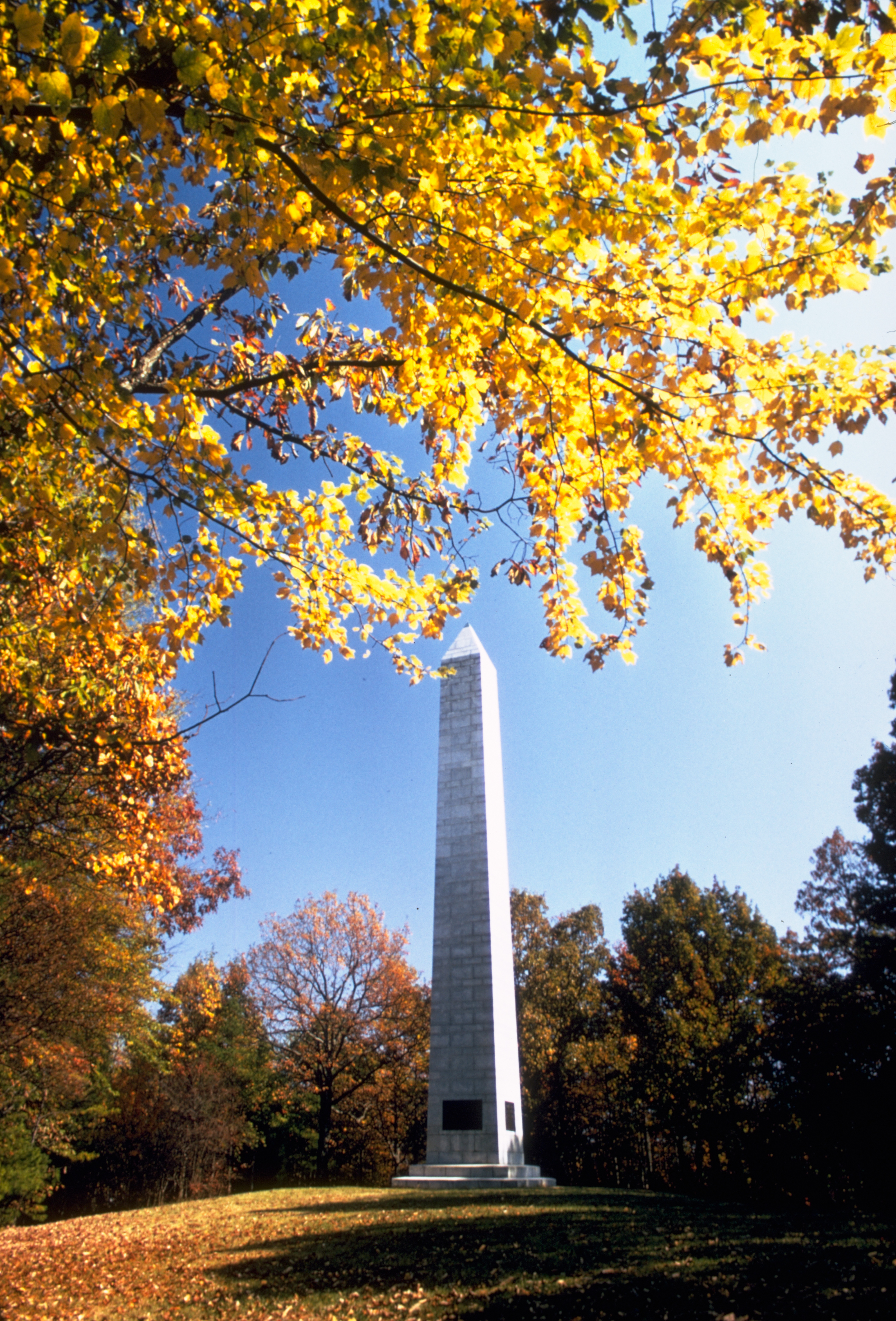
Two Revolutionary War reenactors laid stones on Major Patrick Ferguson's grave-cairn at Kings Mountain, an old Scottish custom for keeping the dead in the ground. Then a voice in a thick Scottish brogue spoke up behind them, laughed, and walked off into the trees.
At Kings Mountain National Military Park, near Blacksburg, South Carolina, a low pile of stones sits behind a granite grave marker. One evening two Revolutionary War reenactors camping on the battlefield walked up to it and did what visitors have done there for two centuries: each dropped a stone on the pile. As they turned to leave, both of them felt someone standing close behind, near enough to touch. They figured it was a park ranger. When they looked, they saw a man dressed like a British major from another century, who said in a thick Scottish brogue, "It doesn't always work, my lads," laughed, and faded into the dark trees.
The grave belongs to Major Patrick Ferguson. He was a Scot, born in Aberdeenshire in 1744, and one of the finest marksmen in the British Army; he had invented his own breech-loading rifle. On October 7, 1780, he stood on this rocky summit commanding about 1,100 Loyalist militia against roughly 900 Patriot "Overmountain Men," and he was the only regular British soldier on the whole field. Every other man fighting, on both sides, was American. The battle lasted about 65 minutes. Ferguson was shot from his horse and dragged behind the Patriot line by a foot caught in his stirrup, and the Loyalists surrendered soon after he was dead. They buried him where he fell.
Ferguson got a grave, which was more than most. The dead were dropped into shallow pits after the fighting, and in 1815, when a battle veteran named Dr. William McLean brought survivors back to gather the remains for a monument, he found human bones lying out on top of the ground, where animals had opened the graves and pulled the men back into the open air.
The stones on Ferguson came later. Laying a stone on a grave is an old Scottish custom, one mourners use to mark a visit, and, in the older telling, one meant to weigh the dead down and hold them where they were put. People have been adding them to the major for generations, and the cairn keeps growing behind his marker, which was dedicated on October 7, 1930, the anniversary of the day he died.
So every stone on that pile was placed, on some level, to keep the major in the ground. And the story goes that the major came up behind two men who had just laid theirs, in his own Scottish accent, to let them know it hadn't taken.