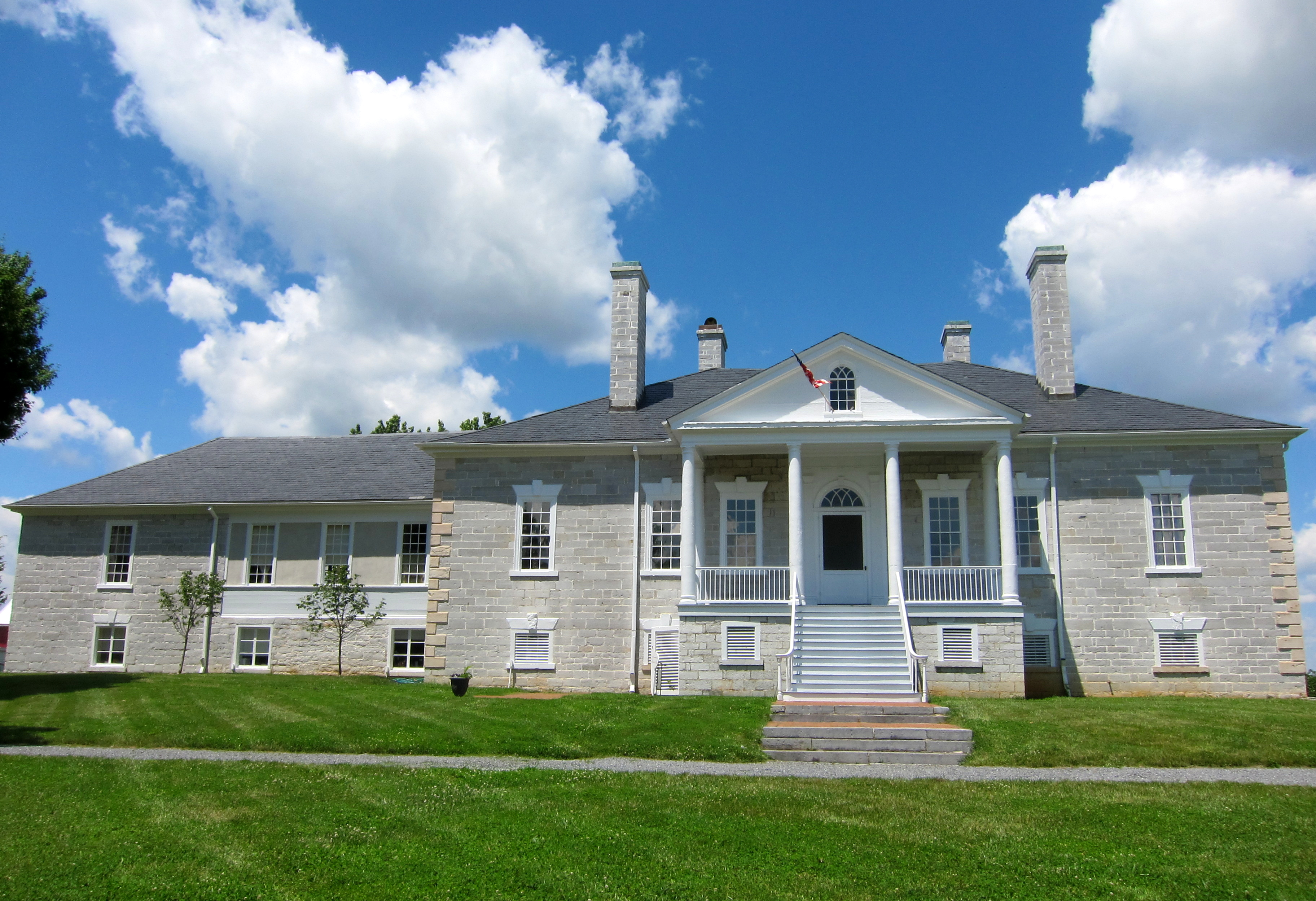
Belle Grove holds a 1797 limestone manor, a murdered mistress, and a Confederate general dying in the old nursery.
A visitor walking through Belle Grove once glanced into the room where Confederate Major General Stephen Dodson Ramseur died and saw a circle of Civil War soldiers, blue and gray together, standing around a figure on a bed. No reenactor was on the property that day. Staff confirmed it. The Southern Spirit Guide writeup of the sighting is one of the cleaner ghost stories you'll find in Virginia, partly because the historical scene it mirrors actually happened in that house on October 20, 1864.
Belle Grove sits in Middletown in the Shenandoah Valley. Construction began in 1794 and finished in 1797, with the stone quarried right out of the property. The builder was Major Isaac Hite Jr., a Revolutionary War veteran. His wife was Nelly Conway Madison, sister of the future president. Thomas Jefferson passed architectural suggestions to the project through James Madison, so there's a direct line from Monticello to the manor's final design. Madison himself stayed in the older "Old Hall" structure during his 1794 honeymoon. The 1815 addition gave the house the 100-foot façade it still wears. At its peak the estate covered 7,500 acres.
It was a working plantation. The Hite family enslaved more than 270 people at Belle Grove between 1783 and 1851. Some of the first arrived as wedding gifts from James Madison Sr.: Jerry, Jemmy, Sally, Milley, Eliza and her five children, Truelove and her four children. There's still an enslaved burial ground on the property. One of the ghost stories that gets reported here, in the Southern Spirit Guide account, is singing heard from that cemetery. It's the only piece of Belle Grove's haunting that explicitly belongs to the people held there.
The first big violence to attach itself to the house was a murder. John and Benjamin Cooley bought Belle Grove on November 15, 1860. Benjamin's new wife, Hettie Ann Shipley, was a widow from Maryland. On February 26, 1861, while Benjamin was off delivering cattle to Alexandria, Hettie was attacked at the house. Sources disagree on the where and the weapon. M.A. Kleen's account has Harriet Robinson striking her in the kitchen with an iron shovel and dragging her to the smokehouse. Another version puts an ax in the basement. What everyone agrees on: James William Gordon, brother-in-law to Benjamin Cooley (married to Benjamin's sister Rebecca, who lived at Belle Grove with their four children), smelled "something burning like wool" near the mansion. The smell led searchers to Hettie's body. She didn't die that night. She lingered four days and died on March 2, 1861.
Harriet Robinson, who ran the Cooley household, was arrested on March 15 and convicted of first-degree murder. Sources split on whether she was enslaved or a free woman of color employed by the Cooleys; the Northern Virginia Daily and Kleen call her free, the academic Hettie Cooley exhibit and Southern Spirit Guide call her enslaved. The case against her was almost all motive. She'd said before the marriage, "If a mistress should ever enter the house, she would not live long." She and Hettie had a documented history of fights. The death sentence never happened. Harriet announced she was pregnant, and the Frederick County sheriff couldn't find women willing to examine her. She disappeared when Union forces moved into the Shenandoah Valley.
For decades after Hettie's death, residents said a white mist would rise from the basement fireplace, drift through the door, and float toward the smokehouse. Whatever the truth of the attack, the ghost story keeps retracing the same path her body was supposedly moved along.
Three years and eight months after Hettie died, a second wave of violence hit. On the night of October 18, 1864, the tents of Philip Sheridan's 32,000-strong Union Army of the Shenandoah covered the Belle Grove fields. Sheridan was using the manor as his headquarters. Before dawn on October 19, Confederate Lieutenant General Jubal Early launched a surprise attack. The Battle of Cedar Creek goes by another name in some records: the Battle of Belle Grove. Roughly 47,210 soldiers fought there. The casualty count came to about 7,682.
Ramseur was 27. He'd been hit in the arm, had two horses shot from under him, and was on a third when a bullet went through both his lungs. Soldiers of the 1st Vermont Cavalry captured him and carried him to Belle Grove. He'd learned the day before the battle that his wife Ellen had given birth. He never knew it was a daughter, Mary Dodson Ramseur. He was laid in a room locally described as the old nursery, the room Isaac and Nelly Hite had once kept for their babies, though neither the National Park Service nor Belle Grove's own history page confirms the room. The nursery framing is local tradition. Union Captain Henry du Pont, his West Point classmate, was at the bedside. Other accounts add George Armstrong Custer and other classmates in Union blue; du Pont is the firmest name. Ramseur's last words, by widely repeated tradition: "Bear this message to my precious wife. I die a Christian and hope to meet her in heaven." He died in the early morning hours of October 20, 1864.
A 1920 monument from the North Carolina United Daughters of the Confederacy stands at the property entrance. Its cannonballs were stolen in the 1960s and replaced. It was rededicated on October 20, 2014, with restored stones and a new bronze plaque.
The other reported sightings have a quieter quality. A carpet delivery man arrived on a Sunday and was let in by a silent woman in a long skirt who pointed to where the carpets should go. He later called the museum director, who told him no one had been at the house that day. Voices and odd noises get reported regularly. A "lady in white" sometimes turns up in tour accounts, though that one's thinly sourced compared to the Hetty mist and the Ramseur tableau.
Francis Welles Hunnewell bought Belle Grove in 1929 and willed it to the National Trust for Historic Preservation when he died in 1964. It opened as a museum in 1967. It's a National Historic Landmark and part of Cedar Creek and Belle Grove National Historical Park, established by Congress in 2002. The limestone manor opens for tours, the battlefield is mapped for visitors, and the enslaved burial ground is where, by one account, you can still hear singing.
The plaque on the rededicated Ramseur monument, set into stones that have stood at this entrance since 1920, marks the spot where a 27-year-old general was carried in with a one-day-old daughter he would never meet.