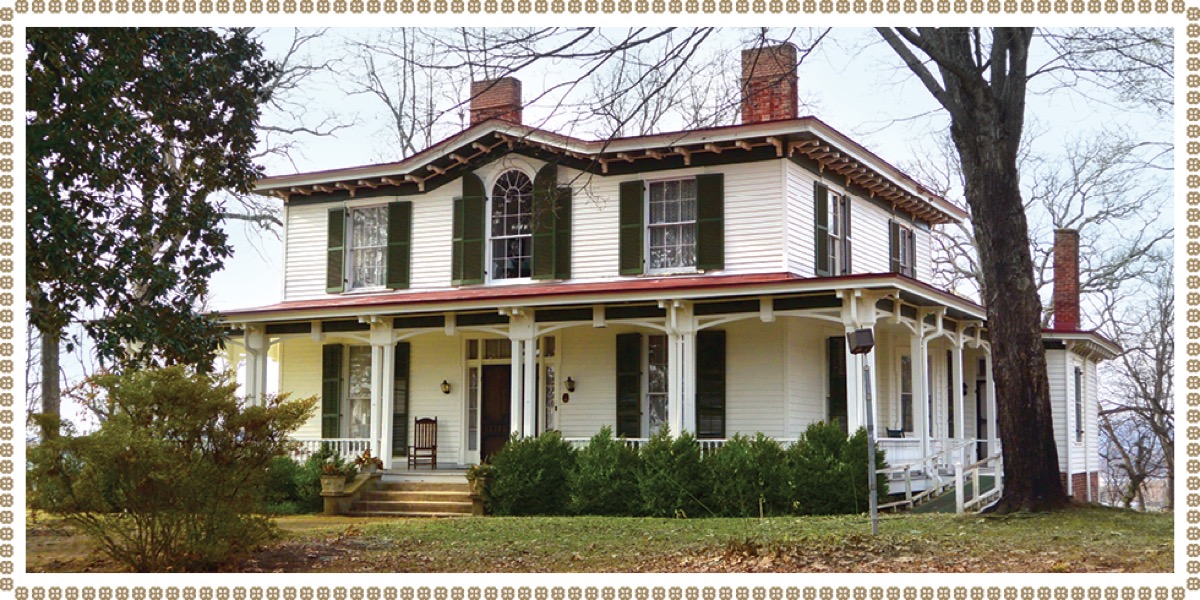
The ghost most often seen at the Baker Peters House in Knoxville, Tennessee is Abner Baker, leaning on the upstairs staircase. His father, the doctor who built the place, was shot dead behind a barricaded bedroom door here in 1863, and Abner was lynched two years later.
A thick interior door in the Baker Peters House, in Knoxville, Tennessee, has two bullet holes through it, set at the height of a man standing inside a small room. Dr. James Harvey Baker was that man. In June 1863, Union soldiers came down Kingston Pike during a raid on Knoxville and reached his Greek Revival brick house, and Baker barricaded himself in his upstairs bedroom. They fired through the door and killed him. Joan Markel, a historian who curated Civil War exhibits at Knoxville's McClung Museum, calls him likely one of the first people killed by Union forces in Knox County.
The door outlived him. The current owners kept it and moved it downstairs, into the same floor where a dental office has run since 1989, and the holes are still open enough to put a finger through.
The ghost people report, though, isn't the doctor. It's his son. Abner Baker had been away serving in the Confederate army, and when he came home, in 1865, he shot and killed a man named William Hall. That same night, a Unionist mob broke into the jail and hanged Abner from a tree in downtown Knoxville. Two Bakers, father and son, killed two years apart by the same divided city.
Staff and visitors say Abner stayed. They describe him leaning on the second-floor staircase railing, and standing at the upstairs windows, watched from the lawn below. Others tell of a cold hand closing on a shoulder from behind, and the person turning to find no one there. Back when the upper floors ran as a jazz club, tenants blamed Abner for glasses dropping and shattering, lights going on and off, objects sliding out of place, whispering in empty rooms.
The legend tells it neater than the record does. In that version, Baker ran a field hospital for wounded Confederates, an informant sold him to the Union, and Abner came home to hunt the informant down. Historians don't back it. There's no evidence the house was ever a hospital. William Hall worked for the court clerk and had fought for the Union, and the earliest accounts put the killing down to an old grudge, not a father's death. That link came later, in the retellings.
The historical marker out front gets it wrong too. It says Baker died in 1864, treating wounded Confederate soldiers. He died in 1863, behind a barricaded door, treating no one.
The marker embellishes. The legend embellishes. The door doesn't. Two holes, a man's height, in a small upstairs room — the one piece of the story still solid enough to touch.