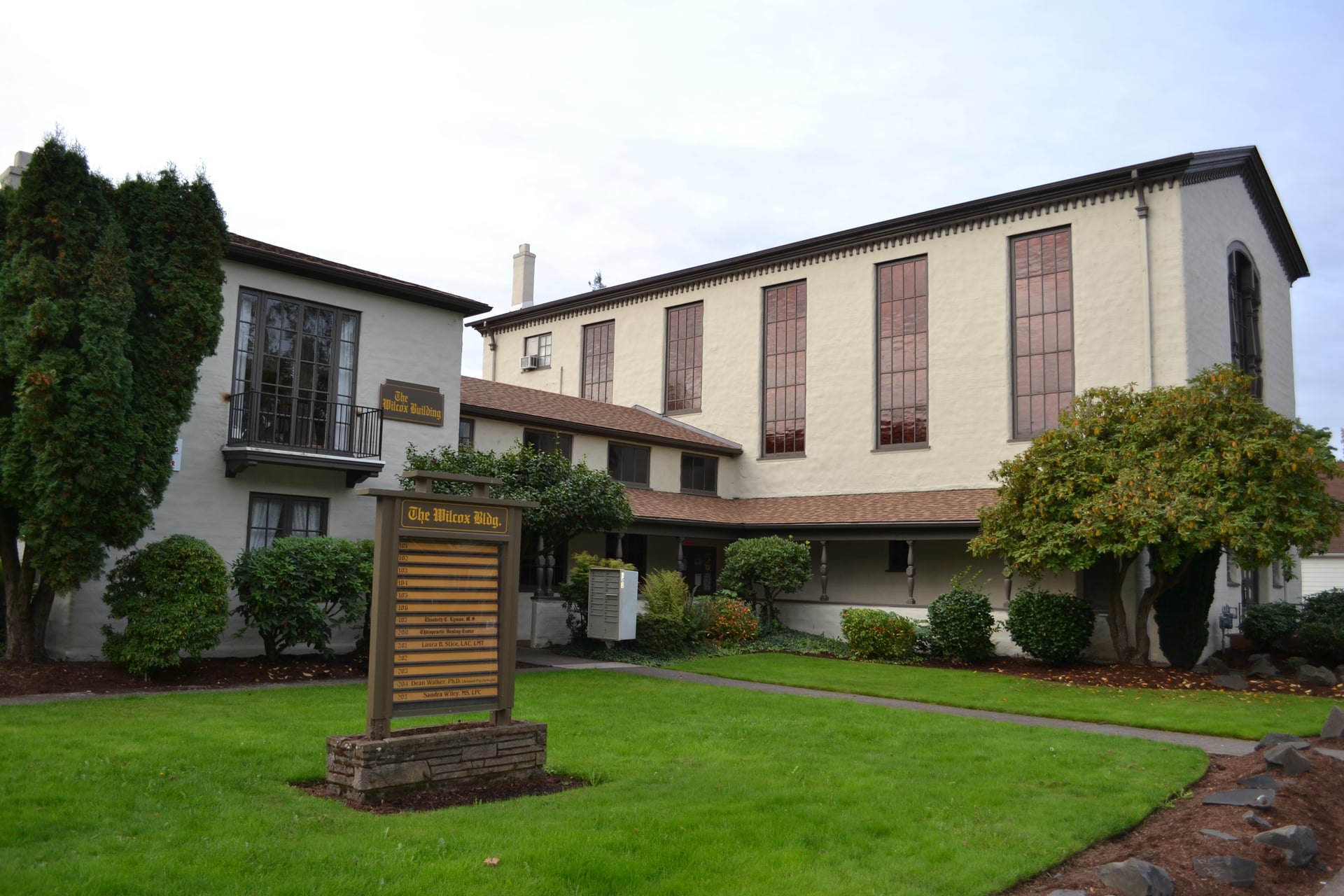
The Art House in Eugene, Oregon has worn three lives in one century: a 1925 church, a mortuary, then a movie house. The room has always sat people in dim rows, and patrons say a gentle presence lingers, content to watch the film.
At the Art House in Eugene, Oregon, the lights go down for a foreign film and, every so often, someone feels a presence settle into a nearby seat. The accounts agree on the strange part: it isn't frightening. Whatever it is seems to want to watch the movie too.
The building has done this work before. It sits people in rows, in a dim room, and asks them to face forward — and it has been asking that of people for a century, across three very different lives.
It went up in 1925 as the First Congregational Church, designed by W.R.B. Willcox, the first head of the University of Oregon's school of architecture. A Spanish Mission-style box of stained glass and hand-stenciled woodwork on the corner of 13th and Ferry, in the college district near campus. In 1956 it became the McGaffey and Andreason Mortuary. For about two decades the same room that had held a praying congregation held caskets, with the bereaved sitting in front of them in the quiet.
The Bijou Art Cinemas opened in the building on October 17, 1980 — two auditoriums, 104 seats and 95. It ran some forty years before the pandemic closed it in 2021. The building sat dark for about two years, then reopened in 2023 as the Art House: a café and bar with movies on two screens, live music staged in the old chapel hall, and a courtyard built around a fountain.
The lore is plain, and the local press keeps it light, calling the building "questionably haunted." The place is thought to be haunted for one reason: it once was a mortuary. The ghosts, by every account, are gentle. "The ghosts here seemed to be friendly," one tourism page puts it, "interested more in enjoying the entertainment than frightening guests." That note lives in tourism pages and haunt directories, not in any signed witness account. Nobody puts a name to it. There's no dated incident, no investigation, no witness on record — only the feeling of someone in the next seat when the room goes dark.
Three uses, one architecture. The congregation prayed, the mourners sat over their dead, and an audience now watches the screen, all of them facing forward in the same dim room, in rows. The local paper said it best: "Any good movie theater should be able to give its patrons a chill. But next time you feel a tingle run up your spine at the movies, think twice about where that feeling could be coming from."