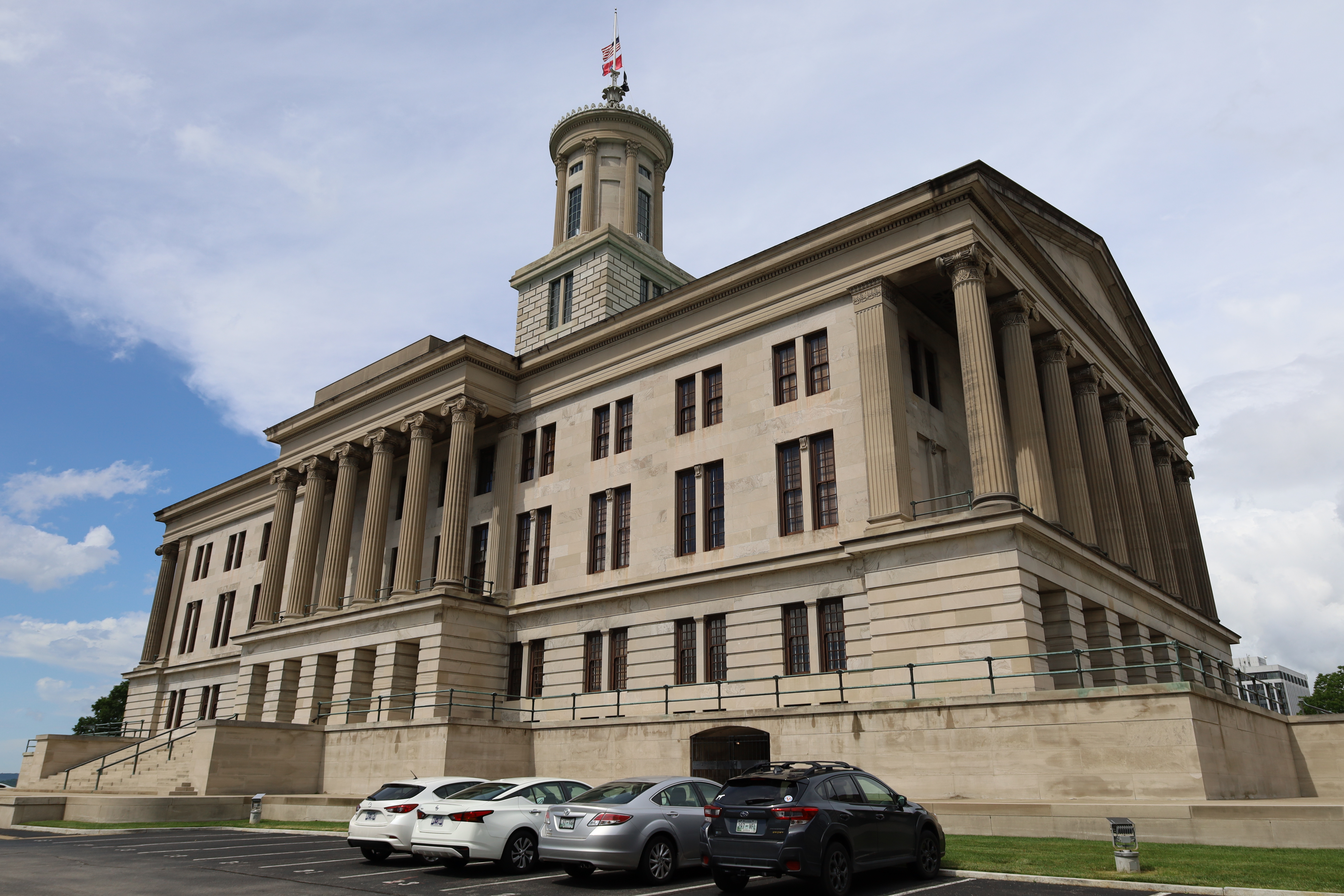
Two men are bricked into opposite corners of the Tennessee State Capitol in Nashville, the only statehouse with bodies in its walls. The legislative librarian hears them arguing after 9 p.m., cursing across the building. Historians say the feud never happened.
Eddie Weeks works late in the second-floor library of the Tennessee State Capitol in Nashville, and some nights, around 9 p.m., two men start shouting. He can't see them. The sound rises from the direction of the north foundation wall, where no one is standing — a raised, furious back-and-forth that carries after hours through the building. Weeks is the Capitol's own legislative librarian, and he's the one who put words to it: "two men engaged in a heated argument…yelling and cursing in a most heated manner."
There are, as it happens, two men in the walls of this building.
The Tennessee State Capitol is the only statehouse in the country with human bodies sealed inside its own masonry. William Strickland, the Philadelphia architect who designed it, is entombed in the northeast corner. Samuel Morgan, who chaired the commission that supervised the construction, is entombed in the southeast — roughly the opposite end of the same structure.
Strickland drew the place in the Greek Revival style, and its cornerstone went down on July 4, 1845. He is said to have called it his greatest achievement. The legislature set aside the wall vault at his request; about five weeks later, on April 7, 1854, he died suddenly, with the Capitol still years from done. It wasn't finished until December 1859. Morgan outlived him by decades, died in 1880, and on Christmas Eve of 1881, more than a year after his death, was walled into the far corner.
The story that grew up around them is a grudge. The two are said to have fought bitterly across the years of construction, over money and design and who was really building the thing, and neither one ever let it go. The argument Weeks hears is supposed to be that fight, running long after both men were bricked into the same building at opposite ends.
There's a quieter one out on the lawn. A ghost-tour operator says visitors most often see James K. Polk — buried on the northeast grounds with his wife Sarah — kneeling in a dark suit at the base of his tomb, an image that thins and evaporates as they walk toward it.
But the grudge is the part that doesn't hold up. When the Nashville Scene went looking into the quarrel the whole haunting depends on, Jeff Sellers of the Tennessee State Museum told them the popular story is unfounded, that by the record, Strickland and Morgan got along quite well. Which leaves two men sealed in opposite corners of the same building, cursing each other across its width for 150 years, over a fight the historians say never happened.