About This Location
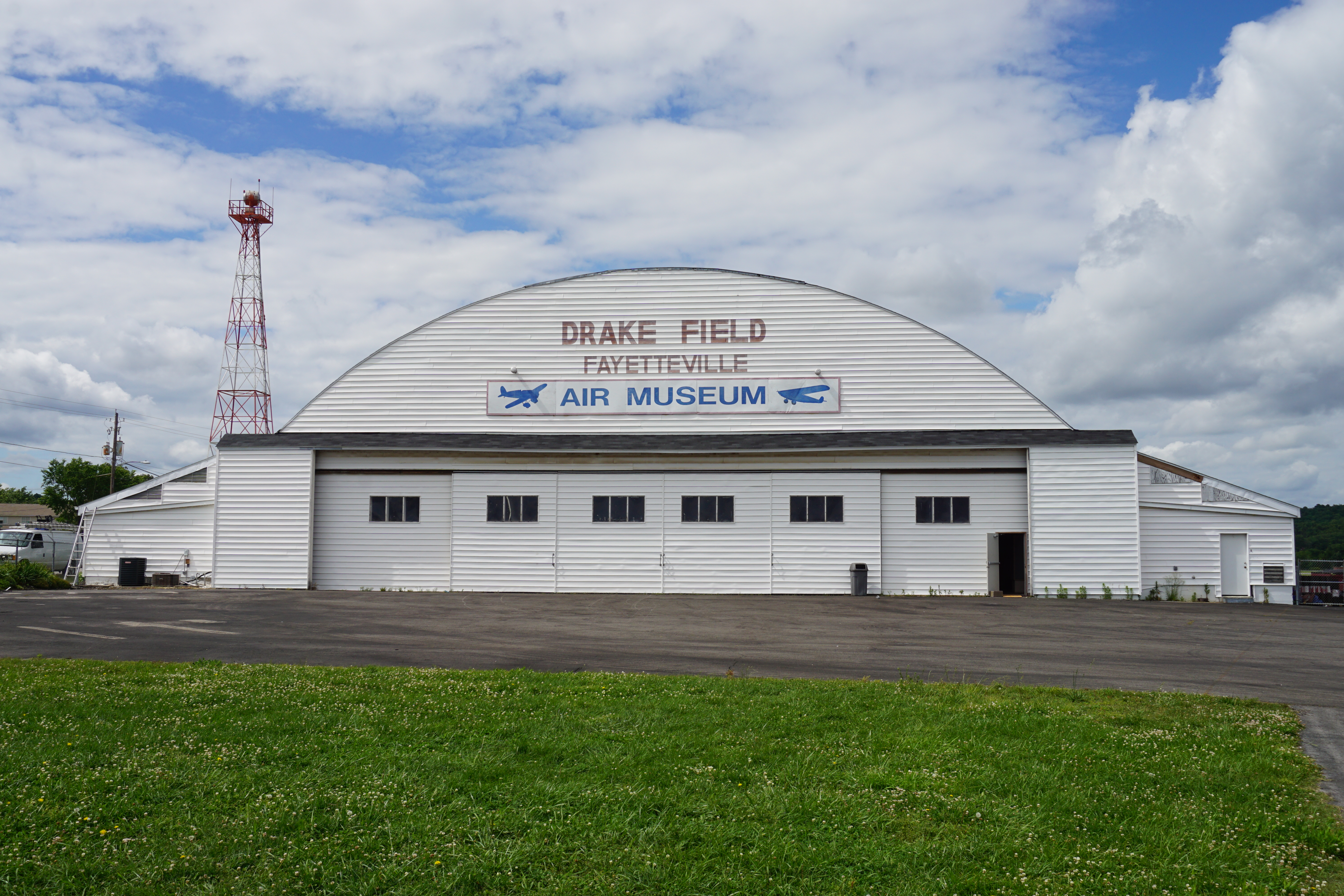
Housed in one of the nation's few remaining all-wood WWII-era structures at Drake Field, this museum preserves vintage aircraft and military artifacts.
The Ghost Story
The Arkansas Air and Military Museum occupies the White Hangar at Drake Field in Fayetteville, one of the nation's few remaining all-wood structures from the World War II era. The airfield originated in 1929 when Dr. Noah F. Drake, a professor of geology at the University of Arkansas, donated $3,500 to purchase land for Fayetteville's first airport. The field was renamed Drake Field in his honor on April 14, 1947. During World War II, the Army Air Corps established the 305th College Training Detachment at Drake Field to train aviation cadets. With wartime metal shortages preventing conventional construction, Henry George, the city's engineering assistant, designed an all-wood hangar that could hold forty aircraft. Construction began on May 1, 1943, employing no more than four carpenters and three helpers, with George himself serving as plumber, electrician, and welder. The total cost was approximately $16,000, funded entirely by the City of Fayetteville. The hangar was formally dedicated on June 28, 1944 — though the 305th College Training Detachment used the facility for only two days before their contract expired and they departed Fayetteville permanently.
After the war, the hangar served as headquarters for Scheduled Skyways, one of Arkansas's earliest commuter airlines, founded by aviation pioneer Raymond J. Ellis. In late 1985, Marilyn Johnson, chairperson of Fayetteville's state Sesquicentennial Committee, conceived the idea for an aviation museum. In January 1986, a group of eight aviation enthusiasts — Ray Ellis, brothers Bob and Jim Younkin, Floyd Carl, Jim McDonald, Larry Browne, Ernest Lancaster, and Bob McKinney — founded the Arkansas Air Museum. After more than $120,000 in renovations, the museum opened in August 1986. The hangar was placed on the Arkansas Register of Historic Places in 1996. In 2007, Sam Walton's first airplane, an Ercoupe 415C, was acquired for the collection. The museum merged with the Ozark Military Museum in 2012 to become the Arkansas Air and Military Museum, now housing over 2,000 artifacts and the state's largest aviation collection.
The museum is considered one of the most continuously haunted places in Northwest Arkansas. At least one male spirit, believed to be a World War II-era aviator, makes regular appearances throughout the facility. Sally Ebbrecht, the museum's Acting Executive Director who worked at the museum for over twenty years, recounted her most vivid encounter in March 2000. She saw what appeared to be a man dressed in a pilot uniform — wearing a pilot-type hat, a medium blue jacket, dress pants, and dress shoes. "It just brought me to a halt," Ebbrecht recalled. The figure vanished before she could approach him. Ebbrecht came to believe the ghost may be the spirit of Ray Ellis, the Arkansas aviation pioneer who co-founded the museum and whose commuter airline Scheduled Skyways once operated from the very same hangar.
A previous museum director's wife also spotted a ghost-like figure dressed as an aviator inside the wing shop, where aircraft are restored. Additional staff members and visitors have reported sightings of silhouettes and unexplained figures moving through the hangar over the years. Aircraft instruments have been discovered switched on inside locked hangars overnight, despite no one having access to the building. The spirit is consistently described as appearing in aviator dress and frequenting the museum library, where the aviation history collection is kept. Ebbrecht characterized the ghost as harmless — startling employees on occasion but never threatening.
The museum sits on a site where generations of pilots trained, flew, and in some cases lost their lives in the service of American aviation. Whether the spirit belongs to Ray Ellis checking on the museum he helped create, a WWII cadet from the 305th who never returned from training, or an unknown aviator drawn to the vintage aircraft that fill the hangar, the White Hangar appears to have retained something of the pilots who once called Drake Field home.
Researched from 9 verified sources including historical records, local archives, and paranormal research organizations. Learn about our research process.