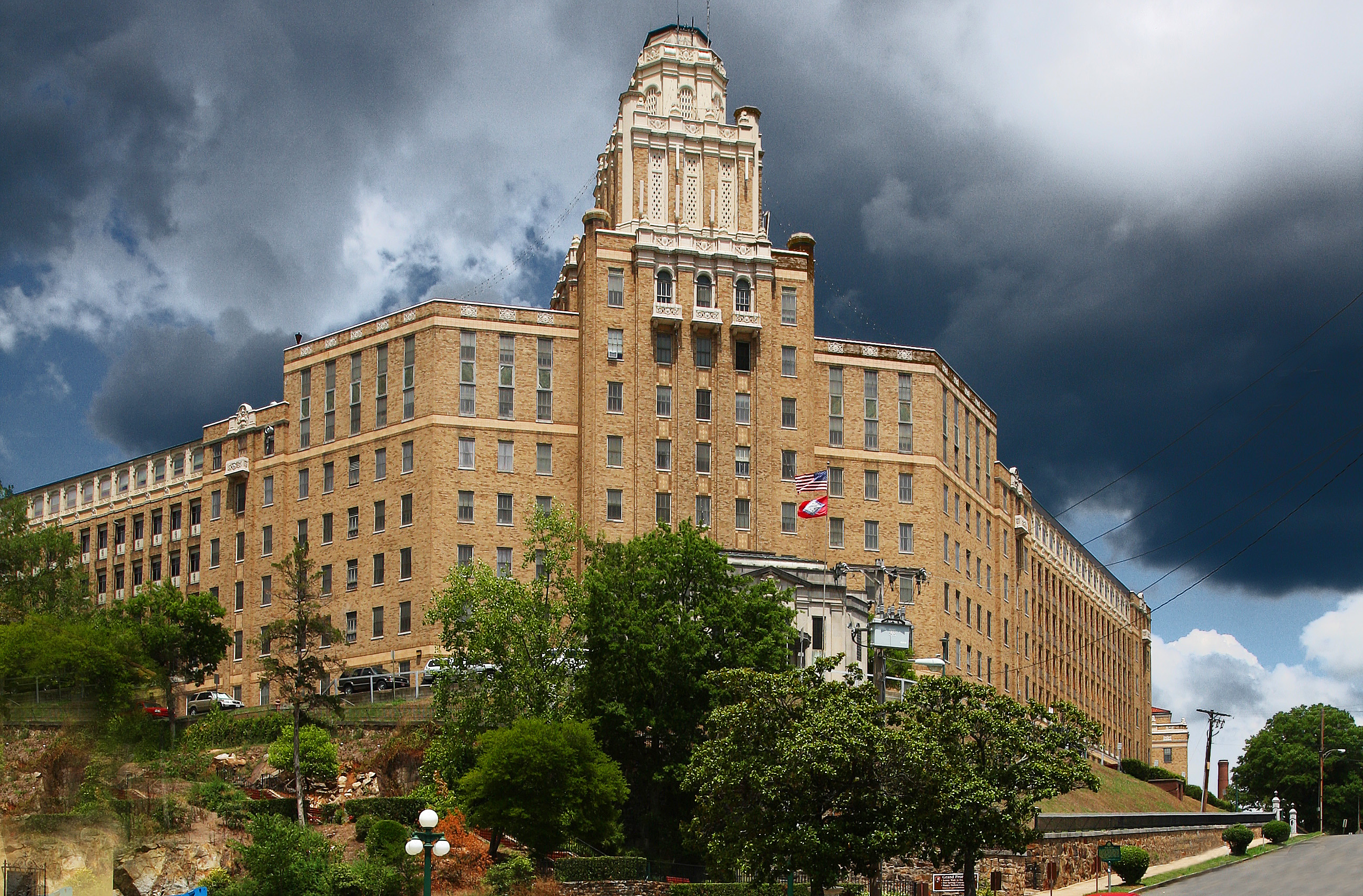
Army-Navy Hospital

Army-Navy Hospital

🏥 hospital

Hot Springs, Arkansas

TLDR

A six-story Spanish Revival hospital sits gated on Hot Spring Mountain, the Army-Navy Hospital that treated 15,000 WWII patients and was abandoned in 2019.

The Full Story

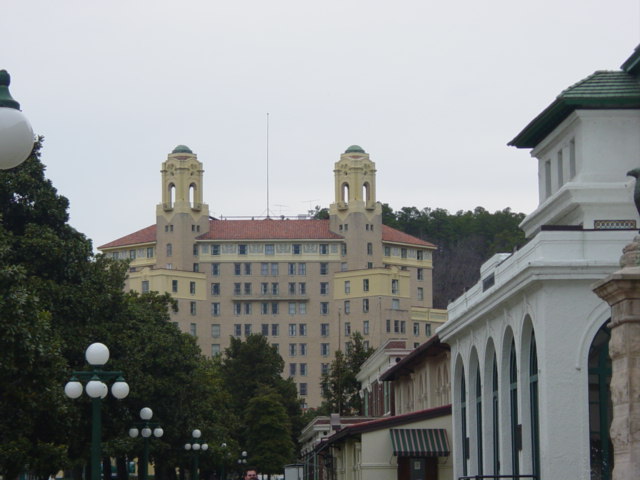
Walk Bathhouse Row in Hot Springs and you'll probably miss it. Most tourists do. Look up the south slope of Hot Spring Mountain and there it is, a six-story Spanish Revival fortress in yellow brick with a seven-story mission tower at its center, balustrade balconies on the fourth floor, and a perimeter fence around the whole thing. The Army-Navy Hospital. It's been gated since 2019. The state walked away, locked the doors, and the most haunted address in Hot Springs by local consensus has been visible only from the street ever since.

The hospital opened in January 1887. It was the first general hospital in the United States to treat Army and Navy patients under one roof, and the only military hospital established solely because of its proximity to natural hot springs. The origin story is specific: an 1882 dinner party at the Palace Bathhouse, hosted by Dr. A. S. Garnett (a former Confederate Army surgeon) and Colonel S. L. Fordyce. They worked on Senator John A. Logan over the meal. Logan called Hot Springs "an ideal location for an institution of this character" and introduced the legislation. President Grover Cleveland signed the executive order establishing the hospital on May 20, 1886.

The 1887 building was a wood-and-slate Victorian Gothic thing with a four-story wrap-around veranda, designed by Smithmeyer and Peltz of Washington D.C. That came down. The building you see now was finished in 1933 at a cost of $1.5 million, 210,000 square feet, 412 patient beds. The Arkansas Gazette covered the construction. Every lock in the building was master-keyed to a single key. Four elevators. Marble, tile, terrazzo. French doors. An X-ray wing. The architect of the 1933 building is, oddly, unknown. I couldn't find it documented anywhere; the NRHP nomination suggests War Department staff.

Then it filled up.

The hospital admitted nearly 15,000 patients between 1941 and 1945, and served over 100,000 veterans by the end of WWII. It became the Army's leading center for arthritis treatment and the largest polio rehab center in the country. Overflow patients were housed in the Eastman, Arlington, and Majestic Hotels downtown. The hydrotherapy pool on the first floor, ten feet by twenty, was piped with hot and cold domestic water and hot and cold mineral water from the springs themselves. The building was built around that pool. Cook the arthritis out of soldiers in spring water. Float the polio kids.

The kill-out reputation comes from this era. Austin Ray, who runs Hot Springs Haunted Tours out of 430 Central Avenue, calls the Army-Navy Hospital the most haunted spot in Hot Springs and anchors his ghost walk with one story. A soldier shows up in 1941 with swollen ankles and a low fever. Seven days later the whole floor is dead. Three weeks later, Ray says on the tour, ninety percent of the hospital is dead. Ray himself quotes Truman: if a story's not worth exaggerating, it's not worth telling. So treat the numbers like tour-guide patter, not a chart in a medical record. The kill-out reputation of mid-century military hospitals is real. The specific 90% figure is the version Ray tells walking groups down Central.

On April 1, 1960, the Secretary of the Army handed the complex to the State of Arkansas. It became the Hot Springs Rehabilitation Center, a residential facility for people with physical disabilities — vocational training, hydrotherapy, wheelchair repair, the only full-scale rehab center west of the Mississippi. (You'll find tour-blog folklore claiming the building was a sanitarium for the criminally insane between the military and rehab eras. The NRHP nomination, the NPS, the Encyclopedia of Arkansas, and UALR Public Radio all describe a single 1960 transition, military to physical-disability rehab. No record I could find documents a criminally-insane phase. The legend exists, but the documented history doesn't back it.) In 2009 it became the Arkansas Career Training Institute. In 2007 the whole 31-building, ten-acre campus went on the National Register as the Army and Navy General Hospital Historic District.

Governor Asa Hutchinson announced the closure in May 2019 under Act 910 reorganization, about 120 jobs gone. The residential program ended in September. The building was vacated by December 31, 2019. The Sentinel-Record described what came next as a "lawless camp" — vandalism, unauthorized entry, six campus buildings rated 10/10 for fire threat. The state had to resume perimeter security in 2022 after gaps. A federal grant of $2.75 million came through in September 2024 for security and fire protection. In October 2025, Alan Barksdale of the Community Development Foundation walked the press through a redevelopment vision; two of three RFI respondents had proposed luxury wellness resorts. So a spa hotel where the polio kids floated is the leading idea on the table.

The haunted reputation, in the meantime, is generic in a way that almost works against it. No named ghost. No specific room. No documented investigator with EVPs or thermal readings, because the building has been gated and security-monitored since 2019 and paranormal groups can't get in. This is unusual for a place this famous. The most haunted address in Hot Springs has no Ghost Adventures episode, no TAPS visit, no equipment log. Tour-guide accounts describe figures spotted in upper-floor windows; the Hot Springs CVB blog repeats the line. Whether that's a real pattern or just what people say about an abandoned hospital looming over a tourist town, you can't really test from the sidewalk.

What you can see from the sidewalk is the building. The yellow brick. The mission tower. The dome. The fence.

And what's underneath the fence is the part that pulls you in. The basement morgue is rock-cut and temperature-controlled, dug into Hot Spring Mountain itself, and it doubled as Garland County's first bomb shelter (Carl Enna documented this in the August 2004 issue of *The Counselor*, the rehab center's own newsletter). In 2019, during the closure, workers pulled up a section of floor in what had been the training room and found an underground swimming pool sealed beneath it, unused for over 50 years. The steps were still there. The original tiled depth marker was still on the wall. Hot Springs Broadcast Network filmed the reveal. The pool had been used for military hydrotherapy, probably polio rehab in the 1940s, and at some point someone had floored it over and the training room had been running on top of it for half a century. Nobody who worked there knew.

Six stories of Art Deco hospital on a tourist mountain, full of rooms nobody has walked through in years. Locked.

If the wellness-resort plan goes through, the pool gets uncovered again. The morgue probably becomes a wine cellar. The tile depth marker either gets preserved or pried off. Until then it sits behind the fence, and the most haunted building in Hot Springs is one you can only look at from the curb.

Researched from 8 verified sources. How we research.