For over half a century a black-clad figure crept into Westminster Burying Ground in Baltimore before dawn on Poe's birthday, left cognac and three roses at his grave, and vanished. Then he stopped coming — and the catacombs below have ghosts of their own.
At Westminster Burying Ground in Baltimore, a man in black used to slip through the gate before dawn on January 19 every year, the date of Edgar Allan Poe's birth. He wore a wide hat and a white scarf and carried a silver-tipped cane. He'd kneel at Poe's grave, pour out a glass of French Martell cognac, raise a silent toast, lay down three red roses, and leave the half-empty bottle behind. Then he'd be gone before anyone could stop him.
No one ever learned who he was. People called him the Poe Toaster, and a Baltimore Sun report had him on the record as far back as 1949 — "an anonymous citizen who creeps in annually to place an empty bottle (of excellent label)." A note in 1993 said "the torch will be passed." By 1999 another note announced the original Toaster had died and a son had taken over. Then in 2010 nobody came. Only imposters showed after that, and in 2012 the cemetery's longtime Poe steward, Jeff Jerome, declared the tradition over.
Poe was buried here in 1849, in an unmarked family plot toward the back that grew over with weeds. A schoolteacher's penny campaign eventually paid for the marble monument near the front, where visitors still leave coins. The three roses were said to honor Poe, his wife Virginia, and her mother Maria Clemm, all laid to rest at Westminster.
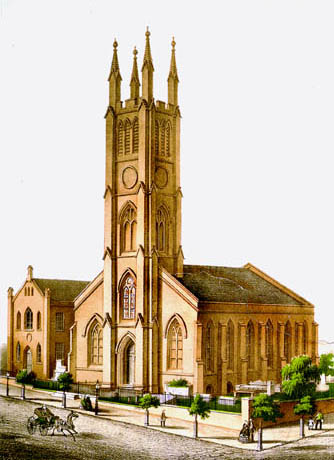
But the cemetery came first, and the church came down on top of it. In 1852 they built the Gothic Revival Westminster church directly over the graves, raising it on brick piers that straddle the old headstones and vaults so the dead wouldn't be disturbed. The space underneath became the "Baltimore Catacombs," and you can still tour them.
By one telling, in *The Chesapeake Book of the Dead*, the catacombs are "haunted by Frank, the ghost of a body snatcher, who once plundered these graves to supply Johns Hopkins University with cadavers for dissection." Body snatching was a real trade in those years, when fresh corpses fed the medical schools, though no record pins a documented raid to Westminster's graves. Frank is a story, not a court file.
Aboveground there are more of them. People report a woman in white — Lucia Watson Taylor, dead at 16 in 1816 — kneeling in prayer at her own grave before she fades. A 19th-century groundskeeper is said to move down the rows and call out the loud ones before shuffling off. And some say they've seen Poe himself near the monument, dark hair matted, looking sorrowful. The cemetery holds Revolutionary War generals and a signer of the Constitution, but it's the writer in the unmarked plot people come back for.
The toasts and roses stopped years ago. The graves the church was built to protect are still down there in the dark.