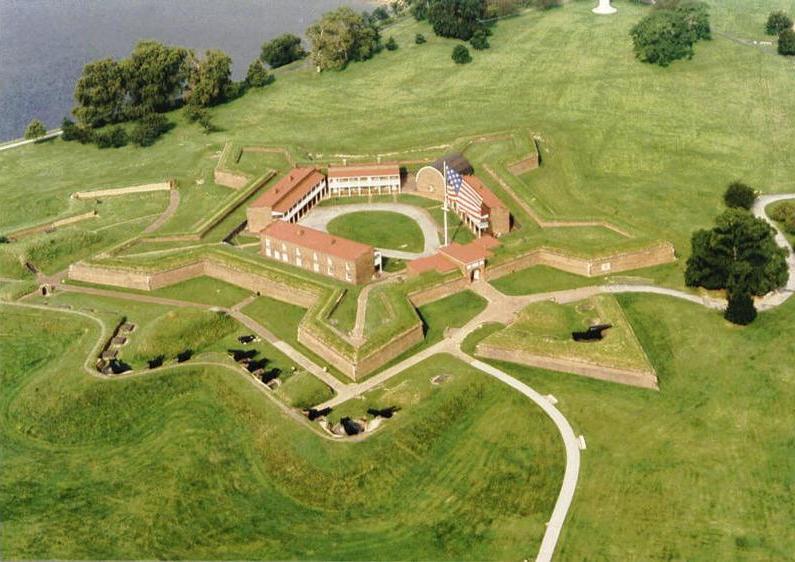
Visitors at Fort McHenry in Baltimore keep coming to the desk to ask about the soldier they saw on Bastion Three. Staff have to explain there were no reenactors that day. He stands where two men died at their cannon in 1814, and he walks through the wall.
At Fort McHenry in Baltimore, visitors keep walking up to the desk to ask about the soldier they saw on the ramparts. He's on Bastion Three, in uniform, and they assume he's a costumed reenactor. Staff have to tell them no actors were on the grounds that day.
Bastion Three is where it happened. On the night of September 13, 1814, British warships had been firing on the fort for hours when a single bomb came down on the gun position there. It killed Lieutenant Levi Clagett, a 34-year-old Baltimore merchant, and Sergeant John Clemm at their cannon. They were two of only four defenders who died in the bombardment that gave Francis Scott Key "The Star-Spangled Banner."
The man people describe is standing on the exact spot. Warren Bielenberg, who ran visitor services here, put it plainly: "He looks solid. You don't realize he's a ghost until he walks through the wall." Before President Gerald Ford visited, the story goes that Secret Service agents spotted a uniformed soldier pacing that same bastion during their security sweep.
In the late 1970s, Bielenberg brought in a psychic named Dorothy Bathgate to go through the fort after hours. On Clagett's Bastion she described wounded bodies, one of them a bearded man, which struck the staff as wrong because beards weren't permitted in the War of 1812. A staffer later turned up the obituary of a Jewish merchant who'd served at the fort during the bombardment. "About 70 to 80 percent of the things she said were substantiated later on," Bielenberg said. "I had a hard time believing some of it, but I have no other way of explaining it."
The bombardment is only the part of the fort's history people sing about. Decades later it became a Civil War military prison so notorious it was nicknamed the Baltimore Bastille. After Gettysburg the prisoner population hit 6,957, and at least three men were executed on the grounds. One of the figures reported here is tied to that era: near the Orpheus statue, a monument to Key and the defenders, a visitor described a uniformed man floating in mid-air at a spot later identified as an 1862 execution site, where a young private was hanged for murder.
The fort has more than one figure. A man in a soldier's cape paces the outer battery, said to be Private John Drew, who shot himself in a cell in 1880 after being arrested for falling asleep on guard. A woman in period clothing turns up in the barracks, where a ranger said she tried to push him down the stairs. But it's the soldier on Bastion Three people keep coming inside to ask about, the one who looks like he belongs there, until he steps through a wall that's stood since the bomb fell.