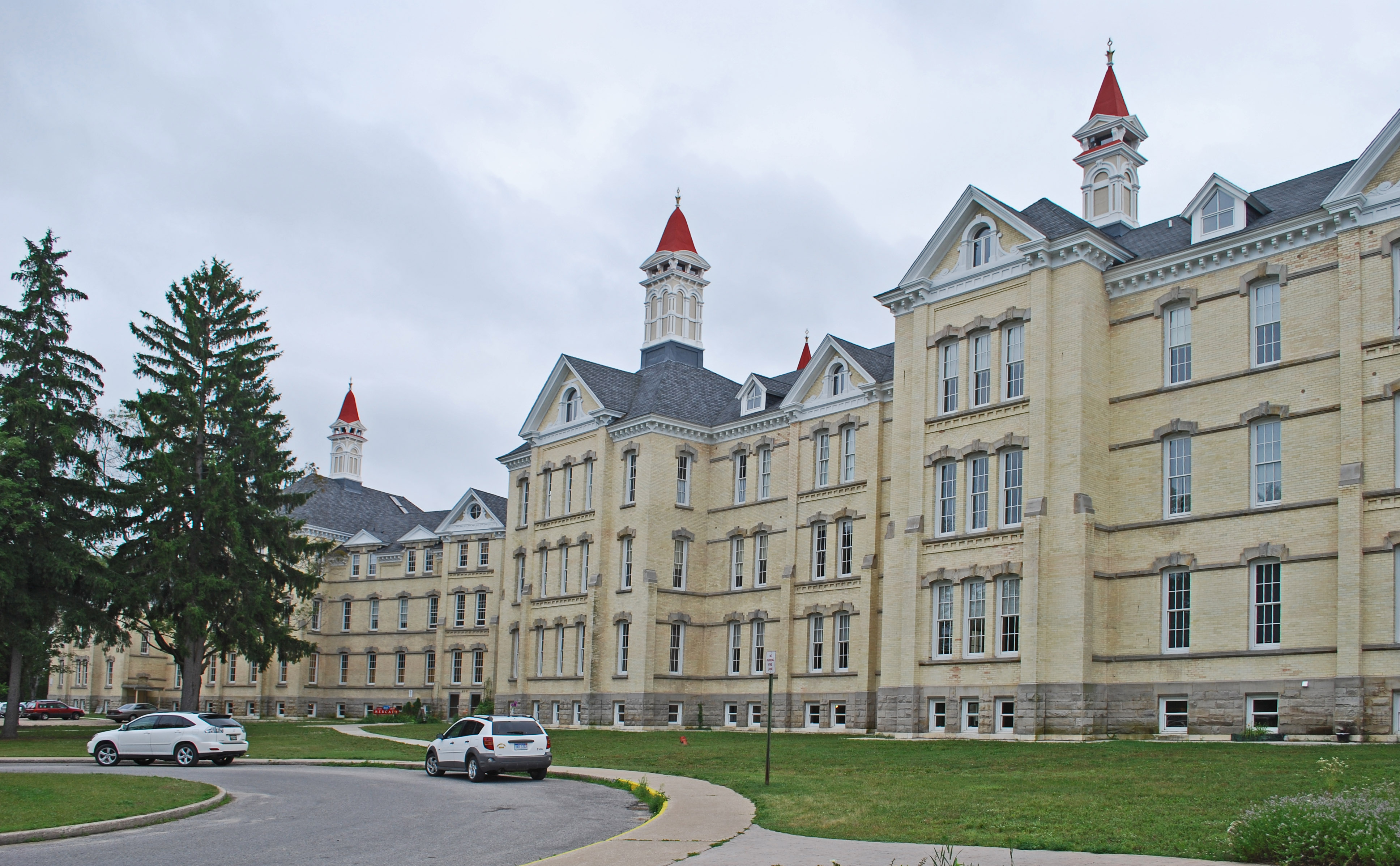
Building 50 in Traverse City, Michigan was the prettiest asylum in America, built on the belief that beauty itself was the cure. It ran 104 years, served over 50,000 people, and now sells truffles in old patient wards — where the floors still don't always sound empty.
Building 50, the old Traverse City State Hospital in Michigan, is a place where you can buy a chocolate truffle in a former patient ward. The tenants who work those wards say they still hear children laughing on floors that are supposed to be empty after closing.
It opened in 1885 as the Northern Michigan Asylum, a quarter-mile-long Victorian building of buff brick with a spire that's still among the tallest things in town. The brick came from a yard down the road in Greilickville, and the wings step back from the center in the staggered bat-wing shape of a Kirkbride asylum. Four of those were built in Michigan. Building 50 is the only one still standing.
The man who ran it, Dr. James Decker Munson, believed something unusual for the time: that beauty itself was medicine. He forbade straitjackets and other restraints. He thought kindness, lovely surroundings, and honest work were the cure, and he stayed at the head of it from 1885 until 1924.
So the patients farmed. The campus ran dairy cattle and vegetable fields beginning in 1885, and people there learned trades like furniture building and fruit canning. By the late 1950s the place held nearly 3,000 of them. Across its 104 years it took in more than 50,000 people, and it kept the ones nobody came back for.
Roughly 470 of them are still here, in a way. They lie in a mostly unmarked meadow at Oakwood Cemetery in Traverse City, unclaimed patients buried under a single central column with no names on them.
The hospital closed in 1989. It sat empty for years, and during that decade urban explorers, teenagers, and ghost hunters wandered the wards and filled them with stories. Then a developer bought the whole campus for one dollar and spent over 60 million putting it back together. It reopened in 2002 as a village of condos, restaurants, a winery, a coffee roaster, shops. The wards have tenants again.
The stories that filled the empty decade never left with the explorers. People report disembodied voices and screams, footsteps and unexplained lights, mostly around the old men's ward and the morgue. Some say recorded voices have told them to leave the grounds.
You can take a tour through the 1883 steam tunnels that still run beneath the buildings. The hospital was built so its patients would never want to leave. Some of them, by every account, never did.