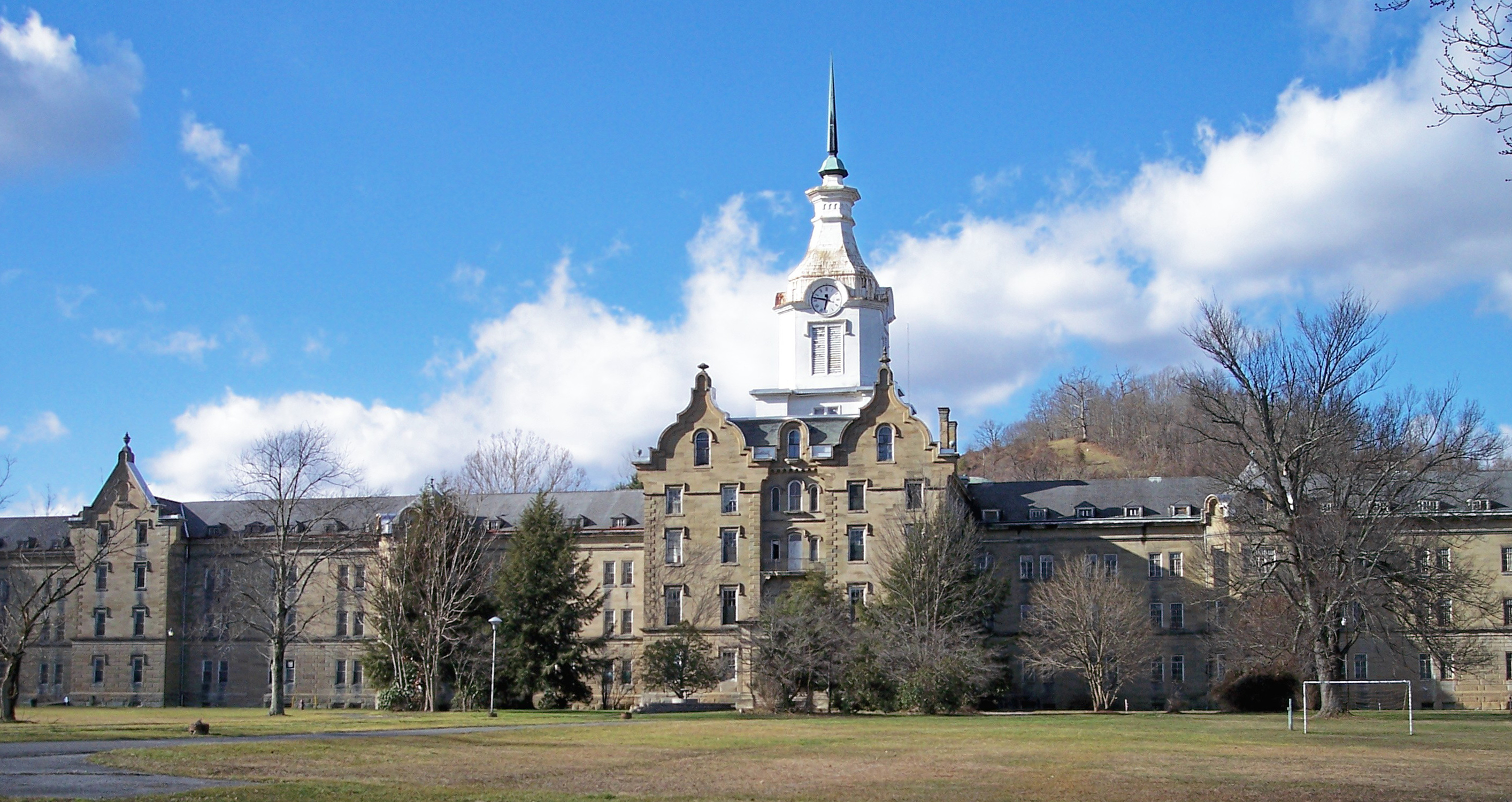
Visitors to the Trans-Allegheny Lunatic Asylum in Weston, West Virginia leave toys in a bright yellow room on Ward Four for a girl named Lily, who is said to roll a ball back. The origin story everyone tells about her was written as fiction.
The Trans-Allegheny Lunatic Asylum in Weston, West Virginia keeps a 9-year-old ghost named Lily, and her room is one of the brightest in the building. Eastern corner of Ward Four, first floor. Yellow walls, peeling paint, bars on the windows. Visitors leave toys, among them a pink-and-white music box with a miniature ballerina, and people say it starts playing when nobody has touched it.
Everything reported there is a child's version of a haunting. Giggling down the hall. Toys that move when someone asks them to. A ball rolled across the floor and rolled back. Local historian Shelley Bailey describes a Cracker Jacks box opening by itself with crunching she could hear, and a game of catch that ran 45 minutes. Paranormal investigator Aaron Sulser, over more than a dozen investigations, has documented flashlights blinking in time with the music box's tempo.
Ask who Lily was and the answer is always the same: her mother, Gladys Ravensfield, was raped by soldiers and committed in 1863, and the girl was born inside the hospital and died of pneumonia at 9.
None of that happened. A paranormal columnist named Stephen Wagner wrote the Gladys version as fiction, on purpose, as a made-up ghost story promoting a 2009 television broadcast, and it got loose. America's Most Haunted ran it down years later and found the source. A West Virginia high school paper was printing the soldiers and the rape as history as recently as 2023. No admission record, no death certificate, no burial and no obituary for Lily has ever been produced by anyone.
The building needs no help. Its plan was drawn for 250 patients and sited deliberately far from any town, where, in the landmark nomination's words, patients "would be housed among strangers only, discouraged from seeing anyone they knew and loved." By 1938 it held 1,661. By the 1950s about 2,400, or 2,600 by Wikipedia's count. In 1952 the state signed four of its hospitals, Weston among them, over to Walter Freeman's lobotomy program: an orbitoclast driven under the eyelid and through the skull with a mallet, 787 procedures across West Virginia in three years, many without consent.
How many people died inside has never been counted. Research to fix a number is underway. The estimate on offer is that it could run to five figures.
Three cemeteries sit on the hill behind the asylum. Numbered brick markers once told you who lay in which grave, and local reporting on the cemeteries' National Register bid says those were carried off between 1979 and 1980, a few of them surfacing later in a Weston house, packed under a furnace as foundation. Find a Grave now lists 2,115 names for that ground, transcribed from death certificates rather than read off stones, and not one of them can be matched to a plot.
So the hill holds 2,115 people nobody can locate, and the building holds one girl nobody can document, in a yellow room, with the toys.