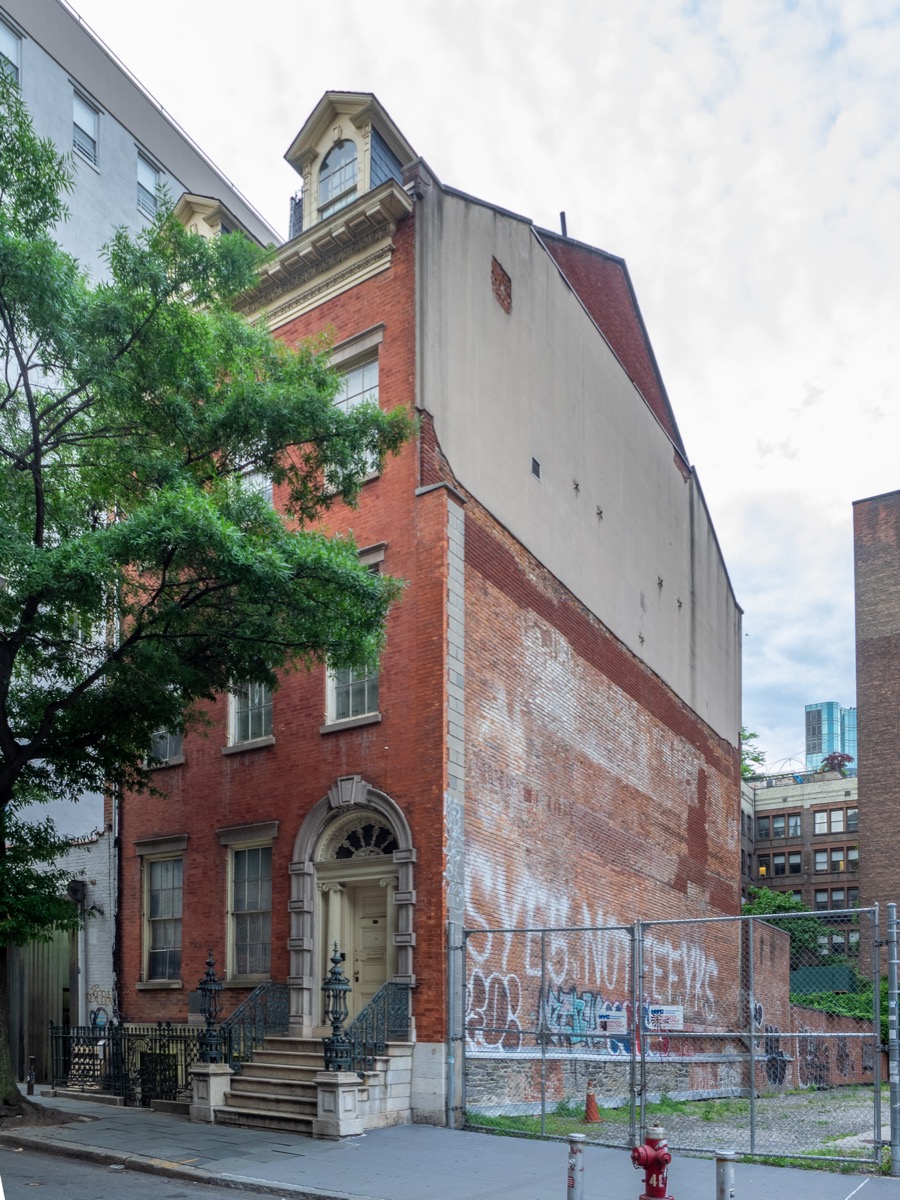
The Merchant's House Museum at 29 East Fourth Street in Manhattan keeps a woman in a long brown dress. People say she's Gertrude Tredwell, who was born and died in the same upstairs bed and has been reported drifting the rooms for over 90 years.
At the Merchant's House Museum on East Fourth Street in Manhattan, the thing people report most often is a woman in a long brown dress, moving through the rooms. They say she's Gertrude Tredwell. She was born in an upstairs bedroom of the house in 1840, the youngest child, and she died in that same bed at 93, in 1933, the last of her family to live there.
The story goes that a few weeks after they buried her, children playing on the stoop were chased off by an elderly woman in a brown dress who rushed out the front door. People on the street are said to have recognized her at once as Gertrude. No newspaper from 1933 confirms it, and the museum tells it as the founding legend rather than documented fact. But the reports of the woman in brown have stayed the same for over ninety years, which is the real reason the place has worn the title of Manhattan's most haunted house.
The house was finished in 1832 and bought by the merchant Seabury Tredwell in 1835. His family lived there for nearly a hundred years, and at least eight people died inside it. When Gertrude died, the house passed almost untouched into a museum in 1936, with the family's mahogany furniture, the gas chandeliers Seabury installed, and the family's belongings still in the closets. It's the only 19th-century home in Manhattan with its original exterior, interior, and furnishings intact, which is part of why people came looking for ghosts in it at all.
What people report sounds like the house going quietly about its old life. The servants' bells ringing on their own, untouched. Footsteps on the staircase and voices in empty rooms. Temperature drops and strange smells. And the strangest of them, heard from the street outside: the sound of a party in full swing, piano and all, coming from rooms with no one in them. Sightings tend to cluster on the main staircase, the front bedroom, the kitchen, and the rear parlor.
Most haunted houses sell the story. This one decided to study it. In 2020, with the building closed and empty during the pandemic, the museum started a formal research program, pairing investigator Dan Sturges with a neuroscientist and a thanatologist and using equipment built for the house. Their published conclusion was careful and strange: the work points to "the very likely reality of paranormal activity at the Merchant's House."
A family that never quite left, and a museum that chose to investigate them rather than sell tickets to the legend.