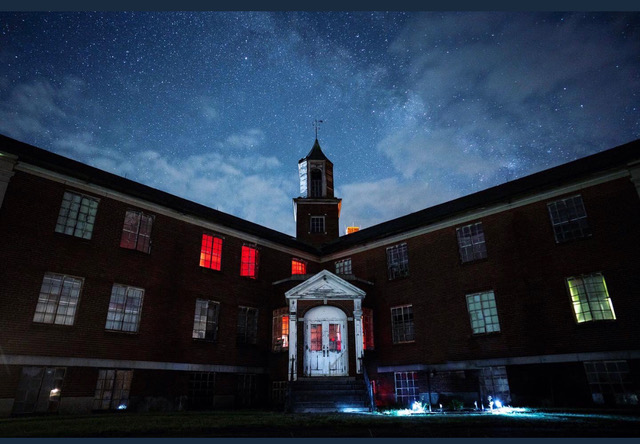
At Rolling Hills Asylum in East Bethany, New York, the owner found a rat dead on the stairs one morning, its neck broken, and above it a giant bloody handprint. She thinks it belonged to Roy, the gentle giant who died here in 1942.
The tallest shadow in the second-floor hallway of Rolling Hills Asylum, in East Bethany, New York, is said to be a man named Roy Crouse. He stood seven feet six inches in life, the result of a tumor on his pituitary gland. He loved opera. He was, by every account, gentle. He died in this building in 1942, at 52, and people on the second-floor men's dormitory, the hall the staff call the Shadow Hallway, say his full-body shadow follows them down it.
Soon after Sharon Coyle bought the place in 2009, a rat startled her in the old infirmary and she ran. The next morning she found the rat dead on the stairs, its neck broken, blood at its mouth. Smeared on the wall above it was a giant bloody handprint. By the story Coyle tells, it was never cleaned off. She believes it was Roy.
The building was never a hospital, not really. It opened in 1827 as the Genesee County Poor House, in a converted stagecoach tavern, and it took in everyone society wanted gone: orphans, widows, the elderly, the mentally ill, the disabled, vagrants, "habitual drunkards." A separate stone building went up the next year for "the confinement of lunatics." The poor house ran as a self-sufficient farm across more than 200 acres, with a bakery and a wood shop that built coffins, some for the home's own dead, some sold to local undertakers. In 1871, the cost to keep a single resident ran about $1.08 a week. Coyle lives in that woodshop now.
The Shadow Hallway is only the start of it. In a first-floor room they call Hattie's, an investigator's recorder once caught the voice of an elderly woman calling out "hello," the way a blind former patient might once have summoned a nurse. In the basement sit the psych ward and the solitary cells, where shackles were used on residents who would not settle. Down in the morgue, visitors report objects shifting on their own, and people knocked or shoved by nothing they can see.
Over 1,700 deaths are documented on the property. Coyle thinks the real number is roughly three times that, lost to unmarked graves. The on-site cemetery has never been found. The only physical proof of who lies on this land is five headstones, dated 1887 and 1888, returned to the county and dedicated in 2004.
The state put up a roadside marker in 2016. It does not hedge. "THIS ASYLUM IS A NATIONALLY KNOWN CENTER OF SUPERNATURAL ACTIVITY," it reads, "SPIRITS BELIEVED TO STILL ROAM GROUNDS." A historic plaque, erected by a foundation, telling drivers the dead never left.