At the abandoned Hudson River State Hospital in Poughkeepsie, New York, trespassers describe orbs that follow them and chase them off the grounds, and a woman in black on the upper floors. The Gothic asylum behind the lore was built on the idea that beauty could cure the mind.
At the abandoned Hudson River State Hospital in Poughkeepsie, New York, the people who climb the fence don't last long inside. They describe orbs that follow them through the dark halls and chase them off the grounds. One 2017 visitor said friends found a woman in black, long-haired, in a semicircular room on the northeast side of an upper floor, and a caged door they swear had never once been closed before, shut tight when they reached it.
The building they were trespassing in was meant to heal them.
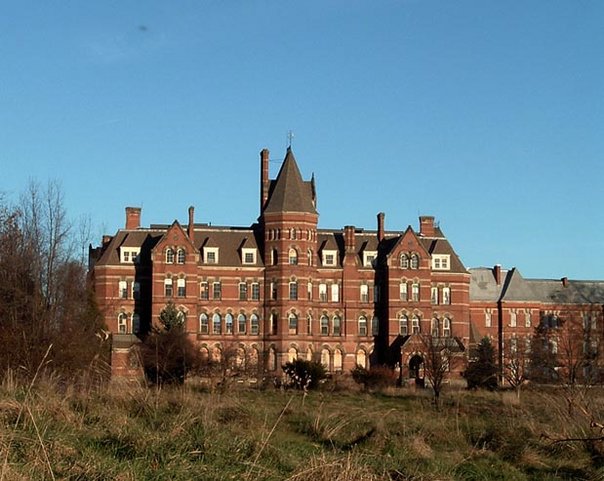
It opened on October 18, 1871, as the Hudson River State Hospital for the Insane, with 40 patients in a red-brick cathedral of High Victorian Gothic — the first American institution ever built in that style. Frederick Clarke Withers designed it. The men who built Central Park, Olmsted and Vaux, laid out the grounds. The whole thing followed Dr. Thomas Kirkbride's theory: long staggered wings stepping back from a central tower, abundant windows, light and fresh air, all of it built on the idea that changing a patient's surroundings could treat what was wrong in their mind. A chapel sat between the male and female wings so that neither side could see across to the other. The campus farmed its own food, with orchards and recreation grounds, nearly self-sufficient. It was supposed to be a cure you could live inside.
It did not stay that way. The 40 patients of 1871 became roughly 6,000 by 1952. A building designed for light and space filled past breaking, and the treatments people remember from its long history — lobotomies, shock therapy, cold-water hosings for patients who would not comply — belong to a place that had stopped resembling the one Kirkbride drew. By 1976 the population had fallen back to about 1,780, the institution winding down toward the end.
A building engineered to cure suffering had become a place to store it. Patient operations ended in 2003, the main Kirkbride building shuttered two years earlier. Then it sat empty for two decades, and the stories filled the dark: screams from the wards, figures in gowns standing at the sealed upper windows, former patients said to wander the grounds at night and make noise. No one name recurs. There's no lady-in-white with a backstory here, just the orbs and the woman in black and the sounds people carry out with them.
On June 3, 2026, fire took the main building. "In the last hour despite heroic efforts, we have lost the historic Admin Building designed by Thomas S Kirkbride," the Town of Poughkeepsie said. Its floors, roof, and windows burned. Five days later, a second fire hit the campus.
The orbs are the lore the empty years grew. The real weight of the place was always in the arithmetic: a cathedral built to heal, filled forty times over, then left to rot, then burned to its brick.