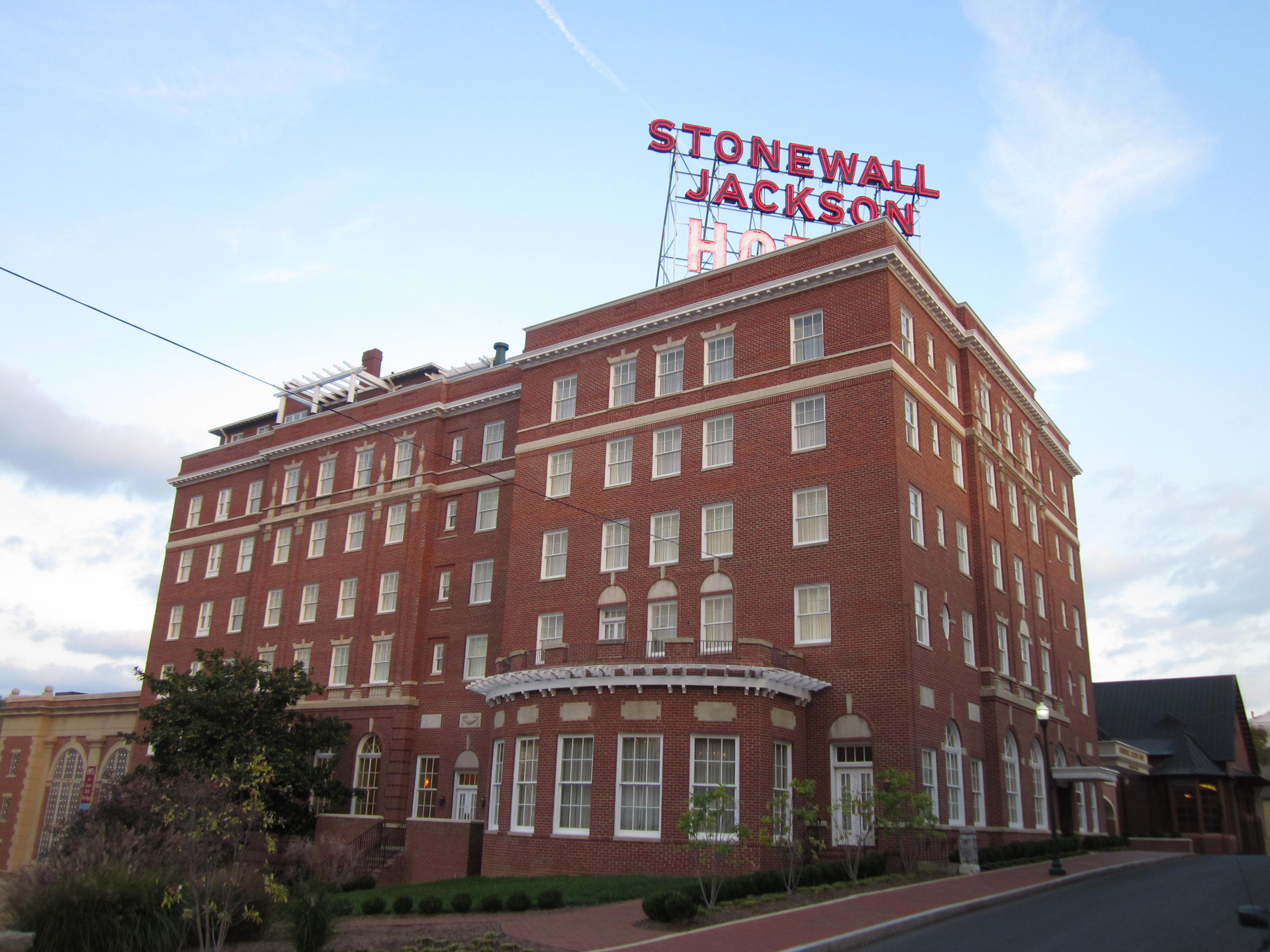
Hotel 24 South wore the wrong name for 96 years; only three people in the whole 1923 contest picked Stonewall Jackson.
The hotel almost wasn't called Stonewall Jackson at all.
In late 1923, Alexander Tobie Moore opened a contest for Augusta County residents to name his new five-story Georgian Revival on South Market Street. The University of Virginia's Valley of the Shadow project went back through the entries. Out of everything submitted by everyone in the county, exactly three people wrote down "Stonewall Jackson." The top runner-up suggestions were "Woodrow Wilson," "Fort Lewis," and "Appalachian." The Confederate general won by tiebreaker, and that name stuck to the rooftop for the next 96 years.
It came off in the summer of 2020.
After Black Lives Matter protests gathered outside the lobby in early June, the facade lettering came down in July and the giant rooftop neon sign, the one aimed straight at I-81 motorists, was peeled off in August. On September 1, 2020, the building officially became Hotel 24 South. The new name is a shrug at the address (24 South Market Street) and a nod to the opening year (1924). The building underneath never changed. The Wurlitzer organ is still on the mezzanine. The soldier apparitions, according to guests, are still walking the halls.
Moore opened the place in May 1924. Construction had started the April before, financed by a door-to-door bond sale run by the local Rotary and Kiwanis clubs in early 1923, which is a wildly small-town way to fund a luxury hotel. The Staunton News-Leader called Moore "one of the best-known hotel men of the South." He'd arrived in Staunton in 1909 and worked his way up. He died in a car accident in 1935. His widow, Elizabeth Clemmer Moore, ran the hotel until she sold it in 1947.
H.L. Stevens & Company of New York designed the building. The original lobby was two stories tall and trimmed in walnut, with a balustraded mezzanine looking down on it. The Fountain Dining Room had a chandelier hanging over a small fountain topped by a statue of a boy holding a fish. The Colonnade Ballroom had bay windows and hosted weddings and cotillion balls for whatever passed for Shenandoah Valley high society in the late 1920s. The 1924 Wurlitzer organ sat on the mezzanine. The venue calls it "the last of its type in operation."
Then I-81 went in, and downtown Staunton emptied out. The hotel closed in 1968.
Allen Persinger's father bought the shuttered building that same year. The family reopened it as a residential hotel and assisted living facility for seniors, and that's what it was for roughly 37 years. A grand 1924 lobby with crystal and walnut, slowly fading into a quiet old-folks home. The Wurlitzer organ got sealed up inside a wall and forgotten.
When the Persinger family partnered with Armada Hoffler on a $21.1 million restoration in 2004 (Wikipedia gives a lower $19.3 million figure, but the venue, Historic Hotels of America, and the 2005 trade press release all agree on $21.1M), the renovation crew broke through that wall and found the organ. They restored it to playing condition. The hotel reopened in October 2005 with 124 guestrooms and about 11,000 square feet of meeting space, joined Historic Hotels of America in 2006, and got another $2 million renovation in 2017.
About that rooftop sign. Three different sources give three different decades for when it went up. Wikipedia says about 1950. The Historic Staunton Foundation puts it in the early 1960s. UVA's Valley of the Shadow places it in the late 1940s. Take your pick. What everyone agrees on is that it was added decades after the hotel opened, glowed over downtown for the rest of the twentieth century, and came down in August 2020.
The ghosts have always been older than the sign.
Encyclopedia Strange calls it "perhaps the most famous of Staunton's haunted inns." Guests have reported soldiers walking through hallways and "standing at attention near windows, gazing out at the town as if still on watch." There's no documented Civil War death in the building. No name, no incident, no specific room. The hotel didn't exist during the war; the namesake did, and the apparitions, if you believe them, are dressed for his century, not Moore's. Whether that's something real or a story the building grew into because of the name on the roof is a question no source answers.
The phantom marching gets repeated too. Guests describe "phantom footsteps marching down the halls" when the corridor is empty. Doors open and close on their own. Cold drafts move through rooms. Longtime staff have told Encyclopedia Strange that certain rooms are more active than others, though no one names which ones, which is either professional discretion or a tell. OnlyInYourState adds an apparition of a hanged man, with no name, no date, no part of the building attached to it. Take that one with more salt than the soldiers.
The Victorian Ghostly Encounters Tour assembles on the sidewalk at 19 South Market Street, directly across from the hotel. Black Raven Paranormal, run by Marty Seibel, leads investigations throughout town and uses landmarks beside the building as tour stops. Nobody has published a documented investigation of the hotel's interior. The soldiers and the marching footsteps are guest reports passed down through staff, with no EVPs or photographs or equipment readings to back them up. Thin, by paranormal-investigation standards. Persistent, by hotel-folklore standards.
The most interesting object in the building is still the Wurlitzer. Built in 1924, walled up sometime during the long sleep, found again in 2004, playing again in 2005. It sat sealed inside the architecture for somewhere around 37 years while the lobby downstairs filled up with retirees. The hotel calls it the last of its type in operation.