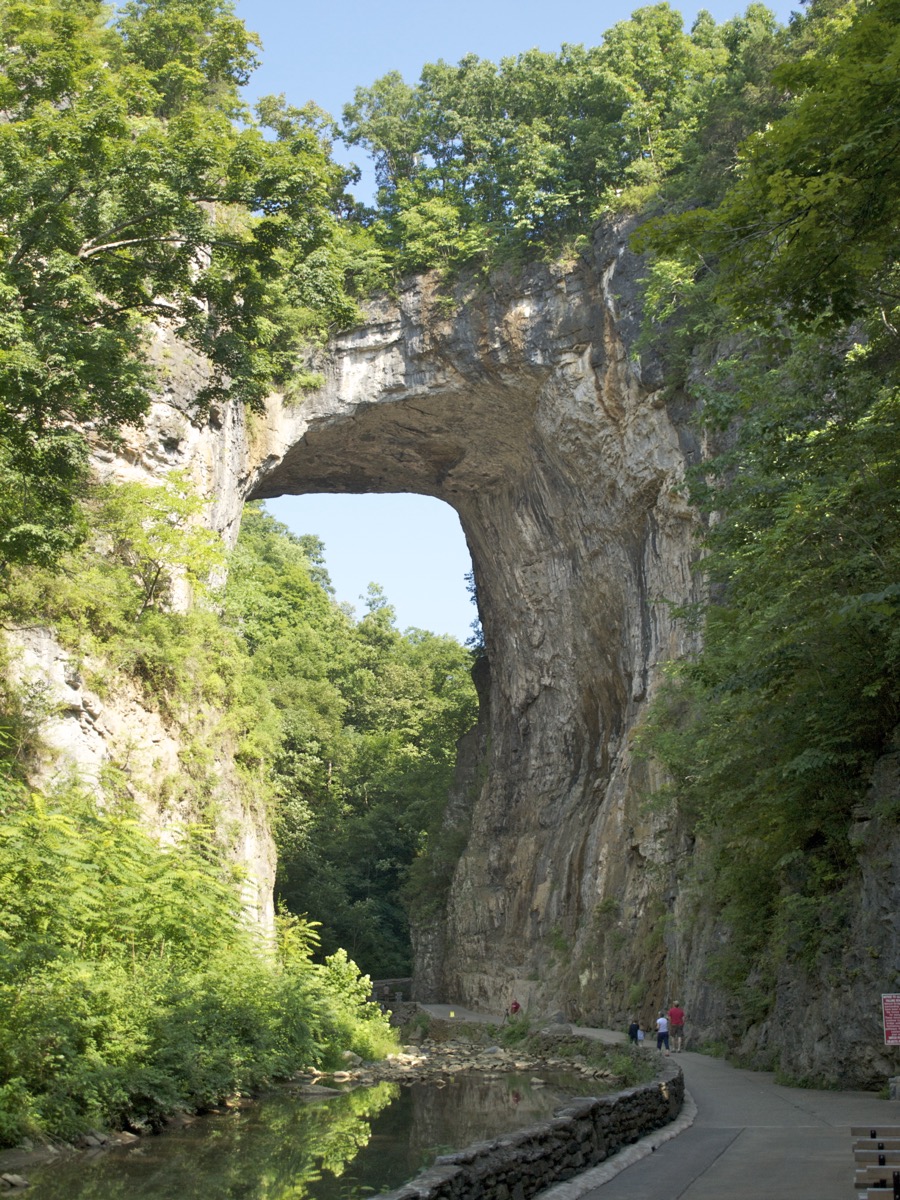
The Monacan called Natural Bridge the Bridge of God. A 215-foot limestone arch in Rockbridge County, sacred long before Jefferson bought it for 20 shillings.
The Monacan people called it *Mohomony*, the Bridge of God. Their oral tradition holds that ancestors fleeing an attacking tribe came to an impassable chasm, prayed to the Great Spirit, and watched a stone bridge appear so the women and children could cross while warriors held off the pursuers. The limestone arch in Rockbridge County, Virginia is 215 feet high with a 90-foot span, the largest of its kind in North America, and every layer of meaning humans have laid over it sits on a foundation older than any of them.
That foundation matters for a place like this. Most haunted sites accumulate stories around a building. Natural Bridge accumulates stories around a piece of geology that was sacred before the building, sacred before the surveyors, sacred before the colony. Everything that came after has been a footnote.
The first footnote belongs to George Washington. Legend says he surveyed the bridge in 1750 as a young man and carved his initials 23 feet up the south wall of the arch. In 1927, workers found a large stone near the site bearing the initials "G.W." and a surveyor's cross, which a lot of historians took as evidence. Wikipedia notes the carving's authenticity is debated, and it may have been added long after Washington died. Traditionally attributed to him is the most you can honestly say. Stand under the arch and look up at the wall and you can squint and decide what you believe.
The second footnote belongs to Jefferson. He first visited in 1767 and called it "the most sublime of nature's works," a line he kept returning to in his correspondence. On July 5, 1774, two years minus one day before the Declaration of Independence, he bought 157 acres including the bridge from King George III for 20 shillings, recorded as a royal land patent that same date. He owned the Bridge of God for a few coins from the king he would soon stop recognizing. Virginia celebrated the 250th anniversary of that purchase in 2024.
The third footnote is the hotel, and this is where the ghost stories start.
The original hotel on the property was called the Appledore, opened in 1890. It was later expanded and renamed the Natural Bridge Hotel. The first Appledore owner was shot in nearby Clifton Forge shortly after the property was relocated to its current spot, a detail that haunting lore tends to fold in without much ceremony. On April 24, 1963, a fire of undetermined origin destroyed the hotel. Construction on the replacement began in 1964 and the new hotel opened in 1965. So when guests check in today and report things, they're reporting them inside a structure that's only about sixty years old, sitting next to a piece of stone that's been there since the Pleistocene.
The most distinctive guest sighting is also the one that loops everything back to the beginning. A guest woke around 4 a.m. to see a glowing Native American figure on the floor of her room, sitting in a meditative posture, visible for several minutes before vanishing. That account comes from the History Museum of Western Virginia's writeup, and it's the one that lingers, because it suggests whatever is happening at the hotel isn't really about the hotel. It's about the ground.
Other accounts are less specific but more frequent. Multiple guests have reported phantom children running and yelling in hallways at night. When doors are opened, the corridors are empty. In 2019, a guest staying on the third floor of the main building reported repeated bumps at the edge of his bed around 2:30 a.m., then sheets being slowly pulled off. His wife reported the same experience the next time they stayed. That account is logged on Ghosts of America with a date and a floor and a couple, which is more grounding than most paranormal reports get.
There's a backstory that floats around ghost-tour aggregator pages: a former owner who descended into madness and killed his wife and children. A reviewer on virginiahauntedhouses.com who identifies as former hotel staff dismissed it flatly: "The story of a former owner killing his wife and kids is just a rumor, probably comes from The Shining plot." No source confirms a name, no source confirms an incident, and the cleanest read is that someone watched Kubrick's movie and laundered the plot into local legend. Treat it as contested.
A few hundred yards from the hotel, the Caverns at Natural Bridge open up into the limestone. Brothers Jake and Joe Fitzgerald discovered them in the 1890s, and the public has been allowed in since 1977. The deepest section reaches 347 feet below the surface, making it the deepest commercial cavern on the East Coast. The folklore is older than the access. Early explorers dropped pots and pans into a deep pit to gauge its depth, and instead of a crash, they heard a woman's loud groan followed by heavy breathing. Lantern tours run through the cavern now, which is exactly the right way to walk into a story like that.
Above ground, the bridge has been a working site continuously. In 1927, an illumination system designed by Samuel Hibben and Phinehas V. Stephens was formally activated by President Calvin Coolidge, turning the arch into a lit attraction at night. Since 2016, the bridge and surrounding land have been managed as Natural Bridge State Park by Virginia's Department of Conservation and Recreation, and the National Park Service designated it an Affiliated Area the same year. The state park hosts a living-history Monacan Indian Village where interpreters demonstrate traditional skills and share Monacan stories. If you want the legend of the Bridge of God, you can hear it from people whose ancestors named it.
Pay attention to what's in your room at 4 a.m.