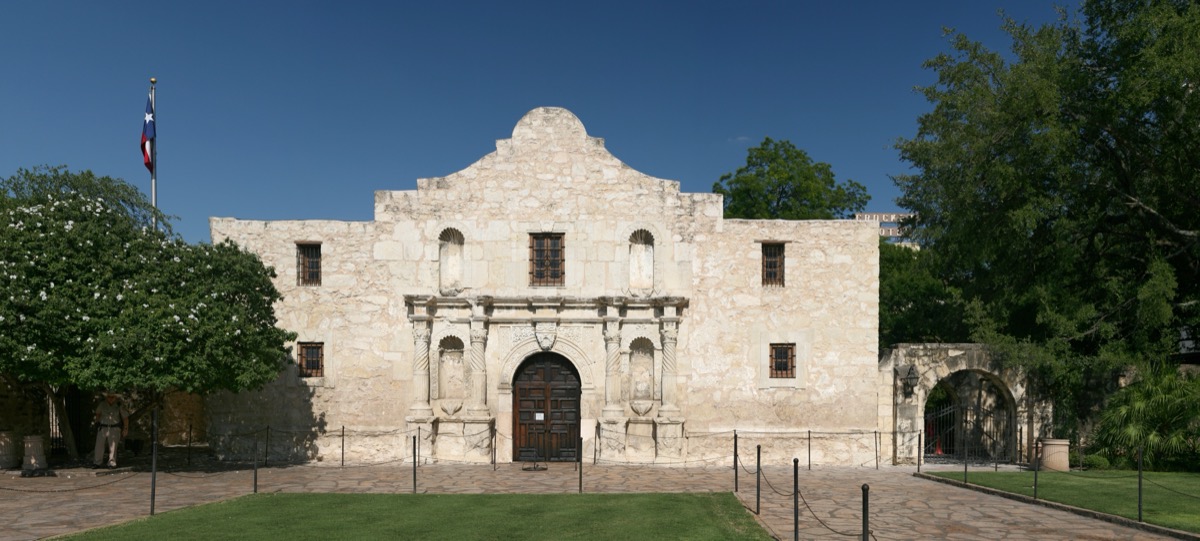
The Alamo in San Antonio, Texas is still standing, and a legend in print since 1917 says why: the soldiers sent to demolish it were met at the walls by spirits carrying flaming swords. The ghosts that came after preferred stormy nights.
The Alamo in San Antonio, Texas is still standing because the men sent to tear it down ran into something at the walls. That is the story, anyway. After San Jacinto, the Mexican command ordered the old mission fortress demolished, and the soldiers who went to do it "were everywhere met by spirits with flaming swords."
The spirits gave a command, and the version that circulates today is a truncation. In full: "Depart, touch not these walls! He who desecrates these walls shall meet a horrible Fate! Multiplied afflictions shall seize upon him and a horrible and agonizing and avenging torture shall be his death!"
That sits on page 55 of Adina De Zavala's *History and Legends of the Alamo*, San Antonio, 1917, under the running head "The Ghosts of the Alamo." She names no witness. She credits "the papers of San Antonio, years ago," and calls the whole thing "one of the current folk-tales of the country." Her version is more specific than the retellings that followed. The soldiers were permitted for a space to disarm the batteries, she writes, but the moment the walls were threatened, there was the flaming sword in ghostly hands. They were spirits "whom the Mexican soldiers feared more than they feared their officers."
The paper record agrees on the outcome, if not the reason. On May 24, 1836, Vicente Filisola ordered General Juan José Andrade to demolish the Alamo's fortifications. By De Zavala's account the guns went, the fosse was filled, the pickets torn up and burned, and only the outer walls of the mission square were injured. Andrade marched his command into Matamoros three weeks later. The church and the Long Barrack, the two original buildings, were left where they were.
De Zavala had her own reasons for guarding that place on paper. She is the woman who saved the Long Barrack. Her Wikipedia biography has the rest: in February 1908 she barricaded herself in an upstairs room, without provisions, for three days, to stop it being leased to a vaudeville company, and the sheriff cut the utilities and waited her out.
Her book records what the building did afterward, too. When part of the fort was in use as a city prison, she writes, inmates and officers alike reported "the rattling of chains, the distinct military tread of ghostly sentinels, the clank of sword and spur being heard, especially on rainy or stormy nights." The Alamo's ghosts have a predilection for stormy weather, she adds, and do not confine themselves to any one room.
Staff and Alamo Rangers still report figures that vanish mid-stride after dark, and a small blond boy at an upstairs window in the first weeks of February.
Asked whether the 1836 prophecy ever came true, De Zavala wrote, those who knew the old tale said, "It was, and will ever be." She pointed to the man most responsible for destroying the fortress's upper story, who died "entombed alive and consumed by flames." She never gives his name.