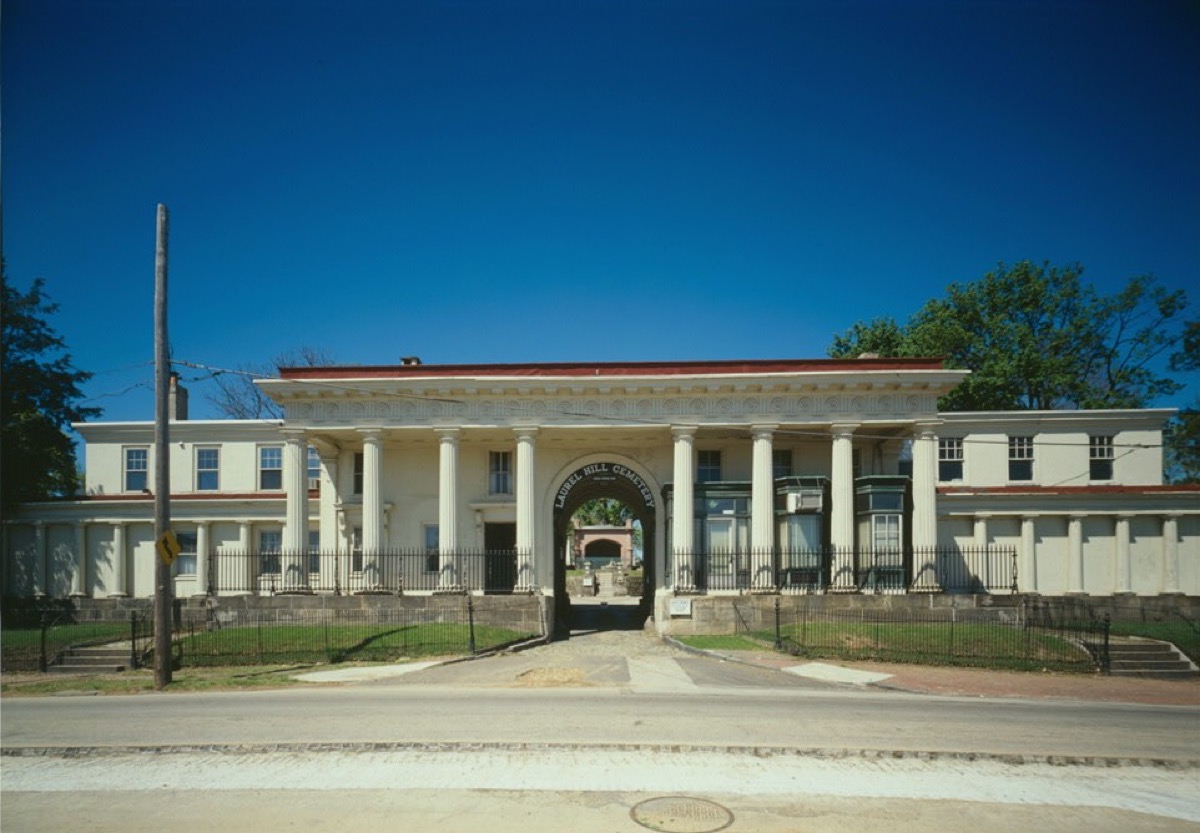
Laurel Hill Cemetery in Philadelphia has spent nearly 200 years collecting the dead, and the stories it tells about them are the dark kind: a heart buried apart from its body, a widow exhumed over a missing will, a doctor's corpse dragged from his tomb.
At Laurel Hill Cemetery in Philadelphia, a woman named Mary Peterson lies in two places. When she died in 1912, she asked that her heart be cut out and buried beside her first husband, Thomas, who had drowned in 1881. The rest of her went into the ground with her second husband. The cemetery still tells that story on a Valentine's-season walking tour. "It was a very telling gesture," its programs director Gwen Kaminski said. "I found her story so moving."
Most of Laurel Hill's hauntings work like that. It isn't a place with one famous ghost. It's a place built in 1836 specifically for the living to come and sit among the dead, the second rural cemetery in America after Mount Auburn near Boston. By the 1840s it had grown so popular it printed admission tickets and drew roughly 30,000 visitors a year, who came by steamboat to picnic on the bluff above the Schuylkill. The managers eventually restricted Sunday access to lot-holders to keep working-class crowds out. By the cemetery's own count, around 75,000 people are buried here now.
The stories it keeps are stranger than apparitions. Henrietta Garrett, widow of a snuff millionaire, died in 1930 leaving an estate of about $17 million. A rumor spread that she'd been buried with her will, so Laurel Hill posted a 24-hour armed guard at her grave and eventually exhumed her. No will was found. The fight over her money ran more than 20 years.
Then there's Dr. Ellwood Kirby, a wealthy physician who died at Christmas in 1935. Within about ten weeks, treasure-hunting vandals broke into his family mausoleum, dragged the casket outside, and stripped the remains looking for jewels. All they found was a pair of cuff links.
And there's Martha Drinnan, the caretaker's own daughter. She was last seen in November of 1903, walking toward the Laurel Hill train station, and her body wasn't found until March of the following year. The family was too poor for a headstone, so she went into an unmarked grave; the marker that sits there now was placed long afterward by the Friends of Laurel Hill.
The cemetery hosts regular ghost tours and paranormal teams who bring equipment onto the grounds. But asked plainly on its own blog whether the place is haunted, Laurel Hill won't claim more than it can prove. The official answer, it says, is that the investigation is still open, and probably always will be.