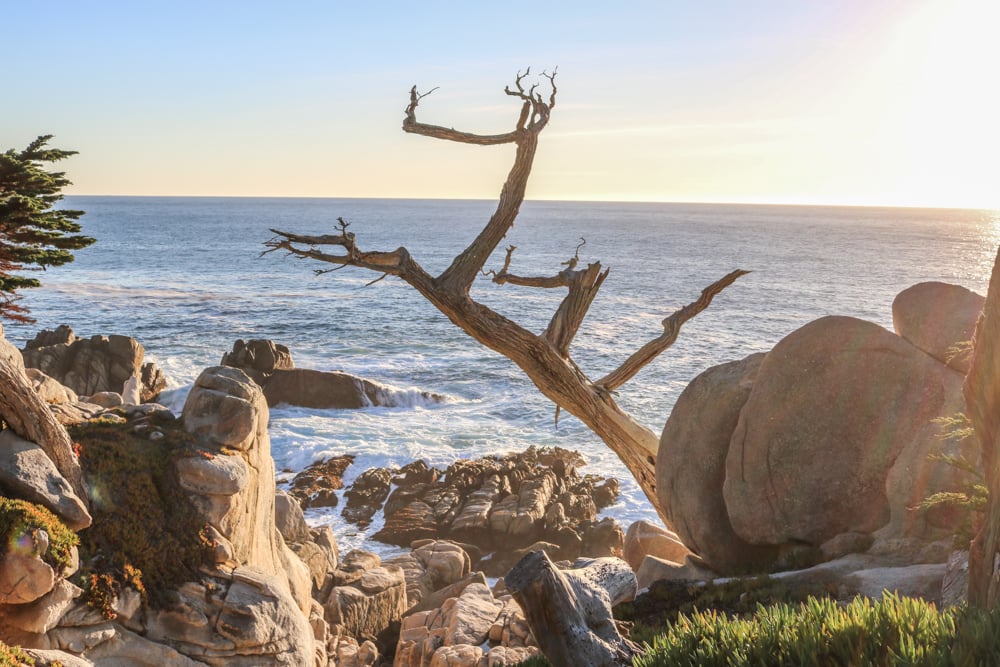
Near the bleached Ghost Tree on Pebble Beach's 17-Mile Drive, drivers on foggy nights report a barefoot woman in white lace walking down the middle of the road. They swerve to miss her, and when they look back she's already gone.
At Pescadero Point, the seventeenth stop on Pebble Beach's 17-Mile Drive, drivers say a barefoot woman in white lace walks down the middle of the road on foggy nights. They swerve to miss her. When they look back, she's gone. By one account she has "frightened many a motorist who, when swerving to miss her, have found that she instantly disappears."
This is the spot people call the Ghost Tree, after a cluster of dead Monterey cypress at the end of the drive. The wood is bone-white now, polished and smoothed by the wind and bleached by the sun and the salt air, gnarled into shapes that locals decided looked like ghosts. The trees gave the place its name. But the woman in lace came first.
Most tellings say she's Doña María del Carmen Barreto, a landowner who once held much of this coast and died in 1856. The Monterey County Visitors Bureau lists her among the area's official haunted spots. The story goes that she never stopped patrolling her land. Other versions disagree: some call her a bride jilted at the altar, some reach for La Llorona, the weeping woman of Latin American folklore, and the skeptics say she's nothing but fog and refracted light on an empty road. No two cafes on the Peninsula tell it quite the same way.
There's a second kind of death here, and it isn't lore. The Ghost Tree is also one of the deadliest big-wave surf breaks in the world, with winter swells reaching roughly 60 feet. On December 4, 2007, during a record swell near 70 feet, a 45-year-old Monterey surfer named Peter Davi drowned at the break. He'd declined a ride in; a friend found him floating about half an hour later.
Davi never liked the name. "It's not called Ghost Tree," he'd said. "It's called Pescadero Point."
Now the place has more ghosts than he'd have wanted to count.