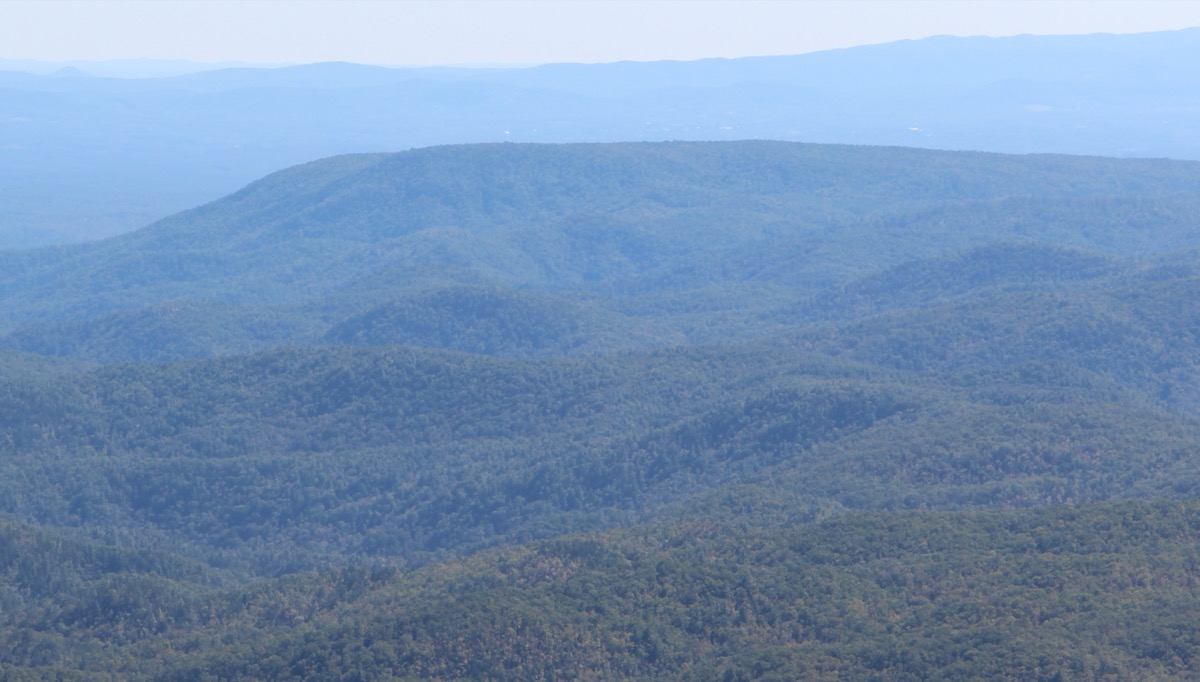
For a century, red orbs have risen over Brown Mountain in Burke County, North Carolina, wavered, and winked out. The U.S. Geological Survey called it twice and called it solved. The lights are still there, and the cameras are still watching.
On dry autumn nights near Brown Mountain in Burke County, North Carolina, small red orbs rise over the ridge, hang, waver, and wink out inside a minute. The first newspaper to print it, in September 1913, described "a distinct ball, with no atmosphere about it... much smaller than the full moon, much larger than any star and very red." The men who reported it, a Morganton fishing club, had been laughed at for seeing things at night.
The government took it seriously. At the request of a North Carolina congressman, the U.S. Geological Survey sent geologist D.B. Sterrett that October, and he settled it: the lights were headlights of westbound Southern Railway trains, seen over the mountain from a hotel six miles off. Case closed.
Then, in the summer of 1916, a flood swept the Catawba River valley and washed out the bridges and rail tracks. No train ran within 40 or 50 miles of Morganton for weeks. The lights kept appearing anyway.
So the USGS came back. In 1922, geologist George Rogers Mansfield spent two weeks above the ridge with a planetable and a surveying telescope, plotting lights by instrument. Of the 23 he recorded, 11 were probably automobile headlights; the rest he laid to trains, brush fires, and house lamps refracted through the valley's humid air. "There is no geologic basis," he wrote, "for the idea that the lights seen are natural wonders of any sort."
The valley refuses to take the hint. The lights had collected stories long before the geologists arrived, and they kept collecting them after. A widely repeated legend holds that they are the torches of Cherokee widows searching the ridge for husbands killed in an ancient battle, though folklorists trace that tale only to a 1938 newspaper, not to any older record. People also point to a 1771 frontier surveyor's account, but historians say his "nitrous vapors" described thunderstorms hundreds of miles south and never mentioned this mountain at all. The legend keeps outrunning the paperwork.
Daniel Caton, a physics professor at Appalachian State University, has pointed cameras at the ridge since the mid-1980s. By 2014 his two low-light cameras had logged more than 6,300 hours with nothing unexplained on them. Then, on July 16, 2016, both cameras caught the same thing at once: a round glowing light above the ridge, well apart from the town lights of Lenoir below, that he and his engineer said they couldn't explain.
Morganton stopped fighting it. In 2022 the city started an annual festival in the courthouse square, leaning into the legend rather than claiming to solve it. A century of instruments, and the firmest verdict is still the one Mansfield wrote in 1922. The orbs keep rising over the ridge that was supposed to have nothing to show.