TLDR
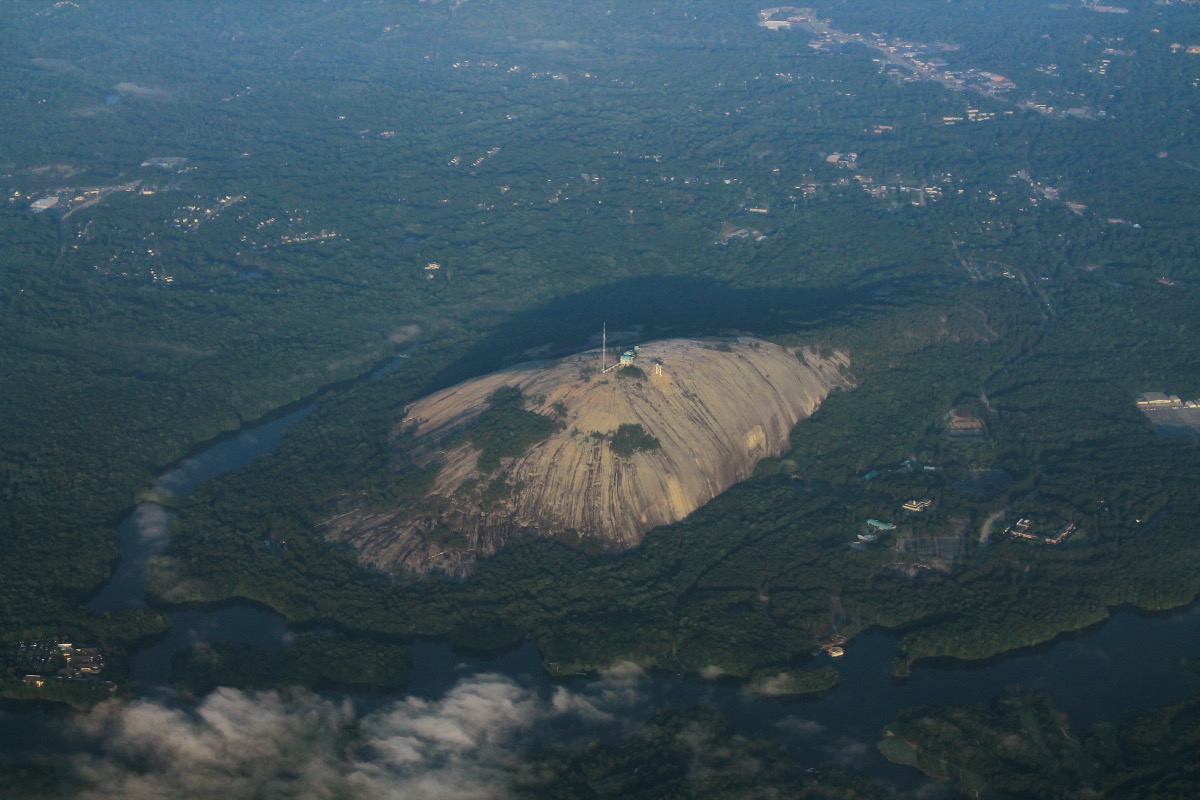
A 1946 Atlanta Constitution article documented a ghostly figure in white on the sunrise side of Stone Mountain, visible only to a witness born in a caul, with horses and dogs refusing to approach. The granite dome was a Cherokee and Muscogee sacred site for thousands of years before becoming the birthplace of the revived KKK in 1915 and the canvas for the largest Confederate monument in existence.
The Full Story
Horses will not go around the sunrise side of Stone Mountain. Dogs tuck their tails and slink the other direction. That is not folklore from a century ago. It is from a March 1946 Atlanta Constitution article by reporter Bill Boring, who interviewed a man identified as N. Johnson about the ghost his wife kept seeing on the east face of the granite dome.
Johnson's wife was born in a caul, a thin membrane covering the face at birth. In Southern folk tradition, caul-born people can see ghosts. Johnson could not see anything. But his wife described a figure in a flowing white robe, "neither white nor black but of a strange neutral color," with eyes like "burning embers set in a skull." She saw it more than once. Johnson said the closest he came to the experience was a feeling of walking through steam, his hair standing straight up, his hat lifting off his head.
The mountain has been considered sacred ground for far longer than anyone has been writing newspaper articles about ghosts. Cherokee and Muscogee peoples used it as a ceremonial site for thousands of years. Burial mounds dot the landscape around its base. Two major trade routes connected it to eastern Georgia, and ceremonies were held at the summit, which an earlier people had enclosed with a stone wall. The reasons for that wall, and the identity of who built it, are lost.
After the Trail of Tears removed the Cherokee and Muscogee, white settlers took the land. Stone Mountain became a quarry, a tourist attraction, and in 1915, something darker. On Thanksgiving night that year, William J. Simmons led 15 men to the summit. They set up a flag-draped altar, opened a Bible, and burned a 16-foot cross. That ceremony relaunched the Ku Klux Klan. Cross burnings continued on the mountaintop until 1962, and Klan rallies marched through the surrounding town as late as 1978.
The Confederate carving adds another layer. Gutzon Borglum, who later carved Mount Rushmore, began chiseling the east face in 1923. He completed Robert E. Lee's head on January 19, 1924, but was fired over disputes with the Stone Mountain Confederate Memorial Association. The group blasted his work off the mountain. Augustus Lukeman took over, carved Lee's head and part of his torso, then ran out of money. The project sat unfinished for decades. The state of Georgia finally completed the 90-foot-tall bas-relief of Lee, Stonewall Jackson, and Jefferson Davis in 1972.
At least one worker died during the decades of carving. The details have not survived in the historical record, which says more about who was considered worth remembering than about the dangers of the work.
Local legend fills in where the historical record goes quiet. The most elaborate folk tale involves a plantation heir named Beau Stephens, who lost $10,000 in a poker game. Despondent, he led a Charleston woman named Emily into a cave on the mountain. The two descended past snakes and bats, reaching an underground stream filled with eyeless fish. Neither Stephens nor Emily was ever seen again, and his $10,000 check turned out to be worthless. Years later, a stone-cutter lowered himself into the same cave, seven feet deep and about as tall as a man. He found a folded note: "You are not the first darn fool who has been here."
Stone Mountain is not a traditional haunted place. There is no single named ghost, no room number to avoid, no apparition in period clothing at the top of a staircase. It is something heavier than that. Eight thousand years of sacred ground, 47 years of cross burnings, a century-long argument about what to do with a Confederate monument carved into living rock, and a figure in white that only certain people can see, walking the sunrise side where the horses refuse to go.
Researched from 5 verified sources. How we research.