TLDR
Frederick Osborne, a French Canadian lighthouse keeper shot dead by his assistant on the grounds in 1880, is heard climbing the 129 cast-iron spiral steps nightly. A keeper's wife in 1908 called out to his ghost for help fixing the light mechanism, saw his figure bending over the works, fainted, and woke to find it running perfectly.
The Full Story
The Svendsen family dog knew something was wrong. Jinx, a terrier who lived at the St. Simons Lighthouse from 1907 to 1935, would growl at empty air, back away from the tower door, and hide under furniture when footsteps echoed down the spiral staircase. Annie Svendsen, the keeper's wife, documented the dog's reactions over the years. Jinx was used to the normal sounds of the lighthouse. These were not normal sounds.
The footsteps belong to Frederick Osborne, a French Canadian who served as head keeper from 1874 to 1880. Osborne lived on the ground floor of the keeper's duplex. His assistant, John Stephens, lived on the second floor with his wife, the two families sharing a central stairway. They worked together for five years before everything fell apart.
Osborne said something to Stephens's wife. No one recorded what it was, but it was bad enough to end in gunfire. On a Sunday morning in late February or early March of 1880, the two men argued on the lighthouse grounds. Osborne drew a pistol. Stephens retreated, came back with a shotgun, and fired. Osborne died from the wound. A jury acquitted Stephens after hearing the circumstances, essentially ruling that Osborne had provoked his own death. The Lighthouse Service relieved Stephens of his duties anyway.
The ghost stories started almost immediately. Keepers who took over after Osborne's death reported footsteps ascending and descending the 129 cast-iron steps of the spiral staircase, steady and deliberate, the rhythm of someone making nightly inspection rounds. No one was ever on the stairs. The pattern has continued for more than 140 years.
The best account comes from a 1908 newspaper. A keeper's wife, identified only as Mrs. C in the article, was alone at the lighthouse while her husband was away, struggling to fix the light mechanism. She remembered that Osborne had once promised her he would help if she ever needed it. In frustration, she called out to his ghost.
"There was a clink and a rattle, and looking up Mrs. C saw the distinct figure of the French Canadian bending over the works." She fainted. When she came to, the mechanism was clicking along perfectly.
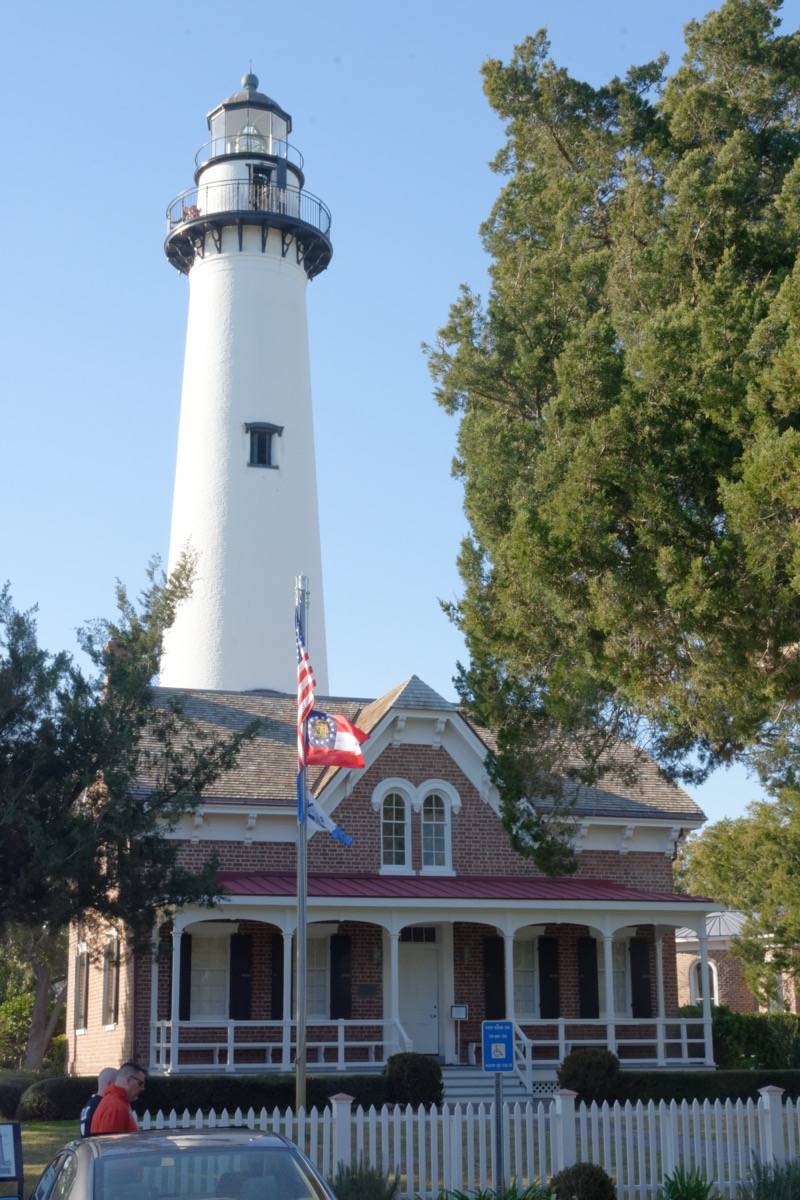
The lighthouse that Osborne still patrols was built in 1872 to replace the original 1810 tower, a 75-foot tabby structure that James Gould constructed for $13,775. Confederate troops dynamited it in 1862 to keep Union ships from using it as a navigation aid. The current tower stands 104 feet tall, fitted with a third-order L. Sautter Fresnel lens that throws its beam 23 miles out to sea. The light first shone on September 1, 1872.
Carl Olaf Svendsen, who kept the light from 1907 to 1935, had the longest tenure of any keeper. He and Annie raised three children in the dwelling: Carl Jr., Lucille, and Helen. The family donated photographs to the Coastal Georgia Historical Society, including pictures of Jinx at the keeper's dwelling. Twenty-eight years of living with whatever walks that staircase, and the Svendsens never requested a transfer.
Visitors have also reported a figure in and around the tower at night, a man tending to a light that has been electric for generations. A local paranormal group, DL Paranormal, claimed to have captured an EVP of Osborne's voice in November 2013. Strange smells with no source. A visitor's photograph that appeared to show a face looking out from a tower window.
The Coastal Georgia Historical Society operates the lighthouse as a museum now. You can climb all 129 steps and see the Fresnel lens up close. The views from the top are worth the climb regardless. But if you hear footsteps above you on the spiral staircase, and nobody else is up there, you are hearing the same thing Annie Svendsen's dog heard. The same thing every keeper since 1880 has heard. Frederick Osborne, a man who took his job seriously enough to keep doing it after a shotgun blast ended his shift.
Researched from 6 verified sources. How we research.