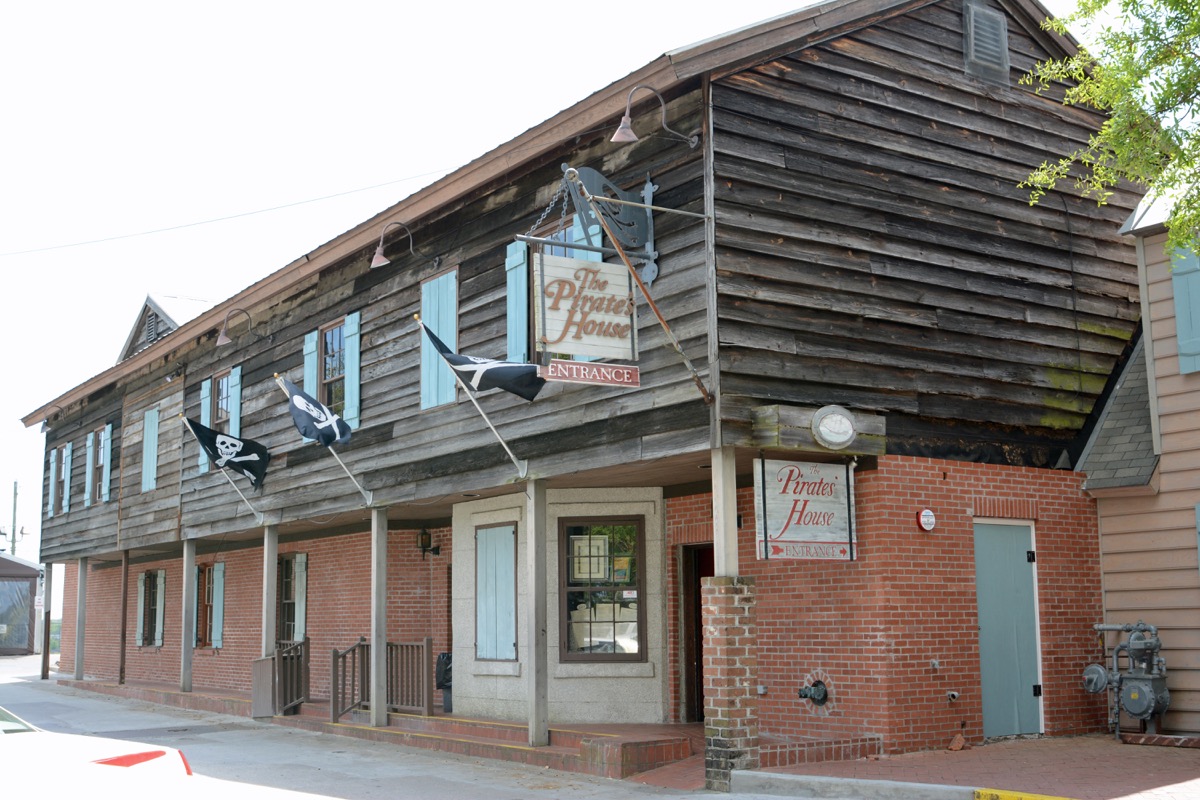
The Pirates' House in Savannah, Georgia is an old sailors' tavern, now a restaurant, where ghost tours have reported the apparition of Captain Flint for decades. The catch: Flint is a character from Treasure Island. He was never a real man.
> The most reported ghost at the Pirates' House in Savannah, Georgia is a pirate named Captain Flint, said to linger in an upstairs room of this old sailors' tavern. Ghost tours have described his apparition there for decades. There's one problem with him: he was never alive. > > Flint is a character from *Treasure Island*. Robert Louis Stevenson wrote the novel in Scotland in 1881 to amuse his stepson, and in the book Flint dies of too much rum at Savannah — "Darby M'Graw, fetch aft the rum," his last words. Stevenson never set foot in Savannah and had no real tavern in mind. But the town decided Flint died *here*, and the legend stuck so hard the tours kept it. > > The building it attached itself to is real enough. By the 1750s a tavern and inn stood on this spot, a block from the river, and the story goes it drew sailors, privateers, and a rough seafaring trade. The oldest piece of the complex is the Herb House, long said to be the oldest standing structure in Georgia — though some historians dispute both that title and its date, putting the surviving building closer to the 1850s. > > The part everyone wants is the tunnel. The legend: drunk sailors were drugged in the rum cellar, dragged through a passage to the river, and pressed onto outbound ships. A real tunnel does end under nearby Randolph Street, sealed now. But the shanghai story has been pushed back on publicly — a Savannah Magazine piece quotes the city's stormwater chief explaining that the brick passages people read as kidnapping tunnels are Civil War-era storm drains. The more plausible use was running rum during Prohibition, not stealing men. > > The restaurant has been open since 1953 — fifteen dining rooms, the rum cellar down in the basement, where visitors and staff report the heaviest feeling and footsteps on the old floors. > > A book of fiction, written in another country, about a man who never breathed — and people still walk up the narrow stairs to look for him.