An 1811 beating, a son's pistol shot, and five generations of grief. The Moses Myers House in Norfolk keeps its top-hatted ghost out in the garden.
A top-hatted figure paces the garden behind the Moses Myers House. Head bowed, hands clasped behind his back. He never goes inside. Ghost-tour accounts and the Norfolk tourism office identify him as Richard Bowden, a former business partner of Moses Myers, and the story everyone tells about why he's out there starts on a May day in 1811 in the Norfolk market square.
Bowden attacked Moses with a cane over a financial dispute. Moses, in his late fifties, was beaten unconscious and carried home. His second son Samuel, twenty years old and fresh from being the first Jewish graduate of the College of William and Mary, got to his father and thought he was dead. Samuel grabbed a pistol and shot Bowden in answer. Sources disagree on exactly where the shooting happened, at the house, in the market, somewhere on the street between, but they agree Samuel did it and that he was charged with manslaughter. He posted bail, waited out the case in Philadelphia, and was acquitted about a year later. The summer after, he went up to New York with his sister Adeline to recover. Bowden, in the lore at least, never recovered enough to come inside.
The load-bearing story sits inside that one. The rest of the house is what the family carried into it.
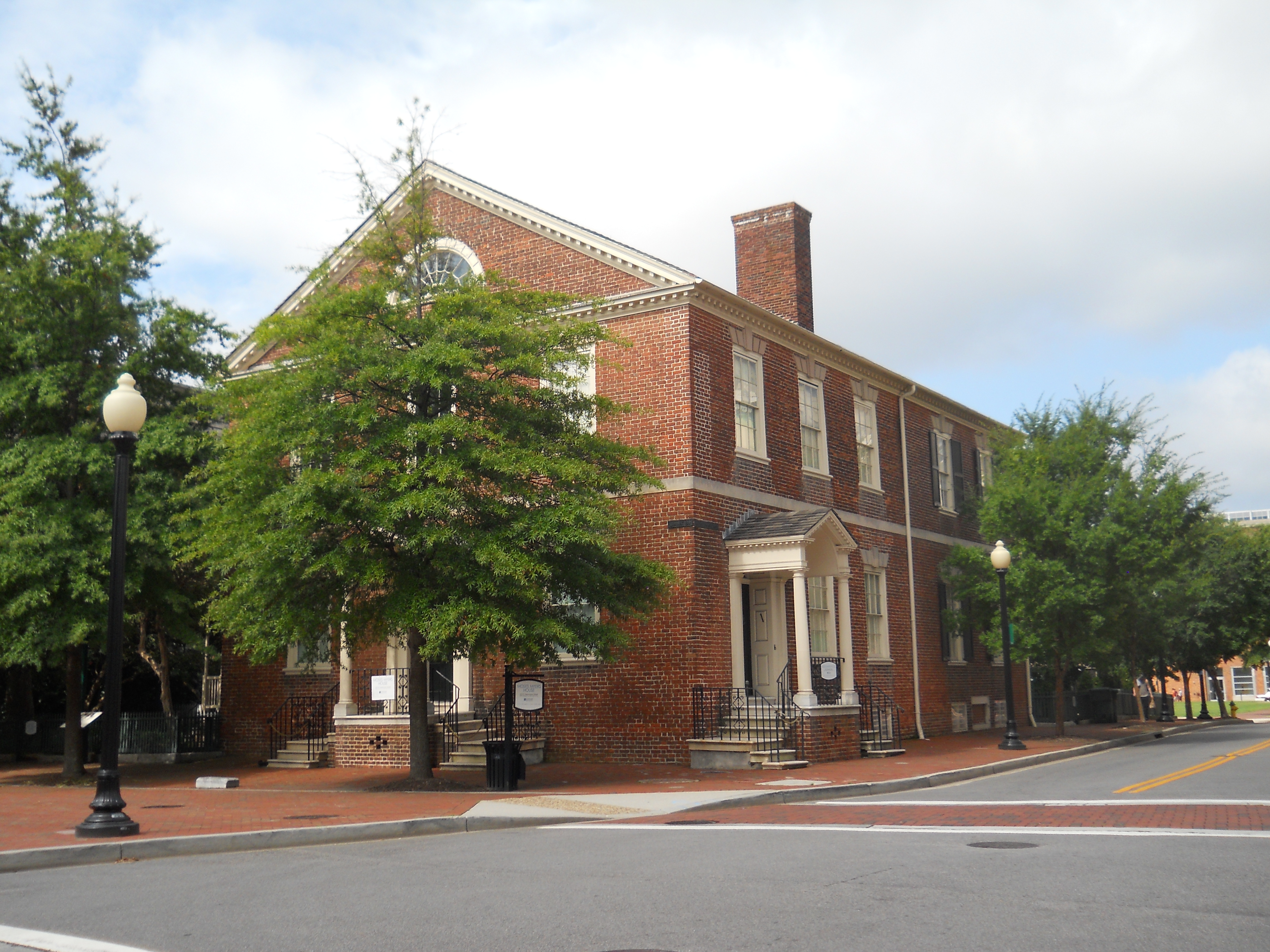
Moses Myers was born in New York in 1753, the eldest son of Haym Myers, a merchant from Amsterdam, and Rachel Louzada, from a prominent Sephardic family. He married Eliza Judah Chapman in 1787 on Passover Eve. She was a London-born childless widow ten years his junior, and over the next couple of decades they had twelve children, nine of whom lived to adulthood. They moved into the new brick mansion at the corner of East Freemason and Bank in the 1790s. It was, and the Virginia Department of Historic Resources still calls it, one of Virginia's finest examples of Federal architecture, with Adam-style interiors finished in intricate composition ornaments on the ceilings, mantels, and cornices.
The Myers household was the first permanent Jewish-American family in Norfolk. For more than a decade, they composed the region's entire Jewish population. The National Register documentation calls the house the most intact and best documented surviving residence of a Jewish family in the United States from the late 18th and early 19th centuries. The family Kiddush cup is still among the heirlooms on display.
Moses was a trusted associate of both Thomas Jefferson and James Monroe. He served on the Norfolk Common Council from 1794 to 1800, held rank as a militia major, was appointed consul to France and the Netherlands, superintended the Bank of Richmond, and founded the Norfolk Chamber of Commerce. At its peak the household held up to thirty people: family, enslaved servants, apprentices, and guests. The kitchen was a detached building. In September 1818, Moses purchased two enslaved laundresses, Drusilla, age thirty-five, and her daughter Chany, age fourteen, specifically to keep them from being sold to Tennessee. Texture of who lived here, named and unnamed both.
Then the Panic of 1819 wiped him out, and the back half of the family's story gets darker fast.
Adeline, the eldest daughter, was engaged in 1819 to Solomon Nones, a Jewish businessman in Norfolk. He died days before the wedding and became the first Jewish adult buried in the city. Adeline never married. She managed her father's household for the rest of her life and died in 1832 at forty-one. She was fluent in French, played harp and pianoforte, and left behind a sheet music collection of more than 900 pieces. Her pianoforte is still in the house.
Two of the youngest sons died in close succession. Abram in 1821. Henry, a Navy midshipman, in 1822, of yellow fever at sea a few days from Norfolk while trying to get home. Eliza was broken by it. In 1823 her son Frederick took her up to Montreal for what was supposed to be a restorative family visit. She died there in November of that year.
In 1826, Frederick bought the family home outright to shield it from his father's creditors. Moses lived until 1835. Five generations of the family stayed in the house through 1931, when it passed eventually to the City of Norfolk. The Chrysler Museum of Art has managed it for more than seventy years. About 70% of the furnishings on display are original to the first generation. Gilbert Stuart portraits of Moses and Eliza hang in the Drawing Room. John Myers's dueling pistols, made in 1810 by Durs Egg of London, sit in their original case.
That's a lot of grief in one house. The ghost stories track it.
The Lady in Black is the one most often described. A figure in dark clothing drifts through the halls and vanishes. Accounts at Visit Norfolk and other regional tellings identify her as Eliza, returned to be near her children. Visitors describe a maternal presence in the rooms where the kids slept. The interpretation is doing some work here, but the loss is real. She buried two sons in two years and died of it.
The service stairs, the back-of-house staircase the family's enslaved laborers used, are the locus of newer claims. A Chrysler Museum photographer named Scott Wolff is said to have opened a third-floor bedroom door in fall 2003 and seen a blonde child in a chair who looked surprised and disappeared. That account traces to one ghost-tour retelling of a paywalled Virginian-Pilot article, so take it as lore rather than documentation. A reported overnight investigation by a 757 teen group, also routed through the same single source, claims a smoky figure on the upper service stairs near dawn. Hedge those.
What's well-documented is the garden. The man in the top hat. Pacing. Head down, hands behind his back. Not coming in. The Myers family stayed in this house for five generations, ruined and grieving and rebuilding, and the story Norfolk tells is that the man who set their unraveling in motion is still trying to apologize at the back door. The house is open Saturdays and Sundays, noon to five, free admission. The Kiddush cup is on the shelf.