In September 1855, Norfolk buried 80 people a day at Elmwood. Coffins ran out. The mass graves are still unmarked.
By the first week of September 1855, gravediggers at Elmwood Cemetery were burying 400 people. In seven days. At the peak of the yellow fever epidemic, Norfolk was losing roughly eighty residents a day, and the city ran out of coffins before it ran out of dead. The Norfolk Society for Cemetery Conservation describes coffins piling up in the cemeteries with no one to dig the graves. More than a hundred victims got family plots at Elmwood. The rest went into the ground unmarked, in mass graves that are still unmarked today.
The haunting here is not a figure in a window. Not a name. A patch of grass where the city couldn't afford the dignity of headstones.
Elmwood opened in 1853 on a fifty-acre tract called Farmingdale, sold to the city by John and Rebecca Tunis. The previous municipal cemetery, Cedar Grove, was filling up across the street, and Elmwood was originally connected to it by a bridge over Smith's Creek. Two years after opening, the new ground took on a catastrophe nobody had planned for. A steamer (sources call her the Ben Franklin, though Encyclopedia Virginia uses Benjamin Franklin) limped into Hampton Roads from St. Thomas on June 7, 1855. Her captain logged a crew death as a heart attack rather than fever, and the ship moved on to Gosport in Portsmouth. By midsummer the mosquitoes had the city. The death count is itself contested: Norfolk Historical Society and NSCC, drawing on local records, put Norfolk's losses at around 2,000; Encyclopedia Virginia and WHRO say closer to 3,000. The combined Norfolk-Portsmouth figure of about 3,000 is steadier across the record. Either way, in a city of roughly 16,000, you can do the math.
The epidemic ended the way yellow fever epidemics did in the nineteenth century. The first heavy frost in October killed the mosquitoes. Ninety days, give or take, from steamer to silence.
Walk Elmwood today and the 1850s damage is mostly invisible by design. The cemetery is laid out in a mid-century grid with the soft Victorian "garden cemetery" treatment on top: winding paths, ornate monuments, and the bed-shaped grave markers that read "death as temporary sleep" if you know what you're looking at. There's Greek Revival, Gothic Revival, Exotic Revival, all of it mingled across more than 400 Civil War veterans on both sides of the war.
Some of the names are worth knowing before you walk in. Colonel William Lamb, the Hero of Fort Fisher, who took command of that North Carolina fort on July 4, 1862 and later served as Norfolk's mayor from 1880 to 1886, is buried here. So is Virginia Governor Littleton Waller Tazewell. So is Walter H. Taylor, Robert E. Lee's adjutant. So is Sarah Lee Odend'hal Fain, one of the first two women elected to the Virginia House of Delegates (1923, alongside Helen Timmons Henderson), and Pauline Adams, the suffragist attorney, and William M. Carr, who earned a Union Navy Medal of Honor at Mobile Bay. Asa Biggs, U.S. Senator and Congressman, is here too. It's the burial map of a city, not a battlefield.
At 4th Alley West, Lot 27, you'll find the Father Ryan Lot. Father Abram Joseph Ryan, the Catholic priest known as the Poet-Priest of the South, bought it to bury sixty unidentified Confederate soldiers. Father Ryan himself is not at Elmwood (he's buried in Mobile, Alabama, despite a stubborn rumor that puts him in Norfolk), but the lot he paid for is. The inscription on the monument justifies the visit on its own:
> "In this lot rest in sleep sixty Confederate dead. We know not who they were. But the whole world knows what they were. They died far from their homes, but fill heroes' graves. And glory keeps ceaseless watch about their tomb."
Sixty unknowns. One stone.
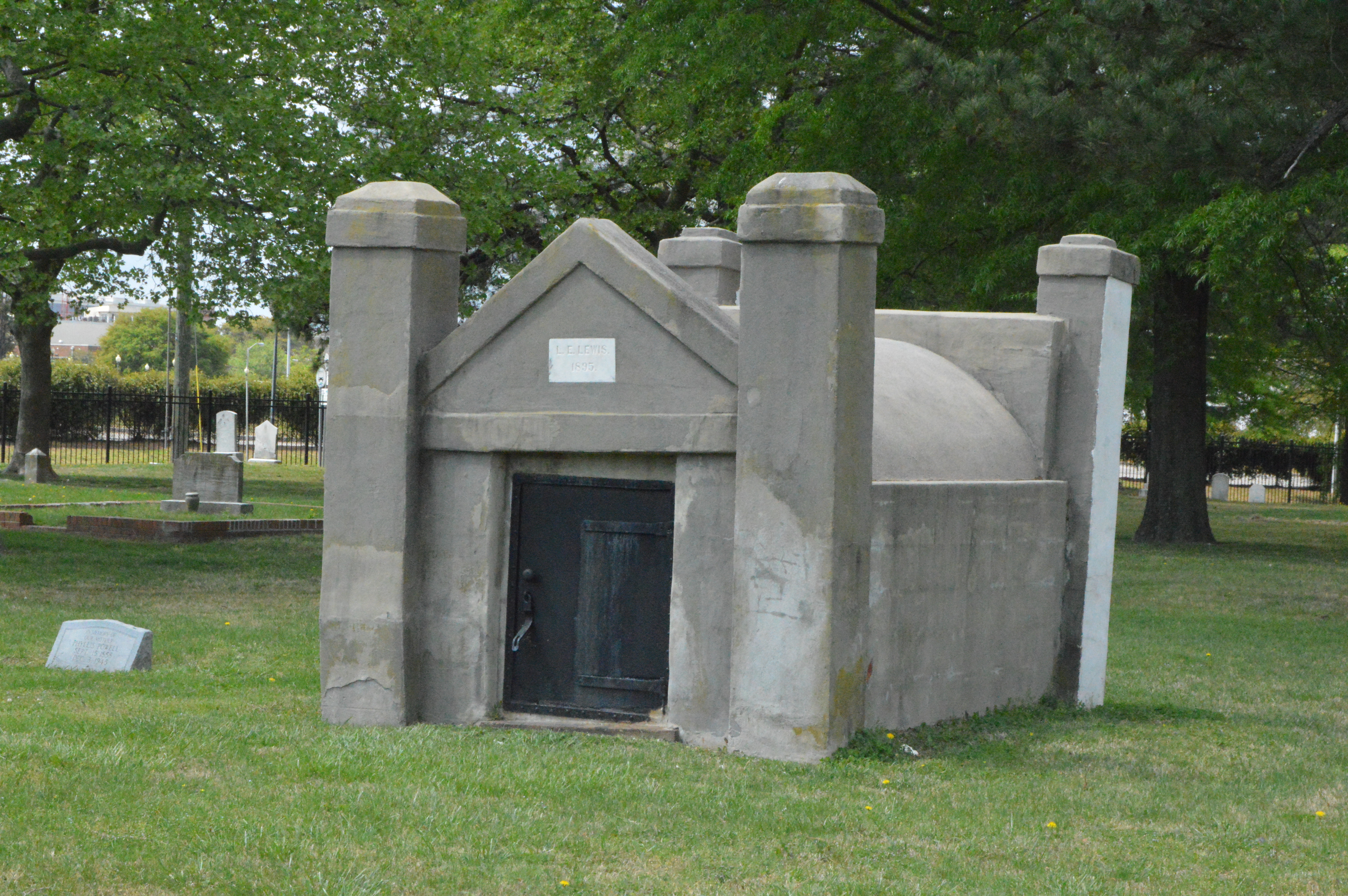
Over at Elmwood Extension, Block 17, Lots 7 through 10, the Couper Family Lot anchors the cemetery's real showpiece. William Couper, the Norfolk-born sculptor, made an eight-foot bronze Recording Angel for his parents and set it on a platform near his mother Euphania's grave. His father John D. Couper had founded the Couper Marble Works in Norfolk in 1848; the family company kept cutting stone until 1981. The L.E. Lewis Mausoleum (1895) sits in the southwestern quadrant, and the Core Mausoleum, the largest on site, was designed by memorial architect Harold Van Buren Magonigle and built between 1910 and 1915 for John Henderson Core, the wealthy farmer whose land became West Ghent.
To the west, contiguous with Elmwood, is West Point Cemetery, Norfolk's first African American burial ground. It opened in 1873 as a Potter's Field, was briefly called Calvary, and was renamed West Point in 1885 at the urging of Norfolk's first African American Councilman, James Fuller, a formerly enslaved man who had served as a Civil War quartermaster in the First U.S. Colored Cavalry. West Point holds fifty-eight Black Union Civil War soldiers in a dedicated section, and the 1906 West Point Monument (with the statue added in 1920) honors Norfolk native Sergeant William H. Carney of the 54th Massachusetts, Medal of Honor recipient. Don't skip it.
The ghost-story bench at Elmwood is honestly pretty thin. No named apparition appears in any credible source. There's a soft, recycled reference in one Virginia-cemeteries roundup to a 1902 newspaper anecdote about a man who took a shortcut through "Elmwood" and had an encounter he couldn't explain, but no original newspaper, no date, no excerpt, and not even a confirmation that the Elmwood in question is the Norfolk one. A travel-search snippet mentions "disembodied voices and phantom yells" with no testimony attached. The haunted file is that thin.
The cemetery doesn't need ghosts to be haunting. NSCC runs tours from April through October at a $5 suggested donation, led by volunteer local historians and co-hosted with Norfolk Recreation, Parks, and Open Space; the October calendar has included haunted-themed walks, and 2025's "Facing the Gallows, the Last Walk" tour on October 4 dug into Norfolk capital punishment. None of the surviving tour materials we could find document a specific ghost story for Elmwood. The atmosphere is the point, and the atmosphere is the unmarked ground.
The lawn at Elmwood in October sits over people who died fast and were buried faster, in the same week the cemetery ran out of pine. The ground itself is the haunting. Glory keeps ceaseless watch about their tomb.